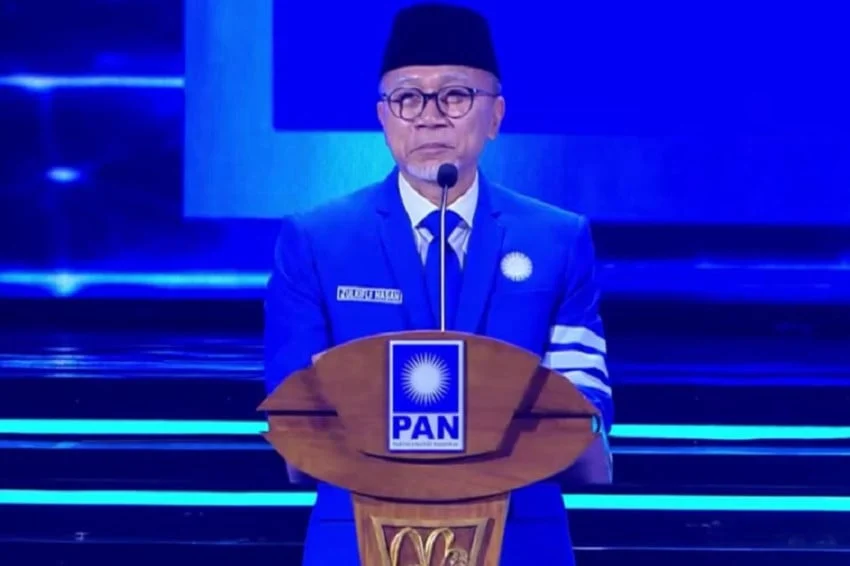
The 28th anniversary of the National Mandate Party (PAN), held at the Jakarta International Convention Center (JICC) in Senayan on Friday, September 18, 2026, served as a significant stage for reaffirming the political alliance between the party and President Prabowo Subianto. In a keynote address that underscored decades of political collaboration, PAN Chairman Zulkifli Hasan emphasized that the party’s commitment to the President is not a product of recent political convenience, but the result of a long, tested history that predates the 2024 electoral victory.
The event, which drew high-ranking party officials and government representatives, served as a strategic platform for PAN to solidify its position within the current administration while setting a trajectory for the upcoming 2029 electoral cycle. For Zulkifli Hasan, commonly known as Zulhas, the narrative of loyalty was the central theme of the evening, aimed at silencing skepticism regarding the party’s unwavering support for Prabowo despite previous electoral setbacks.
A History of Political Resilience
The alliance between PAN and Prabowo Subianto is deep-rooted, characterized by a series of political maneuvers and shared ideological goals that have spanned over two decades. Historically, PAN’s support for Prabowo was most prominently visible during the 2014 and 2019 presidential elections, where the party stood as a core member of the coalition supporting his candidacy. Despite the losses encountered in those two cycles, PAN’s leadership maintained its alignment, a decision that often invited scrutiny from political analysts who questioned the sustainability of such an opposition-leaning stance.
Zulhas addressed these historical inquiries directly, framing the relationship as one built on ideological compatibility rather than mere transactional politics. "The togetherness of PAN and Mr. Prabowo has gone through a long and winding history. It is not just about one presidential election season. We have struggled together for tens of years," Zulhas remarked during his address. He argued that the party’s loyalty is not predicated on electoral success alone, but on a fundamental belief in the leadership vision that Prabowo has consistently advocated throughout his political career.
The transition from a two-time losing coalition to a winning one in 2024 served as the ultimate validation of PAN’s persistence. For the party leadership, the victory was not merely a matter of securing cabinet seats or administrative influence, but a vindication of their long-term political strategy.
Chronology of the PAN-Prabowo Alliance
To understand the weight of the statements made at the 28th-anniversary celebration, one must look at the timeline of the partnership between PAN and the Gerindra Party, which serves as the primary vehicle for Prabowo’s political ambitions:
- 2008–2014: The early stages of political cooperation, where PAN and Gerindra began finding common ground on national issues, particularly regarding economic nationalism and social welfare policies.
- 2014 Presidential Election: PAN officially joins the coalition supporting Prabowo Subianto and Hatta Rajasa, marking the beginning of a formal and high-profile electoral partnership.
- 2019 Presidential Election: PAN remains a steadfast partner in the Prabowo Subianto and Sandiaga Uno coalition. Despite the electoral loss, the party remains active within the broader political framework surrounding the opposition.
- 2022–2023: Strategic shifts occur as PAN begins to align more closely with the incumbent administration, eventually forming the core of the "Indonesia Onward Coalition" (Koalisi Indonesia Maju) that propelled the 2024 victory.
- February 2024: The culmination of years of alliance, resulting in the victory of the Prabowo-Gibran ticket.
- September 2026: Celebration of PAN’s 28th anniversary, where the party reaffirms its commitment to the government and sets sights on future national objectives.
Supporting Data and Political Positioning
PAN’s performance in the 2024 general elections has provided the party with significant leverage in the current legislative and executive landscape. With a consistent voter base and a robust grassroots network, the party has successfully transitioned from a medium-sized party to a pivotal player in the national coalition.
According to data from the General Elections Commission (KPU) regarding the 2024 legislative elections, PAN maintained its relevance by securing a stable number of seats in the House of Representatives (DPR RI). This performance, combined with its strategic role in the executive branch, has allowed Zulhas to project confidence regarding the party’s future. During the anniversary, he explicitly mentioned an ambition for PAN to break into the top four political parties in the 2029 elections, a goal that requires both strong leadership and continued stability within the current government structure.
The party’s ability to remain loyal to a candidate through consecutive losses is an anomaly in Indonesian politics, where shifting alliances—often referred to as "political pragmatism"—is common. By emphasizing "loyalty," PAN is attempting to distinguish itself as a party of conviction, which political communication experts suggest is an attempt to build long-term brand equity with the Indonesian electorate.
Official Responses and Coalition Dynamics
The presence of President Prabowo Subianto at the 28th-anniversary event served as a reciprocal gesture of appreciation. In his remarks, Prabowo acknowledged the "loyal comrades" who stood by him during his most difficult political periods. This public exchange of pleasantries between the President and the PAN leadership signals a high level of mutual trust within the Koalisi Indonesia Maju.
Other political observers note that this narrative of loyalty also serves a secondary purpose: it stabilizes the government coalition. By publicly framing the alliance as "tested by time," the parties within the coalition are less likely to engage in internal dissent. The rhetoric acts as a glue, ensuring that even as political pressures mount during the mid-term period of the presidency, the core members of the coalition remain unified.
However, some critics argue that such intense loyalty can limit the party’s ability to act as a check and balance on the executive branch. When a party defines itself through its leader’s proximity to the President, the traditional role of a political party—to advocate for constituents regardless of the administration—can become obscured.
Broader Impact and Implications
The implications of PAN’s stance are felt across the national political spectrum. Firstly, it indicates that the current administration is likely to maintain a consolidated power base for the remainder of its term. With PAN serving as a foundational pillar, the government can expect consistent legislative support for its flagship programs.
Secondly, the focus on 2029 suggests that the political maneuvering for the next transition of power has already begun. By tying its identity to the legacy of the current administration, PAN is positioning itself as the primary inheritor of the "Prabowo brand." Whether this strategy will resonate with the younger generation of voters, who prioritize economic outcomes over historical loyalty, remains to be seen.
Furthermore, the 28th anniversary highlighted the institutional maturity of PAN. Having survived for nearly three decades, the party has evolved from a movement-based organization into a seasoned political machine. Its ability to navigate the complexities of Indonesian democracy—from the reform era to the modern digital age—demonstrates a high degree of organizational resilience.
Conclusion: Looking Toward 2029
As PAN looks toward the future, the message from the 28th-anniversary celebration is clear: the party intends to maintain its course. Zulhas’s insistence that PAN’s loyalty is "not just a political calculation" is a direct appeal to the party’s base to value consistency and long-term vision. As the 2029 electoral cycle approaches, the political environment will undoubtedly test the strength of these alliances once again.
For now, the partnership between PAN and Prabowo Subianto remains one of the most stable and consequential relationships in Indonesian politics. The challenge for PAN will be to translate this institutional loyalty into tangible policy achievements that benefit the broader public, thereby justifying its claim that its long-standing commitment is rooted in the welfare of the nation rather than just the interests of the political elite. With the party aiming for a top-four finish in the next general election, the next few years will be critical in determining whether this strategy of unwavering loyalty will yield the electoral dividends that the party leadership anticipates.