
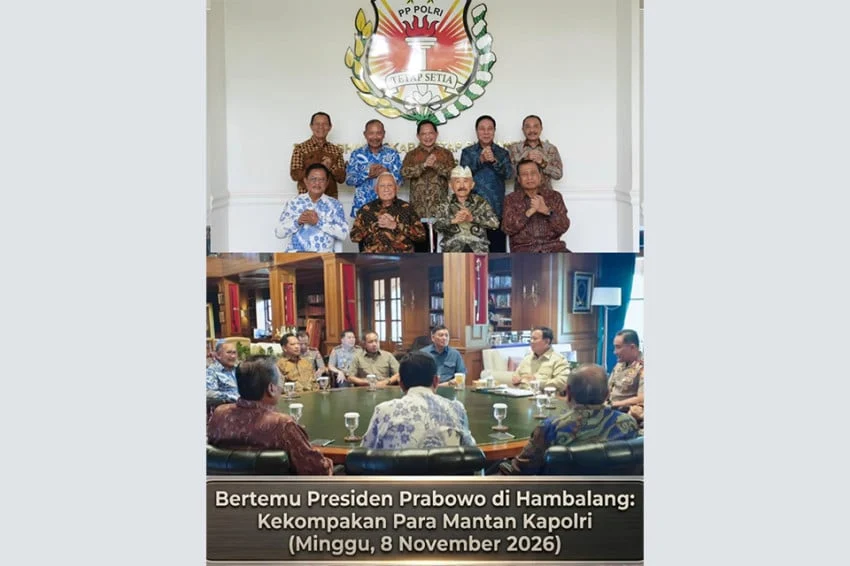
BOGOR — In a significant display of intergenerational solidarity and statecraft, President Prabowo Subianto welcomed ten former Chiefs of the Indonesian National Police (Polri) to his private residence in Hambalang, Bogor Regency, West Java. The high-profile gathering, held on Sunday, November 8, 2026, brought together decades of leadership experience from within the country’s primary law enforcement agency. The meeting underscored the current administration’s ongoing efforts to maintain open channels of communication with key institutional figures, fostering a collaborative approach to national security and governance.
The delegation of former police chiefs represented a broad spectrum of the institution’s history, spanning multiple eras of Indonesian administrative and political evolution. Among the high-ranking attendees was Minister of Home Affairs Muhammad Tito Karnavian, a former Kapolri himself, whose dual presence as a cabinet member and a former law enforcement leader highlighted the seamless integration of institutional memory into the current executive branch.
A Historic Lineup of Leadership
The roster of former police commanders in attendance read like a chronological ledger of modern Indonesian policing. Alongside Minister Tito Karnavian, the delegation featured nine other retired generals who shaped the trajectory of the National Police through periods of profound democratic transition, economic turbulence, and administrative reform.
The distinguished group included General (Ret.) Roesmanhadi, General (Ret.) Rusdihardjo, General (Ret.) Surojo Bimantoro, General (Ret.) Da’i Bachtiar, General (Ret.) Sutanto, General (Ret.) Bambang Hendarso Danuri, General (Ret.) Timur Pradopo, General (Ret.) Sutarman, and General (Ret.) Badrodin Haiti.
The presence of leaders from successive operational eras highlights a rare continuity within Indonesia’s security apparatus. These figures navigated critical junctures in the nation’s history, ranging from the post-reformasi restructuring of the police force in the late 1990s and early 2000s to counter-terrorism campaigns and the safeguarding of major national democratic exercises.
Atmosphere of Warmth and Mutual Respect
The meeting took place in an environment characterized by informality and mutual respect. Eschewing the strict formalities often associated with presidential state dinners, the gathering was arranged to facilitate genuine dialogue and camaraderie. Dressed in coordinated batik attire—a symbol of national identity and cultural unity—the former police chiefs were greeted individually by President Prabowo upon their arrival.
President Prabowo personally welcomed each guest at the entrance of his residence, engaging in brief, cordial exchanges that set a relaxed tone for the discussions. Video and photographic coverage of the event captured a moment of warm recognition when the President approached General (Ret.) Roesmanhadi.
"How are you, Mas (Roesmanhadi)?" President Prabowo asked, using a traditional Javanese honorific term of endearment.
"Oh, very well," Roesmanhadi replied, reflecting the amicable spirit that pervaded the initial encounters.

This personal rapport set the stage for closed-door discussions that reportedly covered a wide range of topics pertinent to national resilience, institutional development, and internal security.
Context and Background of Executive-Institutional Engagements
The Hambalang meeting is part of a broader pattern of outreach by the Prabowo administration, which has consistently emphasized the importance of national consensus and inclusive governance. Since taking office, President Prabowo has frequently consulted with elder statesmen, retired military and police generals, and leaders from various political and social sectors to seek counsel and build a united front on strategic national issues.
For the Indonesian National Police, an institution comprising hundreds of thousands of personnel spread across a vast archipelago, maintaining a connection with its former leaders is vital for institutional morale and strategic continuity. The retired generals, often referred to as senior statesmen of the force, command deep respect within the ranks and carry significant influence among active-duty officers. By convening this group, the presidency reinforces the chain of command’s historical legitimacy while signaling that the wisdom of past administrations remains valued in contemporary policymaking.
Furthermore, the participation of Minister Tito Karnavian bridges the gap between civil governance and law enforcement. As the Minister of Home Affairs, Tito oversees regional governance and regional autonomy administration, making his perspective on domestic security, local stability, and administrative coordination invaluable to the executive branch.
Strategic Implications for National Security and Governance
Political analysts and security observers have noted that gatherings of this magnitude carry substantial symbolic and practical weight. In an increasingly complex geopolitical and domestic landscape, where internal security challenges range from transnational crime and cybersecurity threats to maintaining social cohesion in a diverse society, the collective expertise of ten former police chiefs represents a formidable reservoir of crisis management experience.
While the official agenda of the Hambalang meeting was framed primarily as a gathering for fellowship and consultation, experts suggest several underlying implications:
- Reinforcing Institutional Stability: By visibly uniting past and present leaders, the administration projects an image of stability and unity within the state apparatus. This is crucial for maintaining investor confidence and public trust in law enforcement agencies.
- Advisory Resource Utilization: Former police chiefs possess firsthand knowledge of operational bottlenecks, structural reforms, and strategic vulnerabilities. Engaging them allows the current administration to draw on lessons learned from past crises, such as regional conflicts, major security threats, and institutional reforms.
- Political Consolidation: Bringing together leaders from various political eras helps neutralize potential factionalism and fosters a consensus-driven approach to national security policy, ensuring that the security apparatus remains aligned with national development goals.
Broader Public and Institutional Reactions
The meeting has generated widespread discussion across domestic media platforms, with civil society organizations and political commentators analyzing the significance of the event. Public response has generally been favorable, with many citizens viewing the sight of former adversaries or contemporaries uniting under the national banner as a positive sign of political maturity.
Within the police institution itself, active-duty personnel have reportedly welcomed the event. Sources within the National Police headquarters indicate that the visible respect accorded to retired generals serves as an inspiring precedent for younger generations of officers, emphasizing that service and dedication to the state are recognized long after retirement.
As Indonesia continues to navigate its path toward sustainable economic growth and regional leadership, the counsel of seasoned security veterans remains an asset. The Hambalang gathering illustrates that while administrations change and generations pass, the foundational commitment to national stability remains a shared enterprise among Indonesia’s premier leadership alumni.
The meeting concluded with a group photograph, capturing a historic alignment of leadership that spans decades of Indonesian history. As the former chiefs departed the Hambalang estate, the event left an enduring impression of continuity, collaboration, and a shared dedication to the Republic of Indonesia.
