
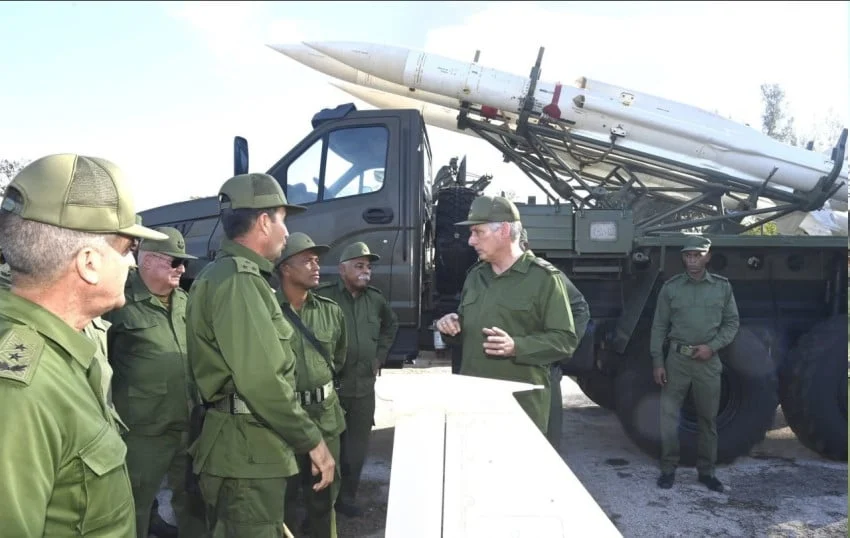
The declaration, made during an interview with the Russian state news agency TASS, underscores a deepening sense of insecurity within the Cuban government. Soberon confirmed that the state has institutionalized "defense preparation days" every Friday, a systemic effort to ensure the population is equipped to protect the country’s sovereignty, independence, and territorial integrity against any external existential threat.
The Context of Defensive Mobilization
The Cuban government’s move to increase its defensive readiness is not an isolated development but rather a reaction to decades of strained bilateral relations and recent geopolitical shifts. According to Soberon, the necessity for these drills arises from a combination of long-standing hostility from Washington and the specific geopolitical actions taken by the United States on the international stage over the last several years.
For Havana, the "scenario of a military invasion" is treated as a tangible possibility rather than a theoretical abstraction. The Cuban leadership frequently cites the persistent economic blockade and the designation of Cuba as a State Sponsor of Terrorism (SSOT) as evidence of a sustained campaign by the United States to destabilize the Cuban government. By conducting regular defense drills, Havana aims to send a deterrent message to Washington: that any attempt at military intervention would be met with a civilian-backed, entrenched resistance.
A Chronology of Strained Ties
To understand the current volatility, one must look at the historical trajectory of US-Cuba relations, which have been defined by cycles of hostility and brief windows of rapprochement:
- 1960–1962: The implementation of the US trade embargo and the failed Bay of Pigs invasion, followed by the Cuban Missile Crisis, set the template for decades of mutual suspicion.
- 2014–2016: The "Cuban Thaw" under the Obama administration saw a significant easing of tensions, the re-establishment of diplomatic missions, and the removal of Cuba from the US list of state sponsors of terrorism.
- 2017–2021: The Trump administration reversed these policies, implementing "maximum pressure" tactics, including the reinstatement of travel restrictions and the return of Cuba to the SSOT list in the final days of his term.
- 2021–Present: The Biden administration has maintained much of the restrictive framework, citing concerns over human rights and Cuba’s governance, which has led to a stagnation in diplomatic progress.
The current atmosphere of heightened vigilance in Havana is largely a response to the persistence of the Trump-era sanctions, which have crippled the Cuban economy and, in the view of Havana officials, created a climate of "permanent siege."
Supporting Data and Economic Realities
The socioeconomic conditions in Cuba provide the backdrop for this defensive posture. The island is currently facing its most severe economic crisis since the collapse of the Soviet Union. Inflation, chronic shortages of essential goods, and energy grid instability have led to significant migration outflows.
Analysts argue that the Cuban government’s emphasis on "external threats" serves two purposes: preparing for potential conflict and consolidating domestic cohesion during a period of profound internal distress. By pointing toward a common foreign enemy, the administration reinforces the narrative that the state’s primary role is to ensure national survival.
Furthermore, Cuba’s defense spending remains a sensitive topic. While the specific allocation for the Friday drills is not publicly disclosed, the island maintains a massive civilian-military apparatus. The Committees for the Defense of the Revolution (CDRs), along with the Revolutionary Armed Forces (FAR), ensure that the defensive structure is deeply woven into the fabric of daily life.
Official Responses and Diplomatic Nuance
Despite the rhetoric regarding military preparedness, Ernesto Soberon was careful to delineate that Havana does not seek a kinetic confrontation with the United States. In his interview, he emphasized that "Havana does not desire a military confrontation and remains hopeful of normalizing relations with Washington."
This dual-track approach—preparing for war while simultaneously signaling a readiness for dialogue—is a hallmark of Cuban diplomacy. Soberon reiterated that Cuba is prepared to engage in talks with the United States, provided those discussions are grounded in the principles of mutual respect and, most importantly, the unequivocal recognition of Cuba’s sovereignty.
From the perspective of the US Department of State, the official stance remains that the current restrictions on Cuba are aimed at supporting the Cuban people and encouraging the promotion of democracy. Washington has consistently denied any intent to invade, characterizing its policy as a measured response to the suppression of democratic rights within the country. However, for Havana, the lack of a formal security guarantee from the US remains the core obstacle to any genuine normalization.
Broader Impact and Global Implications
The standoff between Washington and Havana has significant implications for the wider Caribbean and Latin American region. Cuba’s increasing military cooperation with nations like Russia and China—both of which have signaled their support for Cuban sovereignty—creates a complex geopolitical chessboard.
- Regional Stability: If tensions continue to escalate, there is a risk of regional instability, with other Latin American countries being forced to choose sides between maintaining trade relations with the US and supporting Cuba’s anti-hegemonic stance.
- Migration and Humanitarian Impact: Continued economic hardship and the fear of military conflict are likely to fuel further irregular migration to the United States, presenting a persistent domestic policy challenge for the US government.
- Diplomatic Isolation vs. Engagement: The international community remains divided. While the United Nations General Assembly has repeatedly voted overwhelmingly to condemn the US embargo, the policy remains an immovable object in American domestic politics, influenced heavily by the influential Cuban-American constituency in Florida.
Fact-Based Analysis of the Current Standoff
The current situation can be categorized as a "security dilemma." The actions taken by each side—Washington’s sanctions and Havana’s defensive drills—are viewed by the other as offensive provocations. Washington sees Cuba’s military drills as evidence of a regime that is inherently anti-American and aligned with geopolitical rivals, while Havana sees Washington’s sanctions and rhetoric as the preparatory steps for a "regime change" operation.
The probability of an actual US military invasion remains statistically low in the eyes of most international relations experts. The political cost for any US administration to launch a full-scale invasion of an island nation just 90 miles from its coast would be astronomical, likely triggering a massive humanitarian crisis and widespread international condemnation.
However, the "threat" serves as a strategic tool. For Cuba, it justifies the maintenance of a highly centralized state structure and explains the ongoing economic difficulties as the result of external sabotage. For the US, maintaining the current status quo requires minimal effort compared to the diplomatic heavy lifting required to negotiate a full normalization of ties.
Conclusion
As Ernesto Soberon’s comments to TASS indicate, the atmosphere in Havana is one of prepared alertness. The Cuban government has signaled that it will not be caught off guard, framing its defensive maneuvers as a necessary response to the geopolitical pressures exerted by the United States.
While both nations profess a desire for a different, more stable relationship, the path toward that goal remains obscured by decades of mistrust, conflicting political ideologies, and the entrenchment of existing policies. As long as the current impasse persists, the "Friday drills" will likely continue to serve as a symbol of the fragile and contentious nature of the relationship between the two nations, keeping the specter of conflict alive in the Caribbean. The international community, meanwhile, watches with caution, hoping that diplomacy will ultimately supersede the threat of military force.
