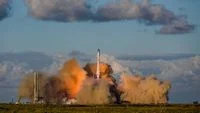
In a monumental leap forward for commercial space exploration and interplanetary transportation, SpaceX successfully launched its massive Starship rocket into Earth orbit for the very first time. Liftoff occurred from the company’s private spaceport at Starbase in Boca Chica, Texas, at 7:15 AM local time, marking a watershed moment in aerospace engineering. This ambitious flight test represents a critical stepping stone in the development roadmap for heavy-lift vehicles explicitly designed to carry human crews and massive cargo payloads to the Moon, Mars, and destinations even further afield within the solar system.
The comprehensive test flight, scheduled to last approximately ten hours from ignition to final splashdown, was engineered to push the boundaries of modern rocketry. The primary mission profile required the upper stage of the Starship vehicle to successfully achieve Earth orbit, execute complex in-space maneuvers, and ultimately deploy a constellation of 26 next-generation Starlink broadband satellites into low-Earth orbit. This multifaceted mission not only demonstrates the raw power and capability of the world’s largest operational launch system but also serves as a rigorous operational dress rehearsal for future commercial and scientific endeavors.
Evolution of a Giant: From Concept to Orbital Flight
The path to this historic orbital launch has been paved with years of meticulous research, iterative prototyping, and rigorous flight testing. SpaceX began testing integrated flight configurations of the complete Starship system in 2023. During those initial phases, engineers deliberately utilized safer suborbital trajectories to gather vital telemetry data regarding aerodynamic stresses, thermal protection systems, and stage-separation dynamics without risking complete orbital insertion before systems were fully validated.
The iconic black-and-silver spacecraft that lifted off from Texas incorporates numerous structural and systemic modifications compared to its predecessors. Engineers refined everything from the vehicle’s aerodynamic flaps and heat shield tile configurations to its avionics architecture and propellant management systems. Standing as the tallest and most powerful launch vehicle ever flown by humanity, Starship combines unprecedented payload capacity with the elusive promise of rapid, full reusability, a holy grail that could fundamentally alter the economics of space access.
Mission Architecture and Technical Challenges
Achieving orbit required overcoming formidable engineering hurdles that separate suborbital hops from true orbital flight. According to aerospace analysts, one of the most critical and perilous phases of the mission was the secondary engine burn required to circularize the orbit. This maneuver demands immense thrust output, precise timing, and incredibly complex navigational calculations to ensure the vehicle transitions smoothly from a ballistic arc into a stable orbital plane.
Kathleen Curlee, a senior analyst at Georgetown University’s Center for Security and Emerging Technology, highlighted the sheer complexity of this milestone during pre-launch assessments. "To achieve the altitude and velocity necessary, the vehicle must execute vastly different operational protocols while transitioning through radically varying levels of gravitational and atmospheric influence," Curlee noted in statements to international media.
To satisfy mission parameters, SpaceX targeted a circular orbit approximately 275 kilometers (171 miles) above the Earth’s surface. Reaching this altitude requires the vehicle to accelerate to an orbital velocity of roughly 28,000 kilometers per hour (17,500 miles per hour). Once this stable orbit was successfully attained, the spacecraft’s payload bay doors opened to release the 26 next-generation Starlink satellites. These advanced spacecraft are intended to bolster the company’s existing satellite internet constellation, which currently provides high-speed connectivity to millions of users across the globe. Following the deployment sequence, mission controllers planned for the vehicle to complete multiple orbits around the Earth before executing a controlled atmospheric reentry and terminal descent toward a targeted splashdown in the remote waters of the Pacific Ocean.
A Busy Week for Commercial Spaceflight
The successful execution of this fourteenth major integrated flight test underscores the relentless operational tempo maintained by SpaceX. The company currently dominates the global commercial launch market, largely on the proven reliability and partial reusability of its workhorse Falcon 9 and Falcon Heavy rockets. However, Starship represents the definitive future of the enterprise, designed to completely supplant older vehicles and drastically lower the cost per kilogram of lifting mass into orbit.
Remarkably, this orbital Starship launch is just one component of an extraordinarily packed schedule for the aerospace manufacturer. Industry observers noted that this flight test is slated to be followed by three additional SpaceX rocket launches within the exact same calendar week. Among those forthcoming missions is a high-profile crewed flight designed to transport professional astronauts to the International Space Station (ISS), demonstrating the company’s vast operational capacity across multiple distinct launch platforms.
Strategic Implications for the Future of Space Exploration
The successful orbital integration of Starship carries profound implications for the geopolitical and commercial landscape of space exploration. As national space agencies, including NASA, look toward establishing permanent outposts on the lunar surface through the Artemis program, the availability of a heavy-lift vehicle with unprecedented cargo capacity is non-negotiable. Starship has already been selected by NASA as the Human Landing System (HLS) variant to ferry astronauts from lunar orbit down to the surface of the Moon.
Furthermore, this test flight paves the way for advanced in-space operational capabilities that have long remained theoretical. Future iterations of the Starship program will heavily rely on orbital propellant transfer—the complex process of docking two massive spacecraft in orbit to refuel them before deep-space journeys. Successfully demonstrating the foundational elements of this architecture during ongoing flight tests brings humanity one step closer to realizing sustained interplanetary transit.
While the development cycle has occasionally encountered regulatory hurdles, technical anomalies, and scheduled delays, SpaceX’s iterative "test, fail, fix, and fly" philosophy continues to yield historic breakthroughs. By crossing the threshold into orbital operations with its flagship vehicle, the aerospace firm has not only validated years of intensive capital investment and engineering grit but has also permanently shifted the horizon of what is possible in human spaceflight.