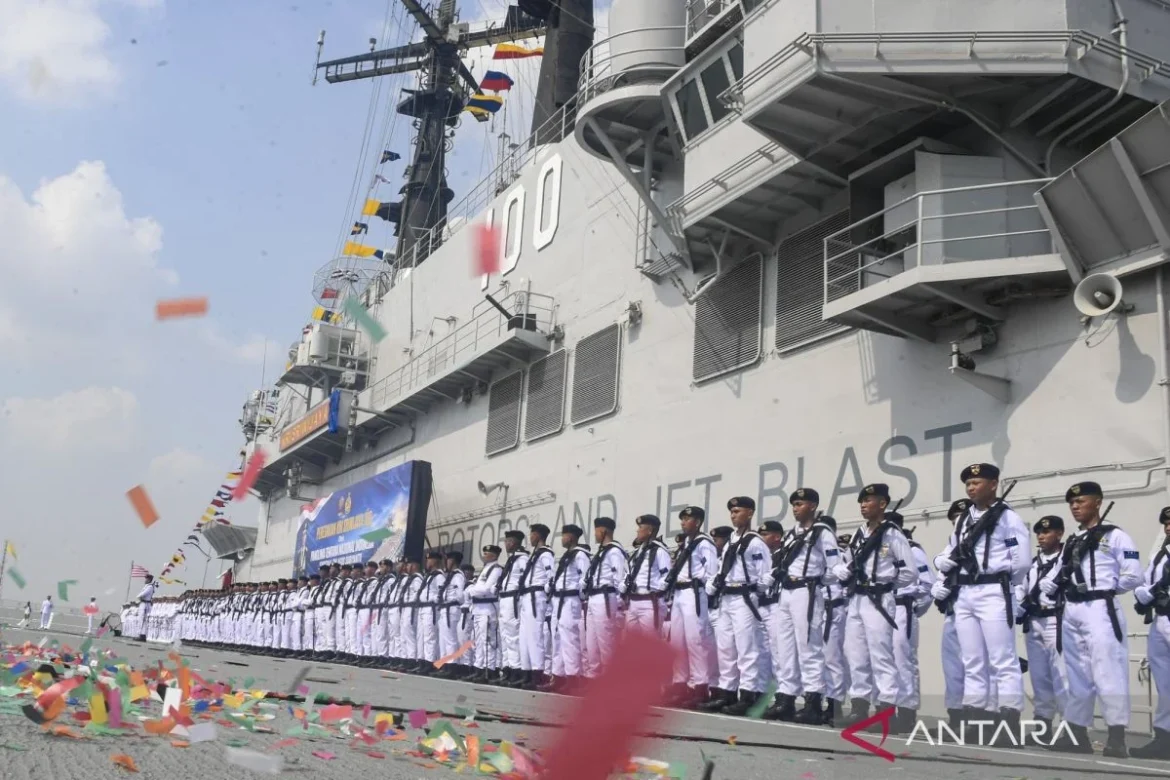
The Indonesian archipelago has taken a monumental step forward in its maritime defense posture with the arrival of the former Italian Navy aircraft carrier, the ITS Giuseppe Garibaldi, at Pier 107 of Tanjung Priok Port in North Jakarta. Docking on Friday, September 18, 2026, the arrival of this prominent vessel marks a transformative chapter for the Indonesian Navy, officially known as Tentara Nasional Indonesia Angkatan Laut (TNI AL), as it prepares to integrate the nation’s very first aircraft carrier into its operational fleet.
Formerly designated under the hull number C551 during its decades of service with the Italian Navy, the vessel is slated to undergo a formal transfer of ownership and a symbolic flag-changing ceremony on September 24, 2026. Upon the raising of the Red and White flag, the ship will officially be rechristened as the KRI Sriwijaya, honoring the glorious ancient maritime empire that once dominated Southeast Asian sea lanes. This historic acquisition has reignited national and international discussions surrounding the strategic utility, operational capabilities, and broader geopolitical implications of operating an aircraft carrier within the world’s largest archipelagic state.
A Floating Airfield: Defining the Modern Aircraft Carrier
To understand the magnitude of the KRI Sriwijaya’s arrival, one must examine the fundamental definition and strategic purpose of an aircraft carrier. In naval warfare and maritime strategy, an aircraft carrier is fundamentally defined as a large surface warship equipped with a full-length flight deck and dedicated hangar facilities designed specifically to carry, launch, recover, and service fixed-wing aircraft and helicopters.
Unlike traditional surface combatants such as frigates, corvettes, and destroyers—which rely primarily on surface-to-surface missiles, naval artillery, and torpedoes as their principal offensive and defensive measures—an aircraft carrier functions as a mobile air base. This unique design allows naval forces to project air power far beyond the operational radius of land-based airfields. According to maritime defense doctrine, including guidelines outlined by global naval forces such as the United States Navy, the strategic value of a carrier lies in its versatility. It serves as a command-and-control hub capable of conducting independent blue-water strike operations, enforcing maritime security, protecting vital sea lines of communication, and delivering rapid humanitarian assistance and disaster relief (HADR) to remote or crisis-stricken regions.
Crucially, naval analysts emphasize that sheer physical dimensions do not automatically qualify a vessel as an aircraft carrier. A true carrier requires a complex ecosystem of internal and external infrastructure, including sophisticated flight decks, aircraft elevators, extensive maintenance hangars, specialized aviation fuel storage, and advanced air traffic control systems. These integrated systems enable the vessel to sustain high-tempo flight operations thousands of miles away from domestic logistics networks.
Chronology of the Acquisition and Upcoming Commissioning
The journey of the ITS Giuseppe Garibaldi from the Mediterranean Sea to the waters of Jakarta is the culmination of extensive bilateral defense diplomacy between Jakarta and Rome. Preliminary discussions regarding the transfer of surplus naval assets began well in advance, driven by TNI AL’s strategic blueprint to modernize its blue-water capabilities and address the complex security dynamics of the Indo-Pacific region.
Following months of technical inspections, crew familiarization training, and contractual finalizations, the vessel embarked on its long-distance transit voyage to Indonesia. Its arrival at Tanjung Priok Port on September 18, 2026, drew immense public attention, capturing the interest of defense observers and maritime enthusiasts alike.
The schedule leading up to full operational integration follows a strict timeline:
- September 18, 2026: The ITS Giuseppe Garibaldi arrives at Pier 107, Tanjung Priok Port, Jakarta Utara, for initial post-voyage checks and port-side preparations.
- Mid-September 2026: High-level diplomatic and defense engagements take place, including scheduled executive meetings between Indonesian state leadership and official representatives of the Italian Navy.
- September 24, 2026: The official transfer of ownership ceremony and flag-change event are scheduled to take place in Tanjung Priok, formally retiring the Italian designation and commissioning the vessel as the KRI Sriwijaya.
- Post-Commissioning Phase: The vessel is slated to undergo comprehensive refitting, engine overhauls, and structural adaptations tailored specifically to the operational doctrines and strategic requirements of the Indonesian Navy.
Strategic Rationale: Focusing on Military Operations Other Than War (OMSP)
The integration of the KRI Sriwijaya into the TNI AL inventory does not signal an immediate shift toward aggressive power projection or expeditionary warfare. Instead, military leadership has outlined a pragmatic approach focused heavily on Military Operations Other Than War, widely known in Indonesian military terminology as Operasi Militer Selain Perang (OMSP).
Chief of Staff of the Indonesian Navy (KSAL) Admiral TNI Muhammad Ali has repeatedly underscored that the acquisition is strategically aligned with Indonesia’s unique geographic realities. As a vast archipelagic nation comprising over 17,000 islands, Indonesia frequently faces logistical hurdles during natural disasters, where conventional land transportation networks can be entirely severed by earthquakes, volcanic eruptions, or extreme weather events.
Admiral Ali highlighted that the KRI Sriwijaya will be systematically refitted and optimized to serve as a floating forward base for helicopters, unmanned aerial vehicles (UAVs), heavy logistical supplies, and medical personnel. This capability will drastically enhance the state’s disaster response mechanisms. By utilizing the ship’s expansive flight deck and hangar space, the Navy can deploy rotary-wing aircraft to ferry emergency food supplies, medical teams, and search-and-rescue units directly to isolated disaster zones without relying solely on distant mainland airports.
Furthermore, naval leadership has expressed a strong operational preference for outfitting the carrier with vertical takeoff and landing (VTOL) aircraft or short takeoff and vertical landing (STOVL) platforms. Historically, the Giuseppe Garibaldi operated AV-8B Harrier II jump-jets during its tenure with the Italian Navy, demonstrating the vessel’s inherent capability to handle specialized tactical aircraft should defense requirements evolve in the future.
Diplomatic Engagement and Official Responses
The procurement of the Italian carrier has generated significant diplomatic dialogue between Jakarta and Rome. State Secretariat officials confirmed that the President of the Republic of Indonesia is scheduled to personally receive a high-ranking delegation from the Italian Navy to commemorate the historic defense partnership.
Defense analysts note that Italy’s willingness to transfer the vessel reflects a deepening strategic alignment between European defense exporters and Southeast Asian maritime nations. For Italy, transferring the seasoned carrier provides a sustainable path for a trusted ally to inherit a high-value asset, while simultaneously fostering stronger industrial and military-technical cooperation between the two nations. For Indonesia, it offers a cost-effective shortcut to acquiring sovereign carrier aviation capabilities, bypassing the prohibitive financial timelines required to build such a complex vessel from the keel up.
Comparative Advantage: Beyond Frigates and Corvettes
To fully grasp the operational leap represented by the KRI Sriwijaya, defense experts draw clear distinctions between standard surface combatants and a dedicated aviation ship. While modern Indonesian surface combatants—such as newly acquired frigates and domestic-built corvettes—frequently feature aviation facilities capable of landing a single tactical helicopter, their primary mission profiles center on surface warfare, anti-submarine warfare (ASW), and air defense via missile batteries.
Conversely, a light aircraft carrier like the Giuseppe Garibaldi is built entirely around the aviation cycle. It features dedicated spaces for ordnance storage, comprehensive avionics maintenance workshops, advanced radar and communication suites, and expansive parking aprons both on deck and below. This architectural philosophy transforms the vessel into an independent floating command post capable of coordinating multi-domain operations across vast expanses of maritime territory.
Broader Implications for Indonesian Defense and Regional Stability
The introduction of the KRI Sriwijaya into the naval order of battle carries profound implications for Indonesia’s national defense posture. Strategically, it signals a maturing naval force capable of exercising sea control and power projection within its sovereign waters and the broader Indo-Pacific theater.
Economically and logistically, the operationalization of the vessel will present unique challenges. Maintaining, fueling, and repairing an aircraft carrier requires rigorous supply chains, highly specialized technical training for naval personnel, and sustained budgetary commitments. However, by intentionally pacing the integration process—focusing initially on HADR missions, helicopter operations, and drone integration—TNI AL is adopting a measured, sustainable pathway to mastery over carrier-based aviation.
As the Red and White flag is hoisted over the newly christened KRI Sriwijaya on September 24, 2026, Indonesia will not only secure a historic milestone in naval engineering and defense diplomacy but will also redefine its capacity to safeguard its maritime borders, protect its citizens, and project humanitarian leadership across the maritime domain.