
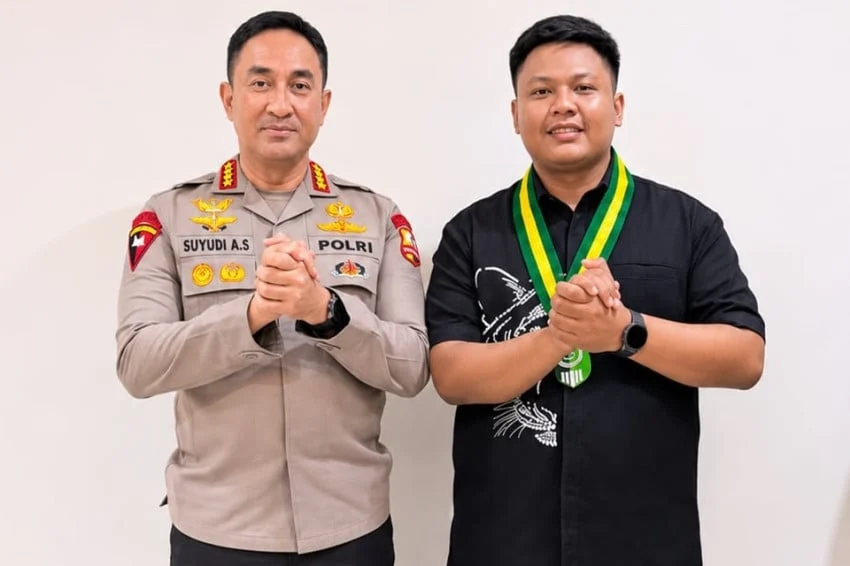
The Executive Board of the Indonesian Muslim Students Union (PB SEMMI) has officially expressed profound concern over the alleged illegal wiretapping targeting Indonesian President Prabowo Subianto. Amid mounting national anxiety regarding state security and intelligence breaches, the student organization has thrown its full weight behind the Indonesian National Police (Polri), urging a rigorous, transparent, and comprehensive investigation into the high-profile security compromise.
The declaration of support was formally announced by PB SEMMI General Chairperson Achmad Donny during a high-profile youth conference held at the Gerakan Bhineka Nasional headquarters in Jakarta. The symposium, themed "The State Must Reform: Golden Indonesia Crumbles in the Hands of the Deep State," served as a critical forum for youth and student organizations to discuss national sovereignty, institutional integrity, and contemporary threats to democratic governance. The event garnered significant public attention due to the high-ranking attendance of key state security officials, including Chief of the Indonesian National Police, General Suyudi Ario Seto, alongside leaders from various prominent student and youth coalitions across the archipelago.
The urgency of PB SEMMI’s intervention stems from a cascading series of events that have shaken the upper echelons of Indonesia’s security apparatus. Just prior to the conference, national news outlets broke the shocking development that high-ranking police official Ahrie Sonta had been dishonorably discharged from the National Police following an expedited ethics tribunal linked to the illegal wiretapping scandal. This unprecedented disciplinary action has brought the hidden vulnerabilities of state communications security into sharp public focus, prompting civil society groups to demand sweeping accountability and institutional introspection.
Background Context: The Anatomy of an Institutional Crisis
The controversy surrounding the alleged interception of presidential communications represents one of the most severe security breaches in modern Indonesian governance. In an era defined by hyper-digitalization and advanced telecommunications, the security of the head of state is paramount. The revelation that unauthorized actors—potentially involving elements within or operating parallel to state apparatuses—managed to compromise presidential channels has sent shockwaves through the executive branch, intelligence communities, and the wider public.
The term "Deep State," heavily featured in the Jakarta youth conference’s theme, reflects growing public and academic anxieties regarding unaccountable networks of power operating within or alongside legitimate government institutions. While political analysts frequently debate the precise boundaries of such influence, incidents involving illegal wiretapping provide tangible ammunition to critics who argue that internal factions may be leveraging clandestine methods to sway political outcomes, influence national policymaking, or sabotage executive leadership.
PB SEMMI, as a historically influential Islamic student movement, has consistently positioned itself as a watchdog for national democracy and constitutional integrity. By stepping into the fray, the organization aims to ensure that the investigation does not stall due to bureaucratic shielding, institutional protectionism, or political interference. The demand for a professional and transparent inquiry is viewed by youth leaders as a litmus test for the credibility of Indonesia’s law enforcement agencies under the leadership of General Suyudi Ario Seto.
Chronology of Events and the Ahrie Sonta Dismissal
The unfolding crisis has accelerated at a breakneck pace over a remarkably short period, catching both political observers and institutional insiders off guard.
The timeline of the scandal highlights the swift administrative and legal maneuvers taken by state authorities in response to the breach:

- Initial Discovery and Internal Audits: Intelligence and internal security units detected anomalous signal tracking and unauthorized access attempts directed toward high-level government communication channels, ultimately alerting executive leadership to potential vulnerabilities surrounding President Prabowo Subianto’s secure lines.
- Internal Affairs Investigation: Prompted by the initial findings, the Internal Professional and Security Division (Propam) of the Indonesian National Police initiated a classified investigation into potential breaches of protocol and criminal misconduct involving law enforcement personnel.
- The Dishonorable Discharge of Ahrie Sonta: In a landmark disciplinary ruling, high-ranking police official Ahrie Sonta was formally subjected to an Ethics Code Commission hearing. The tribunal concluded that his actions constituted a severe violation of police ethics and national security protocols, resulting in a breaking-news announcement of his dishonorable discharge from the National Police in connection with the illegal wiretapping case.
- Civil Society Mobilization and PB SEMMI Declaration: Capitalizing on the momentum of public disclosures, PB SEMMI convened alongside other youth factions at the Jakarta public democracy forum on Tuesday, November 10, 2026, officially declaring unconditional backing for the Kapolri to dismantle any wider conspiracy involved in the wiretapping operation.
This sequence of events underscores a dual reality within contemporary Indonesian law enforcement: while internal corruption and security compromises remain deeply entrenched threats, the willingness of police leadership to execute public, high-level disciplinary measures signals an aggressive push toward institutional self-purification.
Official Responses and Multi-Sectoral Reactions
The stance taken by PB SEMMI reflects a broader consensus emerging among student bodies, legal watchdogs, and political analysts regarding the necessity of civilian oversight over intelligence and security operations.
During the Jakarta conference, Achmad Donny emphasized that the integrity of the republic cannot be compromised by internal sabotage or extrajudicial surveillance. "PB SEMMI supports the Chief of Police to thoroughly investigate this issue professionally and transparently until the truth is brought completely to light," Donny stated during his address. He further stressed that the implications of the wiretapping case extend far beyond a mere administrative infraction, touching upon the very core of national stability and the realization of the "Golden Indonesia 2045" vision.
The presence of the Chief of Police at the forum was interpreted by attendees as a direct acknowledgment of the gravity of the situation. By engaging directly with student leaders and youth organizations, police leadership sought to project an image of accountability and openness, signaling that the institution has nothing to hide and is fully committed to uncovering every individual connected to the security breach.
However, skepticism remains high among various legal experts and opposition figures. Analysts point out that dismissing a high-ranking official, while necessary, represents only the tip of the iceberg. The broader question of who ordered the surveillance, what data was intercepted, and whether foreign or domestic political entities were involved remains unanswered. Consequently, pressure is mounting on both the National Police and the State Intelligence Agency (BIN) to expand the scope of the investigation beyond police internal affairs to encompass a comprehensive national security audit.
Broader Implications for National Security and Democratic Governance
The convergence of the presidential wiretapping scandal and concurrent policy debates—such as the controversial regulatory discussions surrounding vape product prohibitions—has created a complex socio-political landscape in Indonesia. While the vape prohibition touches upon public health, economic trade, and consumer rights, the wiretapping case strikes at the foundational trust between the citizenry, the executive branch, and the security forces sworn to protect them.
Fact-based analysis of the implications reveals several critical challenges for the current administration:
- Erosion of Institutional Trust: When the communications of a sitting president are compromised, public confidence in the security apparatus plummets. Rebuilding this trust requires not just punitive measures like dismissals, but structural overhauls of encryption protocols, cybersecurity infrastructure, and internal vetting processes.
- The Test of Police Independence: The handling of the Ahrie Sonta case and the broader wiretapping investigation will serve as a defining benchmark for General Suyudi Ario Seto’s tenure. The public will closely monitor whether the investigation reaches untouchable elites or stops prematurely at mid-level scapegoats.
- The Role of Student Movements: The active intervention of organizations like PB SEMMI demonstrates that Indonesian youth and student bodies remain a potent political barometer. Their demand for transparency acts as a vital counterweight against institutional opacity, ensuring that high-level scandals are not quietly swept under the rug.
- Vulnerability to Hybrid Threats: The incident highlights the growing danger of hybrid warfare and domestic espionage in the digital age. As Indonesia continues its rapid technological modernization, securing state infrastructure against sophisticated electronic surveillance is no longer optional—it is an existential imperative for national survival.
Conclusion
As the investigation moves forward, all eyes remain fixed on the Indonesian National Police and allied state institutions. The unwavering support voiced by PB SEMMI and other youth coalitions provides a mandate for decisive action, signaling that civil society will not tolerate breaches of state sovereignty from within or outside government ranks.
Ultimately, the resolution of the presidential wiretapping scandal will dictate the trajectory of institutional reform in Indonesia. Whether this crisis becomes a catalyst for profound modernization and enhanced security discipline or merely another chapter in unresolved political intrigue depends entirely on the transparency, courage, and thoroughness with which law enforcement pursues the truth to its final conclusion.
