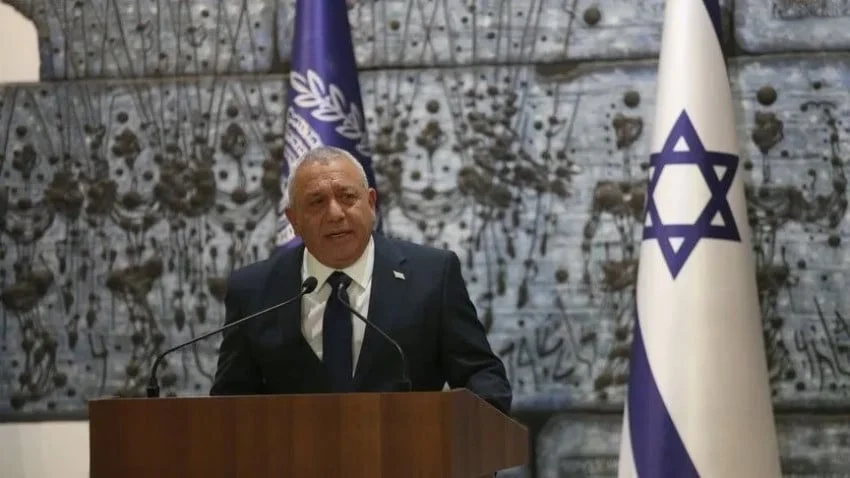
The political stability of Israel faces a significant test as Gadi Eisenkot, a prominent figure currently tasked with exploring the formation of a new governing coalition, has issued a scathing indictment of outgoing Prime Minister Benjamin Netanyahu. Eisenkot, a former Chief of Staff of the Israel Defense Forces (IDF), publicly accused Netanyahu of orchestrating a campaign characterized by "racist and violent" rhetoric directed at Israel’s Arab minority. This accusation, leveled via the social media platform X, arrives at a time of extreme parliamentary volatility, where the path to a 61-seat majority remains elusive for both the incumbent right-wing bloc and the opposition coalition led by Eisenkot.
The tension marks a deepening fissure in Israeli society, where the role of the Arab electorate—representing approximately 21 percent of the national population—has become a central pivot point in the struggle for governance. Eisenkot’s intervention serves not only as a critique of electoral strategy but as a broader challenge to the traditional norms of Israeli political discourse, emphasizing the constitutional responsibility of a prime minister to represent all citizens, regardless of their political affiliation or ethnic background.
The Context of Electoral Polarization
The recent election, held on October 27, underscored the profound fragmentation of the Israeli electorate. The results cemented a stalemate that has persisted through multiple election cycles in recent years. Eisenkot’s alliance, representing a diverse coalition of secular and centrist factions, secured 48 seats. Conversely, the right-wing and ultra-Orthodox bloc, which serves as the traditional power base for Benjamin Netanyahu, garnered 53 seats.
The arithmetic of the Knesset, Israel’s 120-seat parliament, requires a minimum of 61 seats to form a stable government. With both primary contenders falling short of this threshold, the political future of the country hinges on the support of smaller parties and the potential for unusual, often unstable, coalition arrangements. The Arab-majority parties, which saw an unprecedented surge in turnout and representation, secured 19 seats, marking a record achievement for the demographic. This influx of political capital for Arab factions has placed them in a position of potential "kingmaker," a reality that has intensified the rhetoric from the right-wing establishment.
Chronology of the Political Crisis
The current crisis did not emerge in a vacuum; it is the culmination of years of shifting alliances and voter fatigue.
- Mid-2023: Initial discussions regarding the necessity of a new election began as the previous coalition government struggled to maintain internal discipline, leading to the dissolution of the Knesset.
- September 2023: Formal campaigning commenced, with the incumbent administration heavily emphasizing national security and identity politics.
- October 27, 2023: The general election took place, resulting in a fractured legislature where neither the left-leaning alliance nor the right-wing bloc secured a clear mandate.
- Early November 2023: Gadi Eisenkot, leveraging his reputation as a pragmatic military leader, was invited by the President to explore the formation of a government.
- Late November 2023: Public discourse reached a boiling point when Eisenkot issued his statement condemning the "delegitimization" of Arab citizens, accusing the outgoing government of exploiting ethnic tensions for electoral gain.
Demographic Data and the Arab Vote
The role of the Arab population in Israeli democracy is statistically significant and historically complex. According to the Central Bureau of Statistics, the Arab minority—encompassing Muslims, Christians, and Druze—has grown to approximately 2.1 million people. Their integration into the parliamentary process has been marked by varying levels of participation.
Historically, Arab-majority parties have been sidelined from government coalition negotiations. However, recent trends suggest a shift in voter behavior. In the October 27 election, the 19 seats won by these parties represent a critical mass that reflects both the demographic reality and a desire for greater influence over domestic policy. Analysts note that the "delegitimization" campaigns mentioned by Eisenkot often involve political framing that treats the Arab vote as a security liability rather than a democratic participation. By bringing this issue to the forefront, Eisenkot is attempting to redefine the parameters of "legitimate" coalition partners, signaling a possible departure from the exclusionary politics of the past decade.
Official Responses and Political Repercussions
The response from the Netanyahu camp has been one of dismissal, with allies characterizing Eisenkot’s accusations as a "smear campaign" designed to undermine the right-wing’s platform. Supporters of the outgoing Prime Minister argue that their focus on national security and Jewish identity is a necessary defense against external threats and internal fragmentation.
Conversely, civil rights organizations within Israel have largely echoed Eisenkot’s concerns. Groups such as the Association for Civil Rights in Israel (ACRI) have frequently warned that rhetoric targeting minority groups undermines the rule of law and social cohesion. Internationally, observers have watched the discourse with concern. Western allies, including the United States, have historically emphasized the importance of democratic values and equal protection under the law for all citizens, regardless of their ethnic or religious background.
Fact-Based Analysis of Future Implications
The implications of this standoff extend beyond the immediate question of who will serve as Prime Minister. The current political environment poses three distinct risks to the stability of the state:
- Institutional Erosion: The persistent rhetoric of "delegitimization" threatens the integrity of the Knesset as a representative body. If a significant portion of the population perceives that their votes are viewed as illegitimate or "anti-state," it may lead to long-term alienation and civil unrest.
- Coalition Fragility: Should a government be formed without the participation or consensus of the broader spectrum of society, it will likely remain unstable. The necessity of relying on extreme factions to reach the 61-seat threshold often requires policy concessions that can alienate moderate voters and international partners.
- Governance Gridlock: The focus on electoral survival has, by many accounts, diverted attention from critical domestic issues such as the cost of living, housing crises, and infrastructure development. As long as the primary political goal remains the "delegitimization" of opponents rather than substantive policy debate, the ability of the state to function effectively will remain compromised.
The Role of Gadi Eisenkot
Gadi Eisenkot’s emergence as a central political figure represents a shift toward a "security-first" centrist approach. His military background—having served as the IDF Chief of Staff from 2015 to 2019—provides him with a level of authority that is difficult for political rivals to dismiss entirely on grounds of "national weakness." His critique of Netanyahu is not merely political; it is framed as a defense of the state’s foundational principles.
"The prime minister of Israel is the prime minister for all citizens, including those who did not vote for him," Eisenkot’s statement noted. This framing suggests a desire to return to a more traditional, perhaps more conciliatory, model of Israeli governance. Whether this approach can bridge the divide in a country as polarized as Israel remains to be seen.
Conclusion
The path forward for Israel remains obscured by the shadows of political rivalry and ethnic friction. As Gadi Eisenkot continues his efforts to assemble a coalition, the debate he has sparked regarding the inclusion of Arab citizens is likely to become a defining feature of the current parliamentary session.
The record participation of the Arab electorate and the subsequent backlash highlight a society at a crossroads. Israel must decide whether it will move toward a model of inclusive governance that recognizes the diversity of its citizenry or continue down a path of exclusionary politics that risks further deepening domestic divisions. For the moment, the nation waits in a state of political suspension, with the eyes of the international community focused on whether the principles of democratic representation will prevail over the exigencies of partisan combat. The coming weeks will be critical, as the deadline for forming a government approaches, and the rhetoric of the campaign trail is forced to yield to the practical requirements of governing a complex and diverse nation.