
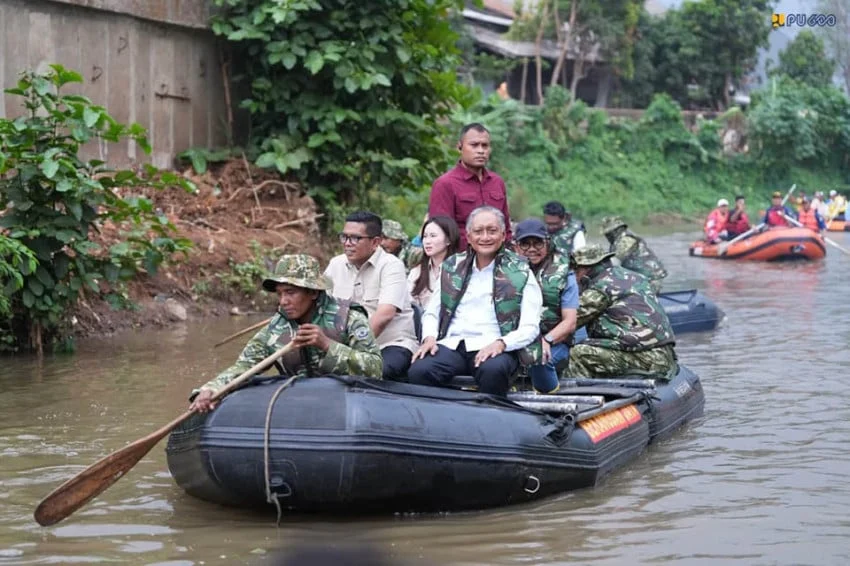
JAKARTA – Minister of Public Works (PU) Dody Hanggodo conducted a strategic field inspection on Friday, October 30, 2026, marking a pivotal moment in the central government’s effort to overhaul infrastructure connectivity across Banten Province. Accompanied by local government officials, the Minister navigated the Kali Angke river via rubber boat to assess firsthand the urgency of flood mitigation efforts, which remain a primary concern for the densely populated regions bordering the capital.
The inspection serves as a physical manifestation of a broader directive from President Prabowo Subianto, aiming to synchronize central infrastructure planning with regional economic necessities. Minister Dody’s visit emphasized that Banten’s role as a buffer zone for Jakarta and a hub for industrial manufacturing requires a more robust logistical framework to sustain its economic momentum.
The Strategic Importance of Banten’s Infrastructure
Banten Province represents a complex socio-economic landscape. To the north, the province is characterized by heavy industrial corridors and logistics hubs serving the Port of Merak and international trade routes. To the south, the province relies heavily on agricultural output and emerging tourism sectors, such as the Tanjung Lesung Special Economic Zone.
According to Ministry of Public Works data, the current disparity between industrial-grade roads and rural agricultural access remains a significant bottleneck. The lack of connectivity in rural districts has historically hampered the distribution of agricultural produce, leading to higher logistics costs that ultimately affect commodity prices in the Greater Jakarta area.
By focusing on the "Sekolah Rakyat" (People’s School) program and irrigation systems, the Ministry is attempting a multi-sectoral approach. This strategy moves beyond simple asphalt laying; it targets the structural roots of poverty and economic stagnation by ensuring that educational facilities are accessible and that agricultural irrigation systems are resilient against the volatile climate patterns currently affecting the region.
Chronology of the Intervention
The collaboration between the Ministry of Public Works and the Banten provincial administration has been gaining momentum throughout the latter half of 2026. The trajectory of this partnership is outlined as follows:
- Early September 2026: Initial assessments of regional road damage were submitted to the Ministry of Public Works following the heavy rainy season, which caused significant erosion in several districts of Banten.
- October 15, 2026: Preliminary meetings between the Ministry and the Banten Governor’s office to discuss the integration of the "Instruksi Presiden Jalan Daerah" (IJD) or Presidential Instruction for Regional Roads program.
- October 30, 2026: The field inspection at Kali Angke, where the Minister assessed flood risk management and critical bridge infrastructure.
- Early November 2026 (Scheduled): The formal signing of a Memorandum of Understanding (MoU) between the Ministry of Public Works and the Banten Provincial Government.
This timeline reflects a fast-tracked approach intended to ensure that construction projects can begin during the transition between the rainy and dry seasons, minimizing delays caused by adverse weather conditions.
Addressing the Flood Mitigation Challenge
The choice of the Kali Angke river for the site visit was not accidental. Kali Angke has long been a primary source of seasonal flooding for both Banten and West Jakarta. During the inspection, Minister Dody emphasized that flood control is not merely a matter of dredging but requires a comprehensive system of water management, including the construction of retention basins and the improvement of riverbank embankments.
Urban planners and water management experts have noted that the rapid conversion of land in Banten for residential housing has reduced the natural water absorption capacity of the soil. Consequently, the Ministry’s commitment to improving irrigation systems serves a dual purpose: ensuring water availability for farmers and managing runoff to prevent urban inundation.
Official Statements and Policy Implications
Minister Dody Hanggodo underscored that the intervention is designed to be inclusive. "Banten possesses an extraordinary range of potential—from industrial output to agricultural productivity and a growing tourism sector. Our task is to ensure that our infrastructure investment is not just reactive, but proactive in serving the needs of the people," he stated during the press briefing following the river inspection.
The provincial government has welcomed the central government’s support, particularly regarding the funding of road repairs that exceed the fiscal capacity of the local budget (APBD). The upcoming MoU is expected to delineate the division of labor, where the central government covers arterial roads of national strategic importance, while the provincial and regency governments maintain local access roads.
From a macroeconomic perspective, this initiative is expected to reduce the "logistics tax" faced by companies operating in Banten. Improved road connectivity directly translates to shorter travel times for heavy vehicles, lower fuel consumption, and reduced vehicle maintenance costs. For the agricultural sector, the improvement of irrigation infrastructure is projected to increase the cropping intensity index, potentially allowing farmers to harvest three times a year instead of the current average of two.
Broader Economic and Social Impact
The economic implications of these infrastructure projects extend beyond the construction phase. By prioritizing the IJD program, the government is essentially creating a multiplier effect. Local labor is expected to be utilized for road and irrigation maintenance, providing a temporary employment boost in rural areas.
Furthermore, the "Sekolah Rakyat" program integrated into this infrastructure package suggests a holistic development model. By linking road access to schools, the Ministry aims to improve human capital outcomes in remote areas where students have historically faced significant barriers to entry due to poor transport infrastructure.
However, the success of these projects will depend heavily on the governance of the construction process. Past infrastructure projects in Indonesia have occasionally faced delays due to land acquisition disputes and bureaucratic friction. The Ministry of Public Works has indicated that the upcoming MoU will include a robust monitoring mechanism to ensure that the projects adhere to strict timelines and quality standards.
The Road Ahead: Challenges and Monitoring
While the commitment from the Ministry is clear, the path toward full implementation faces several hurdles. Firstly, the land acquisition process in high-density areas of Banten remains a delicate issue. Any delay in this stage can lead to significant cost overruns. Secondly, the sustainability of the infrastructure will require a dedicated maintenance budget.
Economists argue that the Ministry’s move to strengthen the partnership with the provincial government is a step in the right direction to ensure shared responsibility. By involving the local government in the prioritization process, the Ministry ensures that the infrastructure being built aligns with the actual, granular needs of the local population rather than top-down estimations.
In conclusion, the inspection by Minister Dody Hanggodo is a significant indicator of the current administration’s focus on bridging the gap between urban industrial development and rural agricultural welfare. The upcoming MoU represents the formalization of this commitment. If executed according to plan, the combined efforts in road, water, and educational infrastructure will likely catalyze a new era of growth for Banten, positioning the province as a more resilient and integrated player in the national economy.
As the Ministry of Public Works prepares for the next phase of implementation, stakeholders remain watchful, expecting the results of this synergy to manifest in tangible improvements in public mobility, flood resistance, and economic productivity by the end of the fiscal year. The focus now shifts to the signing of the MoU, which will serve as the legal and operational blueprint for the months of intensive construction that lie ahead.
