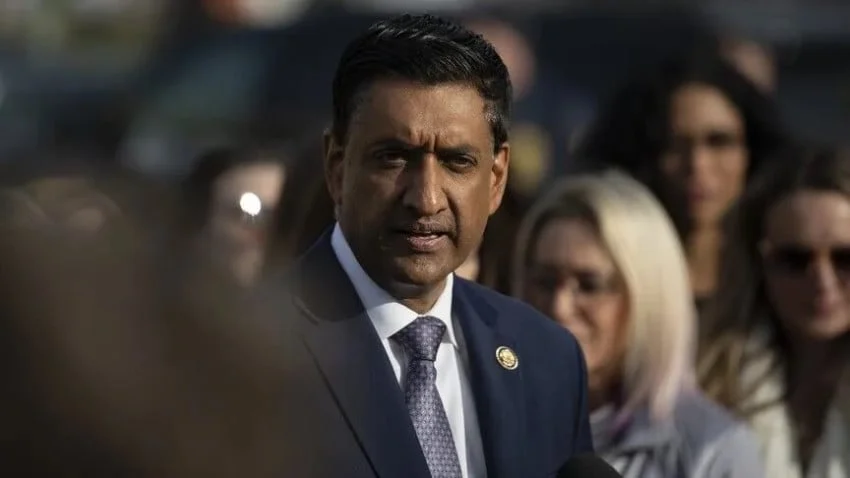
WASHINGTON — As voters across the United States head to the polls for crucial midterm elections, internal debates within the Democratic Party regarding United States foreign policy in the Middle East have reached a critical juncture. Representative Ro Khanna, a progressive Democratic congressman from California, has publicly asserted that his party must adopt an uncompromising stance toward the Israeli government should Democrats secure a legislative majority in Congress. Speaking directly to IHIP News, Khanna outlined a radical shift in traditional American diplomacy, calling for an immediate suspension of offensive military assistance, the cessation of diplomatic shielding at the United Nations, and the unilateral recognition of a Palestinian state.
Khanna’s uncompromising declarations reflect a deepening ideological rift within the Democratic Party, where a growing faction of progressive lawmakers is increasingly willing to challenge decades of bipartisan consensus concerning unconditional military and diplomatic support for Israel. This intra-party friction unfolds against the backdrop of a broader electoral landscape where candidates navigate competing domestic and international priorities, ranging from inflation and healthcare to global human rights and geopolitical stability.
Progressive Demands and Policy Shifts
In his interview, Representative Khanna laid out a comprehensive four-point platform that he argues the Democratic leadership must enact immediately upon reclaiming control of the legislative branch. The core of his proposal targets the material and military pipeline sustaining ongoing conflicts in the Middle East.
"We have to call it a genocide. We have to say: no more aid. We have to say: no more sales of military equipment used to kill civilians," Khanna stated.
Beyond halting arms transfers, the California congressman proposed a dramatic overhaul of long-standing American diplomatic postures. He emphasized that a Democratic-led Congress should mandate the formal recognition of Palestinian statehood within the legislative body’s first operational week. Furthermore, Khanna advocated for the establishment of United States diplomatic missions in Ramallah and occupied East Jerusalem, a move that would fundamentally alter Washington’s physical and diplomatic footprint in the region.
Perhaps most notably, Khanna called for an end to the traditional diplomatic protection afforded to Israel by the United States within the United Nations Security Council. For decades, the U.S. has routinely utilized its veto power to block resolutions critical of Israeli military actions and settlement expansions. Dismantling this protective diplomatic shield would represent a seismic policy departure, potentially exposing Israel to international sanctions and widespread legal accountability frameworks.
Contextualizing the Democratic Divide on Foreign Policy
The outspoken stance taken by Representative Khanna is emblematic of a broader generational and ideological evolution within the Democratic voter base and its elected representatives. While the establishment wing of the party has historically maintained steadfast support for Israel’s security and regional strategic positioning, progressive factions have grown increasingly vocal in their condemnation of civilian casualties and human rights violations in the occupied territories.
This internal tension is further complicated by the realities of domestic electoral politics. While foreign policy crises capture significant media attention and mobilize activist bases, domestic economic concerns frequently dictate voter behavior at the ballot box. Highlighting this dynamic, Democratic Senate candidate Abul El-Sayed noted that everyday voters, particularly younger demographics, often prioritize domestic socio-economic issues over foreign affairs.
According to El-Sayed, concerns surrounding the affordability and accessibility of healthcare, the escalating cost of housing, and the looming disruption of labor markets due to rapid advancements in artificial intelligence (AI) remain primary considerations for a significant portion of the electorate. This divergence in voter priorities creates a complex strategic calculus for Democratic candidates who must simultaneously appease progressive activists demanding moral clarity on international human rights and moderate voters focused on domestic economic stability.
Background and Evolution of U.S. Military Aid to Israel
To understand the weight of Representative Khanna’s proposals, it is essential to examine the historical architecture of United States foreign assistance to Israel. Since the founding of the State of Israel in 1948, the United States has provided cumulative military and economic assistance totaling well over $150 billion, making Israel the largest cumulative recipient of U.S. foreign aid since World War II.
The framework for this enduring alliance was significantly formalized in 2016, when the Obama administration signed a historic ten-year Memorandum of Understanding (MOU). This agreement committed the United States to providing $38 billion in military aid—comprising $33 billion in Foreign Military Financing (FMF) grants and $5 billion for missile defense systems—between fiscal years 2019 and 2028.
For decades, proposals to condition or reduce this assistance were confined to the political fringes. However, the intensity of recent military campaigns in Gaza and the West Bank has catalyzed mainstream legislative scrutiny. Lawmakers have increasingly attempted to leverage oversight mechanisms, utilizing joint resolutions of disapproval and human rights vetting laws, such as the Leahy Law, to question the unfettered transfer of precision-guided munitions and artillery shells. Khanna’s proposal to completely halt military equipment sales marks a significant escalation from conditional oversight to outright prohibition.
Chronology of Escalating Legislative Tensions
The friction between progressive legislators and traditional party leadership regarding Middle East policy has developed through several key milestones over recent election cycles:
- May 2021: Following an 11-day conflict between Israel and Hamas in Gaza, a small group of progressive Democrats introduced resolutions of disapproval attempting to block a $735 million commercial arms sale to Israel. While the resolution failed, it signaled the emergence of a coordinated progressive legislative bloc on the issue.
- 2022–2023: Progressive lawmakers increasingly utilized congressional questioning, committee hearings, and public letters to demand strict adherence to domestic and international humanitarian laws regarding the end-use monitoring of U.S.-supplied weaponry.
- Late 2023–2024: The outbreak of the Israel-Hamas war prompted unprecedented domestic protests across university campuses and metropolitan areas. Concurrently, progressive members of Congress introduced various amendments seeking to condition military assistance on compliance with international humanitarian law and the facilitation of humanitarian aid delivery into Gaza.
- Midterm Elections Cycle: Current campaign rhetoric underscores how foreign policy positions have transformed from secondary talking points into defining ideological fault lines within primary and general elections, pitting progressive candidates advocating for human rights-centric foreign policies against establishment figures favoring traditional alliances.
Broader Implications for U.S. Foreign Policy and Domestic Politics
The policy prescriptions articulated by Representative Khanna, should they ever transition from progressive aspirations to actionable legislative agendas, would carry profound implications for global geopolitics and domestic American governance.
Internationally, a complete cessation of U.S. military aid combined with the termination of diplomatic shielding at the United Nations would fundamentally redefine the strategic calculus in the Middle East. Israel would be forced to seek alternative defense procurement partnerships or significantly increase its own defense expenditures, altering the regional military balance of power. Furthermore, unilateral American recognition of a Palestinian state and the establishment of embassies in Ramallah and East Jerusalem would inject renewed momentum into dormant statehood initiatives, while simultaneously provoking severe diplomatic friction with Israeli governmental leadership.
Domestically, such a stark pivot risks alienating moderate voters and traditional donors who view the U.S.-Israel alliance as an indispensable cornerstone of American national security architecture in an unstable region. Political analysts suggest that while progressive messaging energizes the party’s activist base, it can simultaneously provide lucrative campaign ammunition for Republican opponents seeking to characterize the Democratic Party as shifting toward the political radical left.
As the midterm election results unfold and the composition of the incoming legislative branch becomes clear, the debate initiated by figures like Ro Khanna will undoubtedly serve as a crucial barometer for the future direction of American foreign policy. Whether these progressive proposals remain aspirational rhetoric or evolve into concrete legislative battles will depend heavily on the shifting power dynamics within Washington and the evolving priorities of the American electorate.