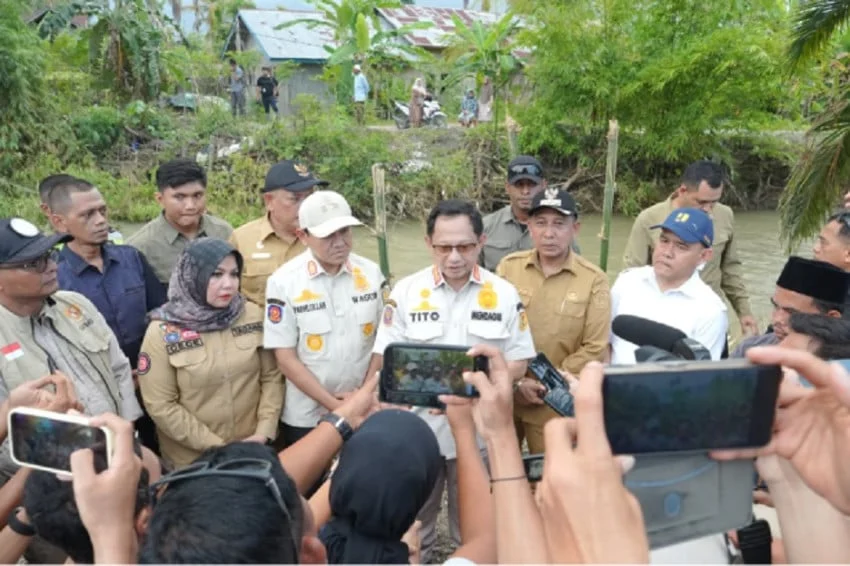
Minister of Home Affairs Muhammad Tito Karnavian, serving in his capacity as the Chairman of the Task Force for the Acceleration of Post-Disaster Rehabilitation and Reconstruction (PRR) in Sumatra, conducted a critical site inspection in Pidie Jaya Regency, Aceh, on November 3, 2026. The visit was prompted by a series of recurring flash floods that have severely compromised the integrity of river embankments and stalled ongoing infrastructure recovery efforts across the region. As the head of the national task force, Karnavian’s presence underscores the urgency of stabilizing vulnerable areas to prevent further economic and humanitarian losses in the province.
The Scope of the Inspection
The inspection focused on two primary locations that have become symbols of the persistent struggle against hydrological instability in Pidie Jaya. The first site was the embankment of the Krueng Meureudu River in Dayah Usen Village. Accompanied by local officials and technical experts, including the Head of the Sumatra I River Basin Organization (BWS), Asyari, Karnavian inspected the structural damage firsthand. The dialog between the minister and the BWS representative was centered on evaluating the technical failure points of the existing flood mitigation infrastructure and determining immediate remedial actions to prevent further erosion.
The second focal point of the visit was the Alue Keutapang River embankment. This area has been particularly susceptible to the recent wave of "secondary disasters"—events where initial flood damage is compounded by subsequent high-intensity rainfall, overwhelming the already weakened soil and temporary repair structures. During his trek along the riverbanks, Karnavian assessed the effectiveness of emergency containment measures and gathered data on how these repeated inundations are impacting the local agricultural sector. In the nearby village of Beuringen, he observed agricultural plots that had suffered severe degradation. While some of these lands have been repurposed for corn cultivation as a temporary survival strategy for local farmers, the loss of primary agricultural productivity remains a significant concern for the regional economy.
Contextualizing the Disaster Cycle in Aceh
Pidie Jaya has long been recognized as a region with high geological and hydrological vulnerability. The current crisis is not an isolated event but rather part of a broader, more complex narrative of environmental management challenges in the Sumatra region. Since the onset of the 2026 monsoon season, Sumatra has experienced erratic weather patterns characterized by extreme precipitation, which has repeatedly breached the capacity of existing drainage and river management systems.
The post-disaster recovery strategy, managed by the task force under Karnavian’s leadership, was originally designed to restore critical infrastructure—such as bridges, main arterial roads, and community housing—that was damaged by initial seismic or hydrological events earlier in the year. However, the arrival of recurring floods has forced a pivot in strategy. The "secondary disaster" phenomenon—where infrastructure is damaged, repaired, and then damaged again within a short timeframe—has significantly inflated the costs of reconstruction and extended the projected timelines for total recovery.
Chronology of the Recovery Strains
The current operational timeline for the PRR Task Force in Sumatra has been defined by high-intensity efforts to meet the 2026 deadline for project completion.

- Early 2026: Initial assessments of widespread infrastructure damage across Sumatra were completed, leading to the formation of the PRR Task Force.
- Mid-2026: The acceleration phase began, with the government allocating significant budget lines for the reconstruction of bridges and river embankments in Aceh and North Sumatra.
- October 2026: Heavy rainfall triggered severe flash floods in Pidie Jaya, leading to the saturation of previously repaired embankments.
- Early November 2026: Minister Tito Karnavian initiated a series of field inspections to evaluate the efficacy of the recovery projects and to coordinate a more robust response to the recurring flood threats.
The recurring nature of these floods suggests that standard repair methods may no longer be sufficient. The Ministry is now considering the integration of more resilient, climate-adaptive engineering designs for river embankments, moving away from simple restoration toward "building back better" to withstand the increasingly volatile climate conditions of the region.
Official Responses and Strategic Realignment
During his briefing, Minister Tito Karnavian emphasized that the government is fully aware of the frustration caused by the persistent damage. "Bencana susulan," or secondary disasters, he noted, act as a direct bottleneck to the state’s developmental objectives. When a jembatan (bridge) is rebuilt, only to have its foundation undermined by a subsequent flood, it reflects a deeper problem of land-use management and the urgency of upstream environmental restoration.
The task force has reiterated its commitment to finishing the 2026 project cycle, but there is a clear shift toward prioritizing structural longevity. Karnavian has urged the regional authorities to coordinate more closely with the central task force to ensure that maintenance protocols are strictly followed. Furthermore, the task force is looking at dredging operations and the potential for upstream reforestation to mitigate the velocity of water flow during heavy rainfall events.
Broader Implications for Sumatra’s Infrastructure
The situation in Pidie Jaya serves as a microcosm for the challenges facing the entire island of Sumatra. As the government attempts to stimulate economic growth through improved infrastructure, these climate-related setbacks threaten to derail fiscal planning. The financial implications are substantial; every time a structure is re-damaged, the government must divert funds from new development projects to emergency repairs, creating a cycle of reactive spending.
Economic analysts observe that the long-term sustainability of Aceh’s agricultural sector—which is heavily dependent on the stability of the Krueng Meureudu and surrounding river systems—is at stake. If farmers cannot rely on stable flood management, the risk of total abandonment of traditional paddy fields increases, leading to a potential shift in the regional demographic and economic landscape.
Future Outlook and Recommendations
As the PRR Task Force moves forward, the strategy is expected to evolve into a three-pronged approach:
- Immediate Infrastructure Hardening: Retrofitting existing embankments with high-durability materials capable of withstanding prolonged saturation.
- Integrated Water Resource Management: Improving coordination between the BWS and local agricultural offices to ensure that river management takes into account both flood prevention and irrigation needs.
- Risk-Based Spatial Planning: Encouraging local governments in Pidie Jaya to enforce stricter zoning laws that prevent residential or high-value agricultural development in the most flood-prone floodplains.
The visit by the Minister of Home Affairs is a signal that the central government is maintaining high-level oversight of the situation. While the immediate goal remains the completion of the 2026 projects, the broader objective is to create a resilient infrastructure network that can withstand the realities of an evolving climate. For the residents of Pidie Jaya, the outcome of these inspections will determine not only the safety of their homes but also the future viability of their livelihoods in one of Aceh’s most vital agricultural heartlands. The coming months will be critical, as the task force must balance the pressure of the end-of-year deadline with the necessity of ensuring that the work being done is durable enough to survive the next inevitable rainy season.