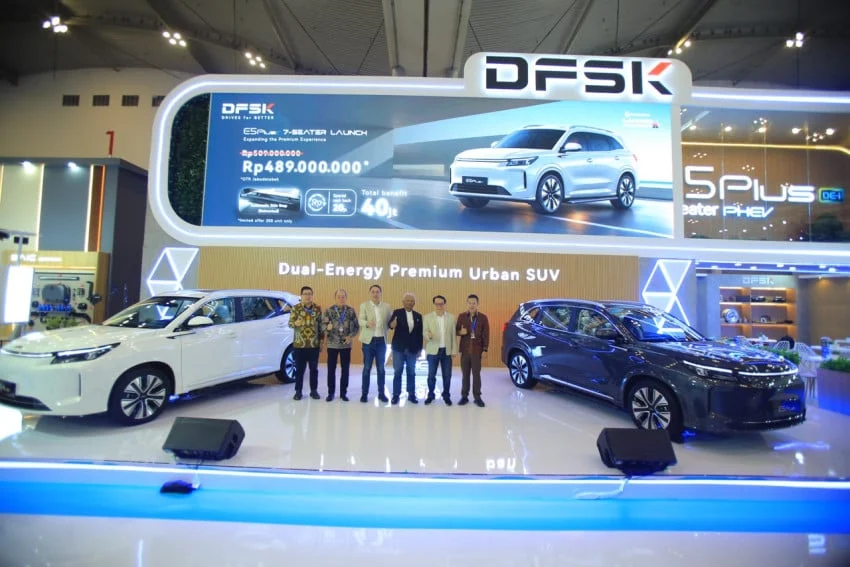
The Indonesian automotive landscape witnessed a significant shift toward family-oriented electrification as PT Sokonindo Automobile, the authorized brand holder of DFSK in Indonesia, officially introduced the DFSK E5 Plus 7-Seater. Unveiled to the public on Friday, November 20, 2026, at the prestigious Gaikindo Auto Week (GAW) 2026, held at the Indonesia Convention Exhibition (ICE) BSD City in Tangerang, this new variant directly addresses one of the most frequently cited critiques of its predecessor. Equipped with a robust 25 kWh battery and a dual-power source Plug-in Hybrid Electric Vehicle (PHEV) system, the newly configured sport utility vehicle (SUV) bridges the gap between eco-friendly commuting and the practical capacity required by large Indonesian families.
During the ongoing automotive exhibition, PT Sokonindo Automobile has set a special promotional price of Rp489 million on the on-the-road (OTR) Jakarta basis. This represents a notable reduction from its standard retail price of Rp509 million, a commercial strategy designed to incentivize early adopters and drive momentum during the exhibition period. By combining the dual advantages of electric vehicle efficiency and internal combustion engine flexibility with an expanded seating capacity, DFSK aims to capture a larger share of the fiercely competitive Indonesian electrified SUV market.
The Evolution of the E5 Plus: Listening to the Indonesian Consumer
The introduction of the seven-seater variant is a textbook example of manufacturer responsiveness to market demand. When PT Sokonindo Automobile first debuted the DFSK E5 Plus earlier in the year at the Gaikindo Indonesia International Auto Show (GIIAS) 2026, the vehicle drew substantial crowds and generated positive interest for its advanced PHEV architecture. However, detailed feedback collected from prospective buyers, automotive enthusiasts, and family-oriented consumers highlighted a specific limitation: the vehicle’s seating arrangement.
In its initial iteration, the E5 Plus was offered exclusively as a six-seater vehicle, featuring a second-row layout dominated by luxurious "captain’s seats." While this configuration provided exceptional individual comfort and a premium cabin feel—often associated with higher-end multi-purpose vehicles (MPVs)—it alienated buyers who required maximum passenger capacity. In a culture where extended family outings and communal travel are deeply ingrained, the inability to seat a seventh passenger proved to be a decisive hurdle for many potential household buyers.
DFSK’s product development and marketing teams closely monitored these consumer sentiments following the GIIAS 2026 showcase. Recognizing that the Indonesian mid-size SUV segment is heavily anchored in practical, multi-passenger utility, the company fast-tracked the development and localization adjustments needed to introduce a bench-style second-row configuration. The result is the E5 Plus 7-Seater, which successfully retains the upscale interior ambiance of the original model while expanding its capacity to accommodate larger family units without compromising on cargo flexibility.
Chronology of the Launch and Exhibition Milestones
The journey of the DFSK E5 Plus from a niche six-seater hybrid to a mainstream seven-seater contender reflects a calculated rollout strategy by PT Sokonindo Automobile throughout the 2026 automotive calendar.
The timeline began earlier in the year at GIIAS 2026, where the initial iteration of the E5 Plus made its grand debut. Positioned as an accessible PHEV option for Indonesian consumers who might still harbor "range anxiety" regarding purely battery-electric vehicles (BEVs), the SUV gained traction for its seamless integration of electric motor propulsion and traditional fuel backup. Despite its commercial appeal, sales teams and booth attendants at GIIAS consistently reported that a significant percentage of inquiries revolved around the availability of a third row capable of seating three occupants rather than two.
Acting swiftly upon this field data, DFSK engineers and regional product planners initiated structural interior adjustments. By redesigning the second-row seating architecture to incorporate a functional bench seat with a 60:40 split-folding mechanism, the company solved the passenger constraint issue while preserving easy access to the third-row seating zone.
This iterative process culminated on Friday, November 20, 2026, at the opening days of Gaikindo Auto Week (GAW) 2026 at ICE BSD City, Tangerang. PT Sokonindo Automobile utilized the GAW platform not merely as a sales exhibition, but as the official redemption stage for their previous design limitation. The dark grey E5 Plus 7-Seater displayed prominently at the DFSK booth immediately drew crowds, validating the brand’s decision to pivot toward a higher-capacity configuration. Alongside the vehicle reveal, the announcement of the special exhibition pricing of Rp489 million—valid exclusively throughout the duration of the GAW 2026 event—created an immediate sense of urgency among showgoers.
Technical Specifications and Dual-Power Architecture
Beneath its revised exterior and accommodating interior cabin, the DFSK E5 Plus 7-Seater remains an engineering showcase for accessible hybrid technology in Indonesia. At the core of the vehicle’s powertrain is a sophisticated Plug-in Hybrid Electric Vehicle (PHEV) system, paired with a substantial 25 kWh battery pack.

The PHEV configuration offers drivers the ultimate duality: zero-emission daily commuting within urban centers using pure electric power, combined with the reassuring long-distance touring capabilities of an internal combustion engine. This setup effectively eliminates range anxiety, a psychological barrier that continues to slow pure EV adoption in regions with developing charging infrastructures. Drivers can plug the vehicle in overnight or at public charging stations for daily office commutes, while retaining the freedom to embark on cross-provincial road trips without plotting itineraries strictly around fast-charging stations.
Performance-wise, the electric motor and internal combustion engine work in tandem to deliver responsive acceleration and optimized fuel efficiency. The 25 kWh battery provides a competitive all-electric range, allowing users to complete standard daily errands entirely on battery power. When the battery depletes or when the driver demands high-output performance—such as during highway overtaking or steep inclines—the gasoline engine seamlessly engages to supplement power or recharge the battery system on the move.
The interior packaging has been carefully optimized to house the larger battery pack without severely encroaching upon passenger legroom or cargo space. With the new seven-seater layout, the vehicle utilizes a flexible seating arrangement. The second row features sliding and folding functionalities, enabling effortless ingress and egress for passengers accessing the third-row bench. When the third row is not in use, it can be folded flat to create a capacious luggage area, ensuring that the vehicle transitions effortlessly between passenger transport and cargo-hauling duties.
Market Positioning and Pricing Strategy
Priced at an introductory promotional rate of Rp489 million (on-the-road Jakarta) during Gaikindo Auto Week 2026—before returning to its normal retail baseline of Rp509 million—the DFSK E5 Plus 7-Seater occupies a highly strategic niche in the domestic market.
In recent years, the Indonesian automotive sector has experienced a surge in electrified vehicle offerings, driven largely by government incentives, rising environmental awareness, and a growing desire for lower operational costs. However, many electrified SUVs and multi-purpose vehicles fall either into the ultra-luxury pricing tier—often exceeding Rp800 million—or are restricted to smaller, five-seater configurations that do not meet the demographic requirements of larger households.
By undercutting the psychological Rp500 million threshold during its exhibition launch, PT Sokonindo Automobile has positioned the E5 Plus 7-Seater as a high-value alternative to both traditional internal combustion engine SUVs and expensive imported hybrids. The vehicle targets middle-to-upper-income families, fleet operators looking to burnish their green credentials, and eco-conscious professionals who refuse to sacrifice passenger capacity for environmental sustainability.
Furthermore, the pricing strategy reflects DFSK’s broader ambitions to cement its market footprint in Indonesia. Rather than positioning electrification as an exclusive, high-end luxury, the brand is leveraging its manufacturing partnerships and supply chain efficiencies to deliver advanced powertrain technology at a competitive price point. This democratization of hybrid technology is expected to pressure competing brands to reevaluate their pricing and feature matrices, particularly within the bustling mid-size SUV segment.
Broader Implications for Indonesia’s Electrified Vehicle Ecosystem
The rollout of the DFSK E5 Plus 7-Seater carries broader implications for the trajectory of Indonesia’s automotive industry and its ambitious transition toward green mobility. As the Indonesian government continues to issue regulatory frameworks supporting low-carbon emission vehicles (LCEV), manufacturers are under increasing pressure to localize production and tailor their product portfolios to local consumer preferences.
The rapid turnaround from the six-seater launch at GIIAS to the seven-seater unveiling at GAW demonstrates the agility of modern automotive brands operating within the archipelago. It underscores the reality that consumer feedback in emerging EV markets can directly dictate product lifecycles and engineering modifications. For DFSK, listening to the market has transformed a well-reviewed product into a commercially viable family vehicle that addresses the unique socio-cultural dynamics of Indonesian transportation.
Moreover, the emphasis on PHEV technology rather than pure BEV solutions highlights a pragmatic transitional pathway for the Indonesian market. While public charging infrastructure in major metropolitan areas like Jakarta, Surabaya, and Bandung is expanding, secondary cities and rural travel routes still lack comprehensive fast-charging networks. Vehicles like the E5 Plus act as a vital bridge, acclimating consumers to the habit of plugging in their cars daily while maintaining the safety net of liquid fuel.
As Gaikindo Auto Week 2026 progresses, early reservation figures and foot traffic at the DFSK booth will serve as a bellwether for the market acceptance of family-oriented plug-in hybrids. If the response to the E5 Plus 7-Seater matches the enthusiasm generated during its debut, it could trigger a wider industry trend where multi-row seating becomes a mandatory inclusion for electrified SUVs entering the domestic market. PT Sokonindo Automobile has effectively raised the stakes, proving that consumer complaints, when met with decisive engineering and aggressive pricing, can catalyze a brand’s growth and redefine its market standing.