
JAKARTA — The Indonesian government has launched a sweeping national security operation to locate, inspect, and neutralize unauthorized surveillance equipment following a major wiretapping scandal targeting President Prabowo Subianto. The high-stakes investigation has already led to the identification and detention of several high-ranking security and law enforcement officials on preliminary allegations of treason.
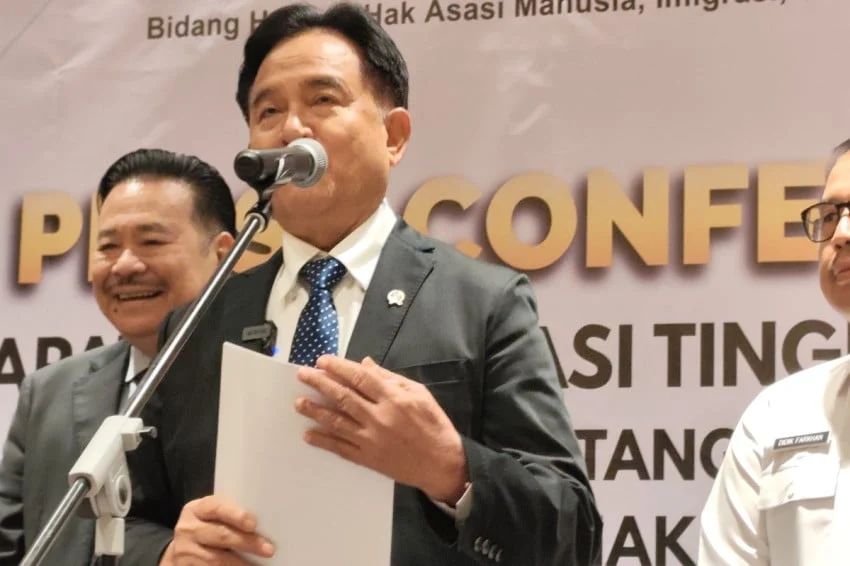
The developments came to light during a press briefing held in Central Jakarta by Coordinating Minister for Legal, Human Rights, Immigration, and Correctional Affairs Yusril Ihza Mahendra. Speaking to journalists, Minister Yusril detailed the gravity of the situation, confirming that state apparatuses are actively conducting sweeps across various institutional facilities to purge any rogue bugging devices that may remain operational in the aftermath of the security breach.
The unfolding political and legal crisis has sent shockwaves through Indonesia’s national security establishment. Among those implicated in the investigation are former Head of the Presidential Staff Office (KSP) and former Indonesian National Police (Polri) Chief General Listyo Sigit Prabowo, alongside three high-ranking active-duty police officers: Inspector General Ahrie Sonta Nasution, Inspector General Eko Hadi Santoso, and Inspector General Slamet Uliandi. The inclusion of figures who previously held immense authority within the nation’s security apparatus has turned this espionage investigation into one of the most unprecedented institutional crises in modern Indonesian history.
Chronology of the Investigation and Discovery
The origins of the investigation trace back to an internal security report filed by concerned individuals who uncovered evidence of unauthorized electronic surveillance targeting the head of state. According to Minister Yusril, the case officially commenced when a formal complaint was lodged with law enforcement authorities, prompting an immediate internal security probe.
"There was a party that reported the wiretapping case to the police. Because of that report, an internal investigation was immediately conducted," Yusril explained during Monday’s press briefing.
Initial intelligence and cyber-forensic findings revealed that sophisticated interception tools—typically restricted to authorized intelligence and counter-terrorism operations—had been covertly deployed. Investigators soon traced the operational footprint of the surveillance network, leading directly to the identification of the high-profile suspects. As the scope of the investigation widened, the legal categorization of the offense escalated dramatically. Rather than being treated strictly as a violation of telecommunications privacy or illegal espionage, the actions of the implicated officials were classified under the serious criminal charge of treason (makar), reflecting the perceived existential threat posed by the surveillance of the nation’s highest executive office.
Government Response and Preventive Sweeps
In response to the security breach, the administration of President Prabowo Subianto has moved swiftly to contain the fallout and reinforce the integrity of state communications infrastructure. Minister Yusril emphasized that while criminal investigations and subsequent legal proceedings will proceed without compromise, the executive branch is equally focused on implementing rigorous preventative measures.

"To anticipate things moving forward, it is certainly being thought about, but the criminal investigations that are currently underway will continue to be carried out," Yusril stated.
The ongoing nationwide sweep is designed to audit all electronic interception hardware held by law enforcement, military, and intelligence agencies. The primary objective is to establish strict regulatory oversight, ensuring that sensitive surveillance equipment cannot be co-opted, duplicated, or utilized outside officially sanctioned legal frameworks. Analysts note that the misuse of state-owned interception technology represents a critical vulnerability in national security, highlighting the urgent need for tighter administrative controls over classified operational assets.
Implications for National Security and Institutional Reform
The involvement of former and active high-ranking police generals in an alleged treason plot involving the surveillance of a sitting president carries profound implications for Indonesia’s ongoing governance and institutional reform efforts. For decades, the nation has worked to strengthen democratic civilian control over its military and police forces, ensuring that powerful state apparatuses remain strictly accountable to the constitutional chain of command.
The revelation that sophisticated intelligence-gathering tools could be turned inward against the executive branch exposes potential gaps in internal oversight mechanisms. Security experts have pointed out that modern authoritarian or subversive threats do not always manifest as armed rebellions; instead, they can involve the quiet compromise of institutional infrastructure, information warfare, and unauthorized intelligence collection designed to exert leverage over political leadership.
Furthermore, the scandal poses a delicate challenge for the Indonesian National Police (Polri) and the broader legal establishment, which must now navigate the prosecution of some of their most senior former leaders. Public confidence in the impartiality and integrity of the nation’s justice system hangs in the balance as investigators prepare to build a robust evidentiary file for trial.
Looking Ahead
As the investigation progresses, the Ministry of Law, Human Rights, Immigration, and Correctional Affairs, in collaboration with other security stakeholders, is expected to introduce new protocols governing the procurement, custody, and deployment of interception technology. These measures will likely include stricter statutory definitions for the authorized use of wiretapping tools, independent audits of intelligence hardware, and heavier penalties for personnel who abuse their access to classified systems.
While the legal battles in the courtroom are only just beginning, the immediate priority for the Indonesian government remains clear: securing the foundational pillars of state leadership and restoring absolute trust in the security architecture that protects the nation’s highest office.
