
The road to the much-anticipated Honda Bikers Day (HBD) 2026 served as the ultimate proving ground for a select group of 20 automotive and lifestyle journalists, who were given the opportunity to thoroughly evaluate the capabilities of the New Honda ADV160. Spanning a demanding route of approximately 151 kilometers across Central Java, this two-day media ride offered a comprehensive test of endurance, performance, and engineering. The journey began in the bustling urban landscape of Semarang and culminated at the grand gathering site in Ambarawa, forcing the exploratory cruiser scooter to navigate a diverse and unforgiving terrain characterized by steep inclines, sharp hairpin turns, dense city traffic, and rural pathways.
Conducted over Friday, October 23, and Saturday, October 24, 2026, the expedition was methodically divided into two distinct stages. This multi-stage format allowed riders to experience the motorcycle’s dynamic versatility across varying environments, ranging from congested metropolitan arterials and winding mountain passes to the serene yet challenging tea plantations of Wonosobo. As automotive manufacturers increasingly design vehicles to bridge the gap between urban commuting and adventure touring, this media excursion provided critical insights into how the New Honda ADV160 performs under real-world conditions, blending rigorous mechanical testing with the camaraderie intrinsic to Indonesia’s vibrant motorcycle culture.
A Rigorous Two-Day Itinerary Across Central Java
The journey commenced on Friday morning at the Astra Motor Safety Riding Center in Semarang, where the contingent of 20 journalists received a comprehensive briefing on safety protocols and route specifics before setting off. Initially, the riders faced the dense and unpredictable traffic typical of Semarang’s suburban peripheries. Navigating through congested intersections and tight urban corridors tested the scooter’s low-end agility and rider ergonomics, proving its capability as a daily commuter vehicle designed to manage urban friction with ease.
Leaving the urban sprawl behind, the convoy transitioned toward the western regencies, passing through the Boja and Patean districts in Kendal. Here, the road topography began to shift dramatically. The smooth asphalt gave way to undulating landscapes, leading the group to their first significant waypoint at the scenic Curug Sewu area in Patean. This initial leg served as a transition zone, preparing both riders and machines for the punishing mountain ranges that lay ahead.
As the route pushed deeper into the Central Javan highlands, the severity of the terrain escalated. The path winding toward Telaga Menjer and the sprawling Tambi tea plantations in Wonosobo presented a continuous sequence of steep ascents, rapid descents, and cambered, winding corners. While the surrounding panorama—featuring sweeping valleys, dense indigenous forests, and emerald-green tea terraces—offered a breathtaking visual backdrop, it demanded absolute concentration from the riders. The changing road surfaces, combined with localized construction zones around Muntung and Tambi featuring uneven patches of gravel and asphalt, pushed the scooter’s chassis and suspension systems to their functional limits.
The first day’s riding concluded with a well-deserved respite at Mota Coffee, overlooking the tranquil waters of Telaga Menjer, where the journalists could analyze vehicle performance against the backdrop of Wonosobo’s natural beauty. The evening wrapped up at Napoleon Tambi, providing a logistical hub for rest and vehicle maintenance ahead of the second day’s challenges.
Day two shifted the objective toward the final destination: the sprawling field of Lapangan Panglima Besar Jenderal Sudirman in Ambarawa, the official epicentre of Honda Bikers Day 2026. Departing from Tambi, the convoy navigated through the historical regencies of Temanggung and Kaloran. This homeward leg reintroduced technical riding challenges, featuring tight switchbacks and descending mountain passes that tested braking stamina and chassis stability. Following the rural descents, the riders re-entered congested urban traffic as they approached Ambarawa, completing the 151-kilometer journey upon arrival at the HBD 2026 venue.
Mechanical Prowess and Powertrain Performance
At the heart of the New Honda ADV160’s performance during this gruelling test was its sophisticated powertrain. The scooter is equipped with a 156.9 cc, 4-valve, single-cylinder engine featuring enhanced Smart Power Plus (eSP+) technology, engineered to optimize combustion efficiency while reducing friction. This modern powerplant churns out a maximum power output of 16 PS (approximately 11.8 kW) at 8,500 rpm and delivers a peak torque of 14.7 Nm at 6,500 rpm.
Throughout the ascent toward the Wonosobo highlands, this engine calibration proved crucial. The torque-heavy delivery at mid-range RPMs provided the necessary thrust to conquer steep inclines without requiring excessive throttle input, ensuring smooth power delivery even when transitioning from a standstill on an upward slope. Furthermore, the electronic fuel injection (PGM-FI) system maintained precise air-fuel ratios despite changes in altitude and barometric pressure as the convoy climbed higher into the mountains.
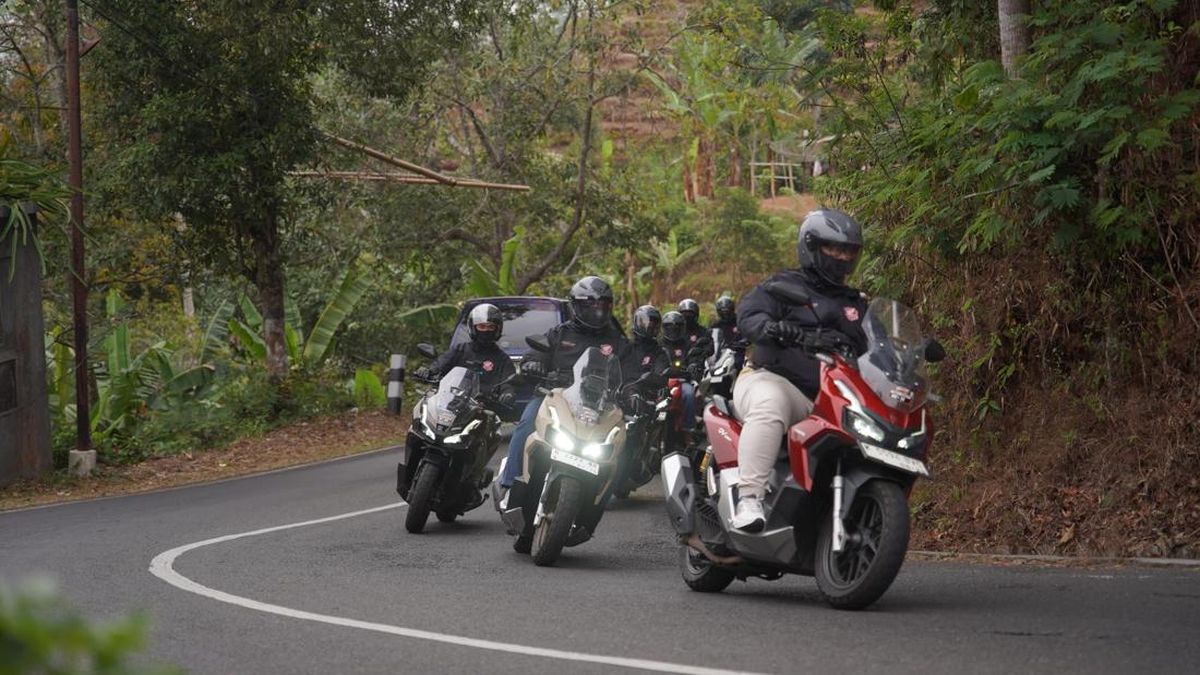
However, conquering the diverse terrain was not merely a matter of raw engine output. The journalists noted that navigating the unpredictable topography required a delicate balance of smooth throttle modulation and defensive riding techniques. The transition from sudden steep climbs to sharp, blind corners necessitated precise speed management, highlighting the importance of the scooter’s responsive throttle connection and predictable engine braking.
Advanced Chassis, Suspension, and Braking Dynamics
Beyond the engine, the chassis architecture and suspension components of the New Honda ADV160 played a pivotal role in absorbing the shocks of Central Java’s varied roadways. The front end relies on robust telescopic forks, while the rear utilizes twin shock absorbers complete with separate sub-tank reservoirs. This configuration was thoroughly tested along the broken asphalt and repair zones near Muntung and Tambi. The sub-tank rear suspension effectively dissipated high-frequency impacts, minimizing rider fatigue over long stretches of rough terrain and maintaining rear-wheel traction during cornering over undulating surfaces.
Ergonomics also contributed significantly to overall comfort during the multi-hour ride. The contoured seat design, coupled with the dual-step floorboard configuration—allowing for both upright and feet-forward riding postures—helped alleviate lower back and leg strain across the 151-kilometer route.
Handling characteristics were further augmented by the staggered wheel setup, featuring a 14-inch front wheel paired with a 13-inch rear wheel. This configuration bridges the gap between high-speed stability and nimble urban maneuverability. The larger front wheel easily rolled over debris and surface imperfections, while the shorter rear setup maintained agile turning characteristics in tight hairpins.
Safety technology featured prominently during the evaluation, particularly on the variant equipped with an Anti-lock Braking System (ABS). When descending wet or loose mountain passes, the ABS prevented wheel lock-up during sudden braking applications, instilling confidence in the riders. Additionally, the Honda Selectable Torque Control (HSTC) system actively monitored wheel-speed differentials, intervening subtly to mitigate rear-wheel slip when accelerating over patches of gravel or slick road markings encountered during the rural transit stages.
Contextualizing Honda Bikers Day 2026
The staging of this media ride is deeply intertwined with the broader corporate and cultural significance of Honda Bikers Day (HBD). As one of the largest annual gatherings for motorcycle enthusiasts in Southeast Asia, HBD serves as a unifying festival for hundreds of thousands of Honda owners, club members, and independent riders from across the archipelago. The 2026 edition, anchored at Ambarawa, continues a long-standing tradition of fostering solidarity, brotherhood, and brand loyalty among Indonesian motorcyclists.
For PT Astra Honda Motor (AHM), the event represents more than just a consumer festival; it is a vital platform for community engagement and product validation. By routing a media test ride directly into the lead-up of the main event, the manufacturer strategically demonstrated the touring credentials and rugged reliability of the ADV160 to the public through independent journalistic assessments.
Industry Implications and Market Outlook
The successful completion of the Semarang-Ambarawa route by the press contingent underscores the ongoing evolution of the domestic scooter market in Indonesia. The sub-160cc adventure-scooter segment has witnessed substantial growth, driven by consumers who demand vehicles that offer both daily commuting practicality and weekend touring capabilities.
The performance of the New Honda ADV160 under rigorous real-world conditions reinforces its market positioning as a multi-purpose machine capable of transcending traditional urban boundaries. As infrastructure development continues to connect remote regions with major economic hubs across the archipelago, motorcycles capable of handling mixed terrain—combining automated convenience with robust mechanical architecture—are expected to capture an increasing share of consumer preference.
Ultimately, the journey to Honda Bikers Day 2026 provided a definitive showcase of engineering adaptability. By merging technical evaluation with the cultural heartbeat of Indonesia’s motorcycling community, the event highlighted not only the resilience of the New Honda ADV160 but also the enduring spirit of adventure that defines modern Indonesian ridership.
