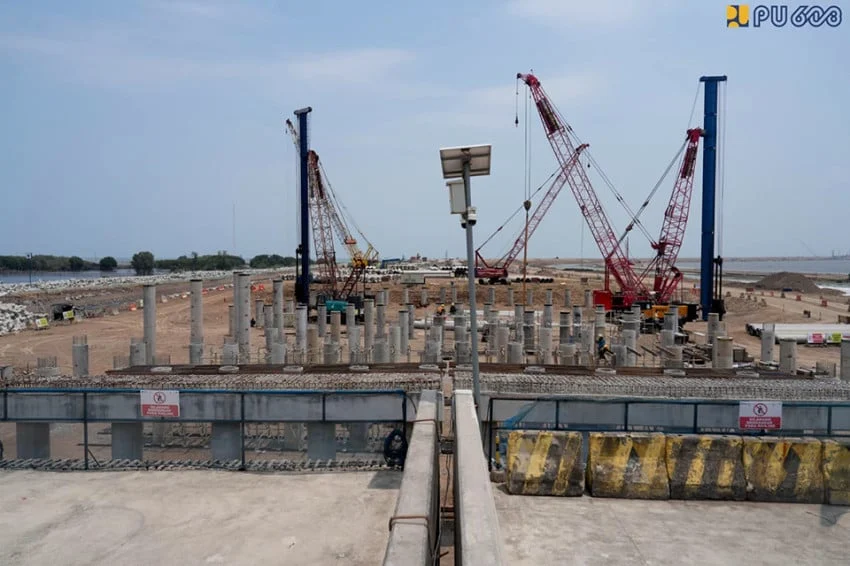
The construction of the Semarang-Demak Toll Road Section 1 spanning Kaligawe to Sayung has officially reached a significant milestone, with physical progress touching 79.42 percent as of October 22, 2026. Spearheaded by the Ministry of Public Works (PU), this strategic infrastructure project is designed not only to serve as a vital transportation corridor connecting major economic hubs along the northern coast of Central Java but also to function as an integrated coastal embankment system aimed at mitigating chronic tidal flooding in the region.
Ministry of Public Works officials have reaffirmed their commitment to finishing the ambitious undertaking by the end of 2027. The project, which marries advanced civil engineering with environmental defense mechanisms, addresses some of the most complex geographical and geological challenges faced by modern Indonesian infrastructure development. By combining a high-speed toll road with a functional sea wall, the government seeks to kill two birds with one stone: alleviate severe traffic bottlenecks on the existing national arterial road and protect densely populated coastal zones from rising sea levels and land subsidence.
Current Status and Package Breakdown
Progress across the various packages making up Section 1 remains robust, varying slightly depending on the specific site conditions and engineering complexities encountered. According to official data released by the Ministry of PU, the construction is divided into three distinct work packages, each assigned to joint ventures comprising prominent state-owned construction enterprises and international partners.
Package 1A currently records the highest completion rate, standing at an impressive 97.49 percent. This segment covers the crucial Kaligawe and Sayung areas, encompassing the construction of the Kaligawe bridge, multiple elevated roadways, and comprehensive supporting infrastructure. Much of the work on Package 1A has entered its final phases, with elevated structures successfully linked to the subsequent segments.
Meanwhile, progress on Package 1B has advanced to 75.22 percent, while Package 1C records a steady 75.68 percent completion rate. These latter packages involve intricate engineering works, particularly involving soft soil stabilization techniques and the integration of the marine barrier design. Because large portions of the alignment traverse swampy terrain and open sea waters, construction teams have had to employ specialized methodologies, such as bamboo mattress installations, vertical drain systems, and extensive pre-loading periods, to ensure long-term structural stability before laying the final pavement layers.
Ministerial Assessment and Engineering Challenges
Minister of Public Works Dody Hanggodo recently evaluated the ongoing development, expressing satisfaction with the overall trajectory of the project. He emphasized that while construction speed is a priority, structural integrity cannot be compromised by rushing through mandatory geological consolidation phases.
"For the progress, we are already at 79.4 percent. Actually, it is completely on the track. So far, it looks good. All stakeholders are providing full support, and there are no significant issues," Dody stated in an official release. He noted that maintaining an open line of communication between contractors, regional governments, and local communities has been vital in preventing the kind of bureaucratic delays that often plague mega-projects of this scale.
The unique nature of the Semarang-Demak Toll Road—often dubbed a "sea toll road"—demands meticulous planning. Constructing heavy transportation infrastructure over marine clay and deep soft soils requires prolonged consolidation to prevent differential settlement, a phenomenon where uneven sinking of the ground can compromise the highway’s foundation. Engineers have had to balance the political and economic pressures for an early opening with the immutable laws of soil mechanics, ensuring that the structural lifespan of the toll road extends for decades without requiring catastrophic remediation.
Background Context and Historical Timeline
The conception of the Semarang-Demak Toll Road dates back over a decade, born out of an urgent necessity to address the compounding crises of severe traffic congestion along the Java North Coast (Pantura) route and the alarming environmental degradation affecting coastal Semarang and Demak. For years, motorists traveling between Semarang and Surabaya faced hours of delays navigating the heavily congested Kaligawe corridor, an area notoriously vulnerable to tidal floods locally known as rob.
The project was officially initiated under the previous administration as part of the National Strategic Projects (PSN) portfolio. The overarching initiative is divided into two primary sections: Section 1 (Kaligawe-Sayung), spanning approximately 10.64 kilometers, which is government-funded and acts as the combined toll road and coastal dike; and Section 2 (Sayung-Demak), spanning 16.31 kilometers, which is built by an enterprise entity (Badan Usaha Jalan Tol – BUJT) and has already been completed and operationalized to ease regional traffic flow.
The genesis of Section 1 faced numerous hurdles, ranging from complex land acquisition disputes and relocation negotiations with local fishermen to technical debates over the most effective design to hold back tidal surges while accommodating maritime traffic. The integration of the toll road into the Semarang City tidal flood defense system required synchronizing the Ministry of PU’s efforts with local municipal planning, the state electricity company, and port authorities to ensure that drainage patterns and shipping lanes remained unhindered.
Socio-Economic Implications and Regional Impact
The completion of the Semarang-Demak Toll Road Section 1 by late 2027 is expected to usher in a transformative era for Central Java’s economy. Economists and regional planners anticipate several major impacts once the entire 26.95-kilometer toll road is fully operational.
First, logistics efficiency will experience a dramatic surge. The Kaligawe intersection has historically served as a notorious bottleneck where heavy freight trucks moving between the industrial estates of Central Java and the port of Tanjung Emas crawl through floodwaters. By elevating the highway and bypassing vulnerable lowland stretches, logistics costs are projected to drop significantly, enhancing the competitiveness of Central Java’s manufacturing sector.
Second, the environmental dividends cannot be overstated. The coastal embankment integrated into the toll road infrastructure is engineered to protect thousands of hectares of residential neighborhoods, industrial zones, and agricultural land from chronic tidal inundation. Without this barrier, large swathes of urban Semarang and Demak faced the grim prospect of permanent submersion over the coming decades due to a combination of rising sea levels, excessive groundwater extraction, and rapid land subsidence. Property values in the affected corridors have already begun stabilizing as investor confidence rebounds in response to the visible progress of the sea wall.
Third, the project serves as a blueprint for future climate-resilient infrastructure in Indonesia. As an archipelagic nation facing acute vulnerabilities to global climate change and coastal erosion, the lessons learned from the engineering feats of the Semarang-Demak project—particularly the interplay between marine geotechnics and highway construction—will likely guide similar infrastructure interventions in other flood-prone coastal cities such as Jakarta, Pekalongan, and Surabaya.
Outlook and Future Steps
Looking ahead, the final stretch toward the late 2027 deadline requires sustained coordination among all involved stakeholders. Contractors are currently ramping up work on the remaining segments of Packages 1B and 1C, focusing on pavement installation, electronic toll collection systems integration, and environmental finishing touches along the coastal boundary.
As the construction enters its home stretch, the Ministry of Public Works has vowed to maintain rigorous quality control standards. With structural milestones consistently being met and strong inter-institutional backing, the Semarang-Demak Toll Road stands out as a triumph of modern engineering designed to secure both the economic mobility and the environmental safety of Central Java for generations to come.