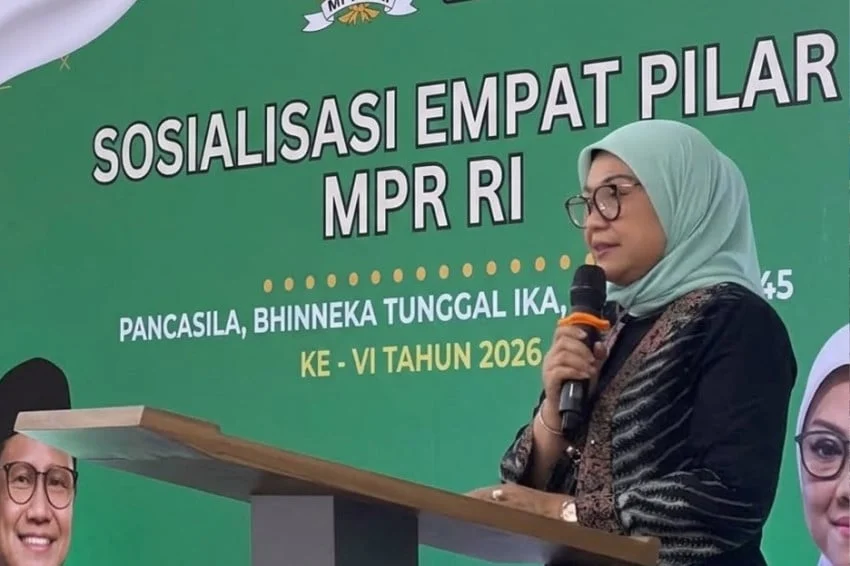
The vibrant and multifaceted social landscape of Jakarta requires a conscious, continuous commitment to inclusivity, dialogue, and mutual respect among its millions of residents. Addressing this imperative, Ida Fauziyah, a prominent member of the People’s Consultative Assembly (MPR) representing the National Awakening Party (PKB) faction, spearheaded a comprehensive dissemination event focused on the Four Pillars of the Nation. Held at the Mampang Sports Hall (GOR Mampang) in South Jakarta, the gathering served as a vital platform to engage the younger demographic, community leaders, and local stakeholders in a profound dialogue regarding national identity, civic responsibility, and the preservation of Indonesia’s foundational ideology.
Against the backdrop of a rapidly modernizing metropolitan city where rapid urbanization continuously tests the social fabric, the event drew a diverse cross-section of society. Attendees included religious figures, youth organization leaders, women’s association representatives, neighborhood administrators (RT/RW), high school students, and university scholars. Through structured discussions and interactive sessions, the program aimed to translate abstract constitutional concepts into actionable civic principles, emphasizing that the preservation of pluralism is not merely a government responsibility but a collective societal duty.
The Core Message: Grounding the Nation in Pancasila and Pluralism
During the proceedings, Ida Fauziyah emphasized that the Four Pillars of the Nation—comprising Pancasila, the 1945 Constitution of the Republic of Indonesia (UUD 1945), the Unitary State of the Republic of Indonesia (NKRI), and the national motto of Bhinneka Tunggal Ika (Unity in Diversity)—must serve as the definitive compass for daily life. She highlighted that these pillars are not relics of political history, but rather living, breathing frameworks that dictate how citizens interact within an increasingly interconnected world.
"These four pillars constitute the indispensable foundation of our national and state life," Ida stated in an official release detailing the event. She underscored that in a city as cosmopolitan as Jakarta, where individuals from hundreds of ethnic backgrounds, various religious denominations, and diverse socioeconomic strata live in close proximity, the potential for social friction exists alongside the immense potential for cultural enrichment. Consequently, proactive civic education is essential to inoculate communities against the corrosive impacts of radicalism, sectarianism, and polarization.
Chronology and Background of the MPR Four Pillars Mandate
The dissemination of the Four Pillars of the Nation is a formalized, ongoing nationwide mandate assigned to members of the MPR. Stemming from the realization that post-reformasi Indonesia required a renewed commitment to national integration, the MPR initiated this intensive educational campaign over a decade ago. Lawmakers are constitutionally mandated to regularly return to their respective constituencies to conduct these socialization events, bridging the gap between state philosophy and grassroots understanding.
Preparations for the South Jakarta event began several weeks prior, coordinated by Ida Fauziyah’s legislative office in collaboration with local community boards in the Mampang district. The selection of Mampang as the venue was strategic; as a densely populated area characterized by high mobility and a dynamic demographic mix, it represents a micro-cosm of Jakarta’s broader sociological challenges.
On Saturday, September 19, 2026, registration commenced at 08:00 Western Indonesia Time (WIB), welcoming hundreds of participants who adhered strictly to local community event protocols. The formal program opened with the singing of the national anthem, Indonesia Raya, setting a solemn and patriotic tone. Following introductory remarks from local civic leaders, Ida delivered her keynote address, which spanned nearly two hours, blending formal constitutional exposition with relatable, contemporary examples of social harmony and conflict resolution. The event concluded in the afternoon with an active question-and-answer session, during which students and neighborhood representatives voiced their perspectives on local tolerance challenges.
Demographic Realities and Sociological Implications for Jakarta
To fully comprehend the gravity of Ida Fauziyah’s message, one must examine the unique demographic and sociological landscape of Jakarta. As the nation’s premier economic hub and former political capital, Jakarta attracts hundreds of thousands of migrants annually from every corner of the archipelago. This constant influx generates an environment of hyper-diversity, where traditional communal bonds are often replaced by fast-paced urban individualism.
Data from the Central Statistics Agency (BPS) and regional population records consistently highlight Jakarta’s status as a melting pot of ethnicities—including Betawi, Javanese, Sundanese, Batak, Minangkabau, Chinese-Indonesian, and many others. While this plurality is a source of immense cultural dynamism, it simultaneously presents administrative and social challenges. Historical precedents in various urban centers across Southeast Asia demonstrate that rapid urbanization, economic disparities, and lack of intercultural dialogue can occasionally be exploited by extremist ideologies or identity politics.
By targeting the younger generation—specifically Gen Z and Millennials—Ida Fauziyah’s initiative addresses a critical demographic imperative. Young urbanites in Jakarta are heavily exposed to global digital currents, social media algorithms, and transnational ideologies. While this digital connectivity fosters global awareness, it also exposes impressionable minds to polarizing rhetoric and historical revisionism. Imbuing youth with a robust understanding of Bhinneka Tunggal Ika and constitutional nationalism provides a critical cognitive defense mechanism against divisive narratives.
Legislative Context and Broader Parliamentary Responses
As a senior legislator currently serving on Commission VI of the House of Representatives (DPR RI)—which oversees trade, industry, cooperatives, small and medium enterprises, state-owned enterprises, and investment—Ida Fauziyah bridges economic policy with socio-cultural governance. Observers note that economic development and social stability are deeply intertwined; foreign and domestic investments, consumer confidence, and commercial productivity in Jakarta rely heavily on a stable, predictable, and harmonious security environment.
Reactions from fellow parliamentarians and political analysts regarding the continuous rollout of the Four Pillars socialization have been largely positive, though debates persist regarding methodology. While traditional lecture-style dissemination remains the administrative baseline, progressive political analysts argue that modernizing these campaigns through digital platforms, interactive workshops, and arts-based cultural festivals is essential to maintain youth engagement.
In response to such observations, representatives from various political factions within the MPR have increasingly adopted multimedia approaches, interactive dialogue panels, and peer-to-peer mentoring models. The inclusion of diverse civil society actors—such as the RT/RW administrators present at the Mampang event—ensures that the messaging penetrates the foundational units of community governance. RT and RW leaders often act as the first responders to neighborhood disputes, making their fluency in constitutional principles of tolerance and due process invaluable for local conflict mitigation.
Analyzing the Long-Term Impact on National Resilience
The broader impact of consistent ideological dissemination extends far beyond localized civic meetings. National resilience is fundamentally built upon the civic literacy of the populace. When citizens, particularly in metropolitan nerve centers like Jakarta, internalize the principles of Pancasila—belief in the Almighty, just and civilized humanity, Indonesian unity, democracy led by the wisdom of deliberations, and social justice—the likelihood of systemic social unrest diminishes significantly.
Furthermore, adherence to the 1945 Constitution reinforces the rule of law, ensuring that disputes are channeled through institutional, legal mechanisms rather than extrajudicial confrontations. The concept of the Unitary State of the Republic of Indonesia (NKRI) acts as an ideological bulwark against separatism and regional fragmentation, maintaining a cohesive national identity that transcends ethnic, religious, and geographic boundaries.
As Indonesia navigates its trajectory toward its centennial in 2045, the preservation of these foundational tenets assumes paramount importance. Policymakers, educators, and community leaders face the ongoing challenge of making these abstract constitutional ideals resonate with the lived realities of a digital-native generation. Initiatives such as the one led by Ida Fauziyah in South Jakarta provide a blueprint for grassroots engagement, demonstrating that maintaining national unity requires deliberate, sustained, and inclusive communication.
Conclusion and Future Outlook
The dissemination of the Four Pillars of the Nation at GOR Mampang underscores the enduring relevance of Indonesia’s foundational philosophy in contemporary urban life. By actively mobilizing youth, religious leaders, and grassroots administrators, lawmakers can foster a resilient social ecosystem capable of weathering the complexities of modern metropolitan existence.
As Jakarta continues to evolve as a global city, the synthesis of economic progress and cultural inclusivity will remain the ultimate determinant of its societal health. Through continuous education, interfaith dialogue, and steadfast adherence to Pancasila, UUD 1945, NKRI, and Bhinneka Tunggal Ika, leaders and citizens alike work to ensure that diversity remains a source of collective strength rather than division.