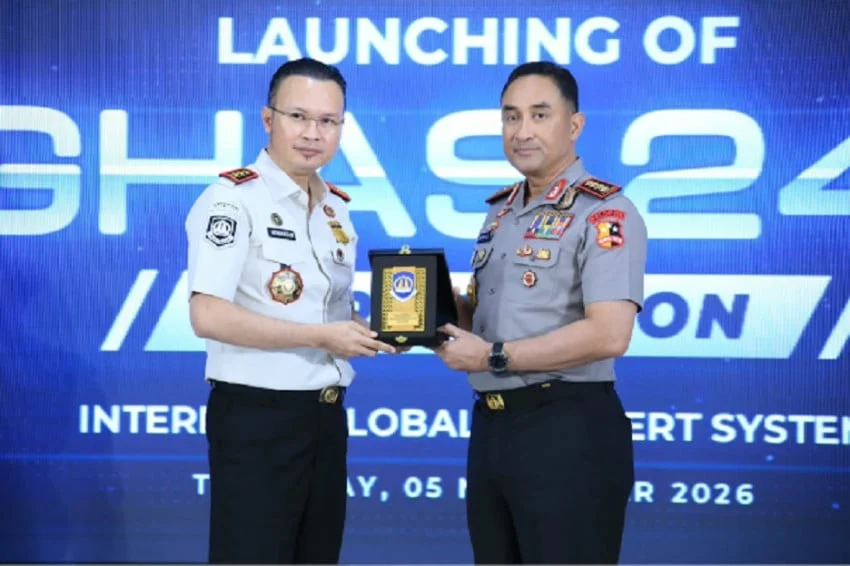
JAKARTA — In a decisive move to fortify national security and close critical loopholes at international borders, the Indonesian National Police (Polri) and the Directorate General of Immigration have officially integrated their surveillance frameworks through the deployment of the Interpol Global Hit Alert System, known as I-GHAS 24/7. The landmark collaborative system was formally launched by the Chief of the Indonesian National Police, General Suyudi Ario Seto, alongside the Director General of Immigration, Hendarsam Marantoko, during a high-profile ceremony held at the Rupattama Building within the National Police Headquarters in Jakarta on Thursday, November 5, 2026.
The integration of the I-GHAS 24/7 application marks a transformative leap in Indonesia’s cross-border law enforcement capabilities. By creating a direct, real-time digital bridge to Interpol’s vast global database encompassing 196 member countries, frontline immigration and law enforcement officers can now conduct instantaneous identity verifications on travelers. The system is engineered to flag high-risk individuals, international fugitives, and transnational criminal syndicates attempting to enter or exit Indonesian territory, drastically reducing the procedural delays that have historically hindered transnational crime investigations.
Background Context and Strategic Imperatives
Transnational crime, human trafficking, narcotics smuggling, and financial fraud have grown increasingly sophisticated, with criminal networks frequently exploiting globalization and porous border controls to evade justice. Historically, the verification of foreign nationals against international criminal databases relied on fragmented communication channels, periodic bulletin updates, and bureaucratic procedures that could span hours or even days. During these critical windows of delay, suspects often succeeded in passing through border checkpoints, blending into local populations, or fleeing to secondary jurisdictions.
Recognizing these systemic vulnerabilities, the International Criminal Police Organization (Interpol) developed I-GHAS 24/7 to provide participating nations with immediate, automated alerts whenever a flagged passport or biometric profile is scanned at an official port of entry. The adoption of this system by Indonesian authorities underscores a broader strategic shift toward intelligence-led policing and proactive border management. Rather than reacting to crimes after suspects have successfully entered the country, Polri and the Directorate General of Immigration aim to neutralize threats at the outermost perimeter of the nation’s sovereignty.
Chronology of the Integration Initiative
The groundwork for the implementation of I-GHAS 24/7 in Indonesia involved extensive inter-agency coordination, technical integration, and protocol harmonization over preceding months. The initiative was spearheaded by the International Relations Division of the Indonesian National Police (Divhubinter), which worked closely with immigration IT specialists to ensure seamless data synchronization between domestic border management systems and Interpol’s centralized servers in Lyon, France.
Following successful system trials and stress tests at major international gateways—including Soekarno-Hatta International Airport in Jakarta and Ngurah Rai International Airport in Bali—the leadership of both agencies greenlit the official nationwide rollout. The formal inauguration on November 5, 2026, cemented the operational framework, establishing standard operating procedures (SOPs) for joint intervention teams stationed at strategic air, sea, and land borders.
Official Perspectives and Inter-Agency Collaboration
During the launch event, Directorate General of Immigration Hendarsam Marantoko emphasized the profound operational value of the new system, praising the proactive initiative undertaken by the National Police.
"The initiative from Divhubinter to establish I-GHAS 24/7 is something we welcome with the highest enthusiasm," Hendarsam stated during his official address. "It redefines how our collaborative communication channels function, particularly in sensitive border regions. Through this system, data exchange is no longer hindered by administrative bottlenecks; it is connected via a mechanism that is genuinely more precise, faster, and remarkably accurate."
General Suyudi Ario Seto echoed these sentiments, stressing that national security in the modern era requires absolute synergy between domestic law enforcement and international intelligence networks. The police chief noted that transnational syndicates often view developing nations as safe havens due to perceived lapses in border oversight. The activation of I-GHAS 24/7 serves as an unmistakable deterrent, signaling that Indonesia’s borders are tightly monitored and fully synchronized with global security grids.
Technical Functionality and Operational Workflow
The I-GHAS 24/7 application operates on an automated matching algorithm. When a traveler presents their passport at an immigration counter equipped with the integrated system, the document’s metadata and traveler biometrics are instantaneously queried against Interpol’s red notices, blue notices, and stolen or lost travel documents (SLTD) database.
If a match is detected—colloquially referred to as a "hit"—the system immediately triggers an alert on the immigration officer’s terminal, alongside a simultaneous notification sent directly to the National Central Bureau (NCB) Interpol Indonesia within Polri. Within seconds, frontline officers receive specific operational directives regarding how to handle the individual, whether through secondary inspection, immediate detention, or coordinated arrest in collaboration with specialized tactical units.
Crucially, the "24/7" designation highlights the round-the-clock availability of the system. Given that international flights and maritime vessels operate continuously across Indonesia’s vast archipelago, uninterrupted monitoring is vital. The system eliminates vulnerabilities associated with night shifts or weekend gaps in manual verification processes.
Broader Implications for National Security and Global Standing
The deployment of I-GHAS 24/7 carries significant implications for Indonesia’s domestic stability and its international reputation as a responsible global partner in crime prevention.
- Enhanced Compliance with Global Standards: By integrating deeply with Interpol’s infrastructure, Indonesia demonstrates compliance with international aviation and maritime security mandates, reassuring foreign governments and international bodies that the country is actively closing avenues for illicit migration.
- Crackdown on Passport Fraud and Identity Laundering: The system complements recent domestic crackdowns on identity manipulation. For instance, recent high-profile cases involving foreign nationals utilizing multiple passports with conflicting identities—such as the recent deportation of an Indian national apprehended for holding dual passports—highlight the urgent need for advanced biometric and database-driven screening tools. I-GHAS 24/7 provides the exact technological backbone needed to catch such discrepancies before suspects clear customs.
- Deterrence for Transnational Fugitives: International fugitives seeking to use Indonesia as a transit hub or long-term refuge will face exponentially higher risks of detection. The instantaneous nature of the alert system strips away the time advantage that criminals previously relied upon.
- Inter-Agency Cohesion: The project reinforces a unified operational culture between police investigators and immigration officials, breaking down historical bureaucratic silos that frequently hampered intelligence sharing in the past.
Future Outlook and Expansion Plans
Following the successful rollout at primary international airports and major seaports, Polri and the Directorate General of Immigration have outlined plans to expand the deployment of I-GHAS 24/7 terminals to secondary and tertiary entry points across the archipelago. This includes regional immigration offices and border posts situated in remote land and maritime zones, particularly in regions bordering neighboring Southeast Asian nations and the Pacific.
Furthermore, ongoing training programs are being conducted for immigration officers and police personnel to maximize the utility of the application. These training modules focus not only on technical proficiency in handling system alerts but also on human rights compliance, crisis management, and tactical safety protocols when encountering dangerous international fugitives.
Ultimately, the launch of the I-GHAS 24/7 application represents a pivotal milestone in Indonesia’s ongoing modernization of its law enforcement and border control architecture. By fusing advanced digital intelligence with unwavering inter-agency cooperation, Indonesian authorities have constructed a formidable shield against transnational crime, safeguarding the nation’s borders while reinforcing global security standards.