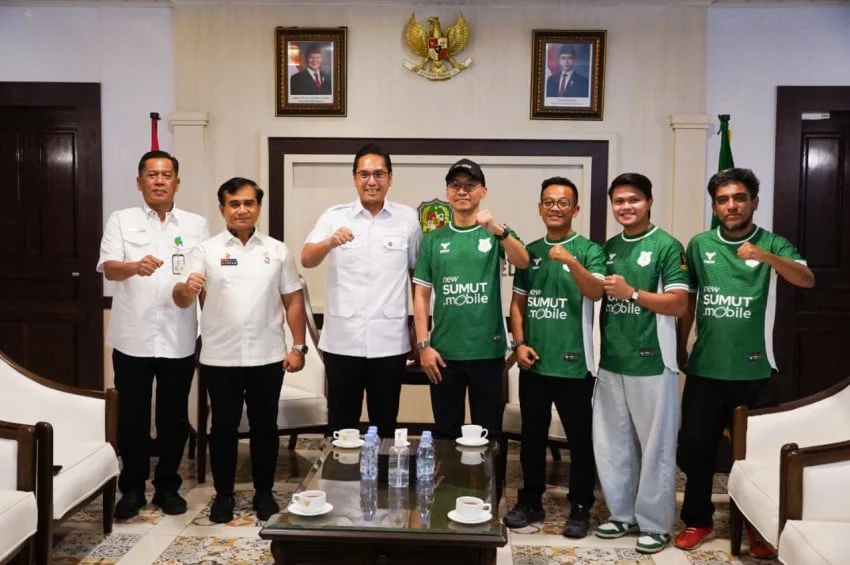
The historic football club of North Sumatra, PSMS Medan, has officially secured the green light from the municipal government to return to its spiritual home, the iconic Stadion Teladan. The announcement came following a high-level official audience at Medan City Hall, where Mayor Rico Tri Putra Bayu Waas formally granted permission for the club to utilize the legendary venue as its primary home base for upcoming competitive fixtures. This pivotal decision marks a significant milestone in the ongoing efforts to revitalize regional sports infrastructure and strengthen the symbiotic relationship between local governance and professional football development.
The confirmation was delivered during a constructive meeting between the city’s chief executive and the executive management board of PSMS Medan. The dialogue centered not only on securing a permanent venue for the club’s league campaigns but also on mapping out a collaborative future for the modernization of Stadion Teladan. For decades, the stadium has served as the roaring amphitheater of North Sumatran football, echoing the glory days of the club famously known as Ayam Kinantan. By welcoming the team back to its historic grounds, the municipal administration has underscored its commitment to preserving local sporting heritage while fostering a competitive environment for modern athletic excellence.
Main Facts and Official Authorization
During the official proceedings at City Hall, Mayor Rico Waas expressed profound enthusiasm regarding the collaborative path forward for both the football club and the municipal landmark. He emphasized that the administration’s policy is rooted in the recognition of PSMS Medan as an invaluable cultural and athletic asset to the region.
"It is a genuine pleasure to meet directly and discuss the future of PSMS and Stadion Teladan," stated Mayor Rico Waas during the session. "For me, PSMS is the pride we all share, so there is absolutely no issue with PSMS making Stadion Teladan their home base."
This unequivocal endorsement cuts through years of administrative uncertainty and temporary relocations that plagued the club during previous renovation phases. Furthermore, the Mayor introduced a forward-thinking strategic option during the discussions, proposing that the club consider expanding its operational footprint across multiple top-tier venues within the province.
Elaborating on this vision, Rico Waas suggested a dual-venue strategy to maximize the club’s regional appeal and logistical flexibility. "If possible, PSMS should have two home bases—namely Stadion Teladan and the North Sumatra Main Stadium," he added, pointing toward the newly constructed state-of-the-art facility in the region as a complementary asset for high-profile matches and regional tournaments.
Chronology of the Stadium Redevelopment and Club Relocation
The journey toward securing Stadion Teladan as a permanent home base has been defined by a complex timeline of infrastructural overhauls, temporary displacements, and civic anticipation. Understanding the context of this recent authorization requires a retrospective look at the operational challenges faced by PSMS Medan over recent seasons.
For several years, Stadion Teladan underwent a comprehensive modernization program sponsored by the central and local governments aimed at bringing the historic venue up to modern safety, accessibility, and aesthetic standards mandated by national and international football authorities. The multi-billion rupiah renovation project necessitated the complete closure of the stadium, forcing Ayam Kinantan to seek alternative venues across North Sumatra and neighboring regencies to host their league matches.
During these transitional periods, the club encountered logistical hurdles, fluctuating matchday attendances due to venue distances, and operational strains associated with managing makeshift home grounds. The recent meeting at City Hall represents the culmination of these infrastructural improvements, signaling that Stadion Teladan has reached a completion phase robust enough to resume hosting professional league fixtures safely and efficiently. The formal handover of operational permissions thus serves as a critical bridge between the conclusion of heavy civil engineering works and the resumption of live professional sports entertainment in the heart of Medan.
Supporting Data and Infrastructural Significance
Stadion Teladan holds a legendary status in Indonesian football history. Built in the early 1950s ahead of the 1953 National Games (PON III), the stadium has witnessed the golden eras of PSMS Medan, including their dominance in the Perserikatan competitions during the 1960s, 1970s, and 1980s. The recent revitalization initiative was designed to preserve this historical facade while modernizing key functional components, including pitch drainage systems, single-seat spectator stands, floodlighting, player dressing rooms, and media facilities.
Integrating the North Sumatra Main Stadium (Stadion Utama Sumut) into the equation provides an additional layer of logistical advantage. Constructed recently to accommodate major national sporting events, the Main Stadium offers a massive seating capacity and cutting-edge amenities. By floating the idea of a dual-homebase model, the municipal government is positioning PSMS Medan to leverage both the nostalgic, city-center charm of Stadion Teladan and the grand scale of the provincial arena. This dual approach aligns with modern professional club management trends, where teams optimize venue selection based on opponent tiers, expected attendance volumes, and broadcast requirements.
Stakeholder Reactions and Management Perspective
The leadership of PSMS Medan welcomed the Mayor’s decision with immense relief and optimism. Club executives attending the City Hall audiography noted that returning to Stadion Teladan is vital for restoring the psychological and competitive edge of the squad. Playing in front of a passionate home crowd within city limits is expected to invigorate player morale and re-energize the club’s massive fan base, known locally as the SMeCK Hooligan, Kampak Cyber, and other dedicated supporters groups.
Management representatives acknowledged that the municipality’s proactive stance eliminates bureaucratic friction and allows the coaching staff to focus entirely on tactical preparation for the ongoing league season. Furthermore, the club’s administration has pledged to work closely with the Medan City Government to ensure the proper maintenance and operational sustainability of Stadion Teladan, recognizing that preserving a modern public asset requires a shared commitment between the tenant club and the municipal owner.
Broader Impact and Economic Implications for Medan
The return of PSMS Medan to Stadion Teladan extends far beyond the boundaries of athletic competition, carrying profound economic and social implications for the city of Medan. Professional football acts as a significant catalyst for local micro-economies, driving commercial activity around the stadium precinct on matchdays.
- Local Commerce and SMEs: The reactivation of Stadion Teladan guarantees increased foot traffic for surrounding small and medium-sized enterprises (SMEs), street vendors, merchandise sellers, and culinary businesses that historically thrive during matchdays.
- Hospitality and Tourism: Away supporters and visiting officials traveling to Medan for league matches contribute to hotel occupancy rates, transport services, and regional tourism revenue.
- Youth Engagement and Community Pride: A stable, high-performing local club playing in a modernized historic venue fosters community cohesion, civic pride, and positive engagement opportunities for the youth of North Sumatra.
From an urban management perspective, the municipal government’s support demonstrates an effective model of public-private cooperation in sports infrastructure management. By facilitating seamless access to premier venues, the local administration helps professional clubs build sustainable business models through ticket sales, sponsorships, and enhanced fan experiences.
As PSMS Medan prepares to transition back to its historic home, the immediate focus shifts to scheduling test events, finalizing operational protocols with stadium management, and organizing community outreach programs to celebrate the homecoming. With both the municipal government and club leadership aligned in their vision, the stage is set for a triumphant new chapter in the storied history of Ayam Kinantan at Stadion Teladan.