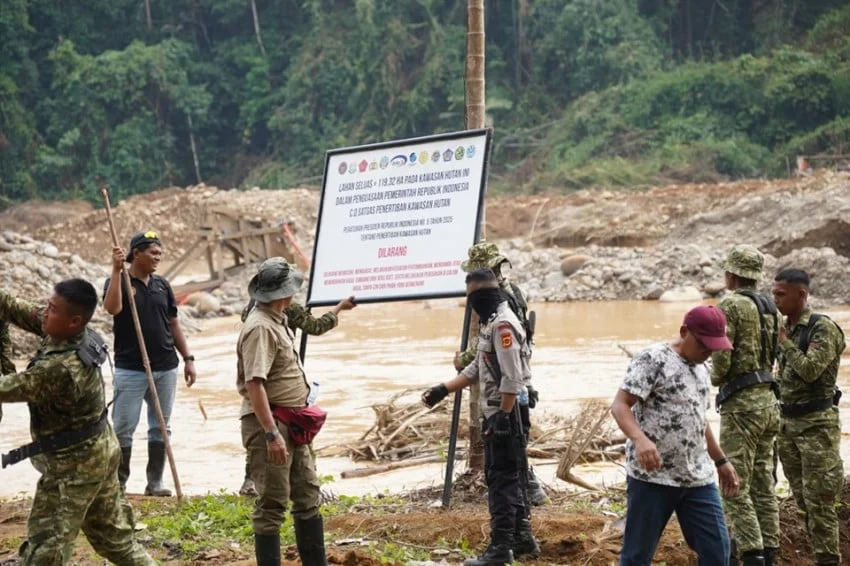
The integrity of Indonesia’s premier ecological sanctuaries faces an escalating crisis as illicit extractive industries penetrate deeper into protected conservation zones. The Satuan Tugas Penertiban Kawasan Hutan (Satgas PKH), the national forest area regulation and enforcement task force, has initiated a comprehensive, high-stakes security and environmental operation to dismantle large-scale illegal gold mining activities operating within the borders of the Kerinci Seblat National Park (TNKS) in Jambi Province. This intervention marks a critical juncture in the government’s ongoing struggle to balance economic pressures with constitutional mandates to protect natural heritage and biodiversity hotspots from irreversible ecological degradation.
Geospatial intelligence gathered ahead of the operation revealed alarming figures regarding the scale of the destruction. According to preliminary spatial analyses, approximately 119.32 hectares of pristine forest land within the Penetai region—situated in Muara Hemat Village, Batang Merangin Subdistrict, Kerinci Regency—have suffered severe, direct impacts from unauthorized excavation, heavy machinery operation, and toxic chemical runoff associated with clandestine gold processing. Environmental scientists note that the actual subterranean and downstream damage is likely significantly higher once soil erosion, hydrological disruption, and wildlife displacement are fully accounted for.
Strategic Directive and Multi-Agency Deployment
The execution of this sweeping enforcement operation follows direct directives issued by the Chairman of the Steering Committee of Satgas PKH, Minister of Defense Sjafrie Sjamsoeddin. The Ministry of Defense, working in tandem with environmental agencies, forestry directorates, and law enforcement arms, has established a strict protocol: the eradication of illegal mining within national parks must be executed decisively, in an integrated fashion, and maintained continuously until the illicit networks are completely dismantled.
Barita Simanjuntak, Spokesperson for Satgas PKH, detailed the scope of the initial phase during a briefing in Jakarta. Simanjuntak emphasized that the task force is employing a synchronized, multi-front approach designed to disrupt not only the field operations—often backed by heavy financial syndicates—but also the supply chains and distribution networks that enable the illegal trade of refined gold extracted from protected zones.
In its initial deployment phase, the joint task force struck simultaneously across three distinct focal points identified as primary hubs of illegal mining activity. These targeted areas included the Penetai sector in Kerinci Regency, alongside two other known hotbeds: Desa Air Liki in Tabir Barat Subdistrict, and Desa Baru Pangkalan Jambu in Pangkalan Jambu Subdistrict, both located within neighboring Merangin Regency. The simultaneous raids were designed to prevent operators from relocating equipment or escaping to adjacent jurisdictions ahead of enforcement teams.
Background and Chronology of the Kerinci Seblat Encroachment
Kerinci Seblat National Park is universally recognized as one of Southeast Asia’s most vital conservation landscapes. Spanning the Bukit Barisan mountain range across four provinces—Jambi, West Sumatra, Bengkulu, and Lampung—the park serves as the backbone of the Sumatra ecosystem. It is a designated UNESCO World Heritage site, forming part of the Tropical Rainforest Heritage of Sumatra, and acts as a crucial stronghold for critically endangered species such as the Sumatran tiger, the Sumatran rhinoceros, and the Sumatran elephant, alongside thousands of endemic flora species.
The genesis of the current enforcement surge can be traced back to a steady accumulation of satellite surveillance data and community intelligence reports dating back to the post-pandemic economic downturn. During this period, rural unemployment and rising global gold prices created a volatile socioeconomic cocktail. Local syndicates, often utilizing imported heavy excavators smuggled piece-by-piece into remote forest peripheries, began organizing mechanized alluvial mining operations along riverbanks originating within the park boundaries.
Despite intermittent localized crackdowns by local police and provincial forestry agencies over the past three years, illegal mining syndicates repeatedly adapted their tactics. Operations became increasingly sophisticated, utilizing lookout networks, bribes, and difficult-to-navigate terrain to evade detection. By late 2023 and into 2024, monitoring NGOs and park rangers reported a dramatic escalation in turbidity within major rivers flowing out of the park, signaling widespread upstream washing and mercury usage. The formation of the centralized Satgas PKH under high-level ministerial oversight represents a strategic escalation, shifting the response from reactive local policing to a coordinated national security and environmental defense campaign.
Environmental and Socioeconomic Implications
The ecological fallout of unregulated gold mining in the Kerinci Seblat watershed extends far beyond the immediate 119.32 hectares of deforested land in Penetai. The primary mechanism of extraction—alluvial washing utilizing hydraulic monitors and toxic mercury or cyanide amalgamation—presents a catastrophic hazard to both terrestrial and aquatic ecosystems.
When topsoil and riverbeds are stripped away to extract gold flakes, the resulting silt clogs waterways, destroying aquatic habitats and drastically reducing fish populations upon which local communities depend for sustenance and livelihood. Furthermore, the introduction of heavy metals like mercury into the river systems bioaccumulates through the food chain, posing severe long-term health risks to human populations downstream who utilize the water for drinking, bathing, and agricultural irrigation.
From a climate perspective, the destruction of secondary and primary rainforests in the Bukit Barisan range releases massive stores of sequestered carbon back into the atmosphere, undercutting Indonesia’s national commitments under the Paris Agreement and its FOLU Net Sink 2030 targets. Furthermore, the fragmentation of forest cover compromises wildlife corridors. Conservation biologists warn that the persistent presence of machinery, human settlement, and poaching pressure in core habitats forces apex predators like the Sumatran tiger into closer proximity with human settlements, exacerbating human-wildlife conflict.
Socioeconomically, illegal mining creates a complex paradox. While it provides short-term cash flow and employment for impoverished local laborers, the lion’s share of profits is funneled upward to external financiers and illicit syndicates. The local community is left bearing the long-term environmental degradation, loss of ecotourism potential, and heightened vulnerability to natural disasters such as flash floods and landslides, which are exacerbated by deforested mountain slopes.
Official Responses and Stakeholder Reactions
The deployment of Satgas PKH has drawn cautious praise from environmental organizations, conservationists, and civil society groups who have long advocated for stronger federal intervention in Sumatra’s conservation zones.
"The involvement of high-level defense and security apparatuses sends an unmistakable message that environmental crimes within national parks are treated as threats to national sovereignty and security," noted an environmental policy analyst based in Jakarta. "However, the true test of this operation will not be the initial seizure of excavators or the temporary halting of operations, but the persistence of post-operation monitoring and the successful prosecution of the financial masterminds behind these syndicates."
Local government officials in Jambi Province have expressed a willingness to cooperate with the central task force, acknowledging that regional enforcement agencies often lack the logistical capacity and operational resources required to confront well-armed and heavily capitalized mining syndicates. Provincial authorities are currently collaborating with the Ministry of Environment and Forestry to formulate post-clearing rehabilitation frameworks. These plans aim to restore degraded riverbanks and reforestation initiatives in Penetai and surrounding subdistricts.
Simultaneously, economic development agencies are under pressure to introduce alternative livelihood programs for communities residing on the periphery of the national park. Experts emphasize that punitive enforcement alone cannot succeed without addressing the underlying economic drivers that push vulnerable rural populations into partaking in or tolerating illicit extractive industries.
Future Outlook and Sustained Enforcement
As Satgas PKH continues its phased operations across Jambi and other priority provinces, the task force faces the formidable challenge of institutionalizing long-term preventative measures. Ministry of Defense officials have reiterated that the current campaign is not a temporary media campaign, but the foundational phase of a permanent strategy to reclaim and rehabilitate Indonesia’s protected forest estates.
Future steps outlined by the task force include the deployment of permanent ranger outposts equipped with real-time drone surveillance and satellite telemetry in high-risk sectors of Kerinci Seblat National Park. Additionally, asset-tracing investigations led by financial intelligence units are underway to freeze the accounts of individuals and corporate entities suspected of laundering profits derived from illegal mining within protected areas.
Ultimately, the success of the intervention in Kerinci Seblat will serve as a critical benchmark for Indonesia’s broader environmental governance. By demonstrating that illegal resource extraction in protected heritage sites carries severe, unyielding legal and operational consequences, the government aims to deter similar illicit enterprises nationwide, ensuring that ecological treasures like TNKS are preserved for future generations.