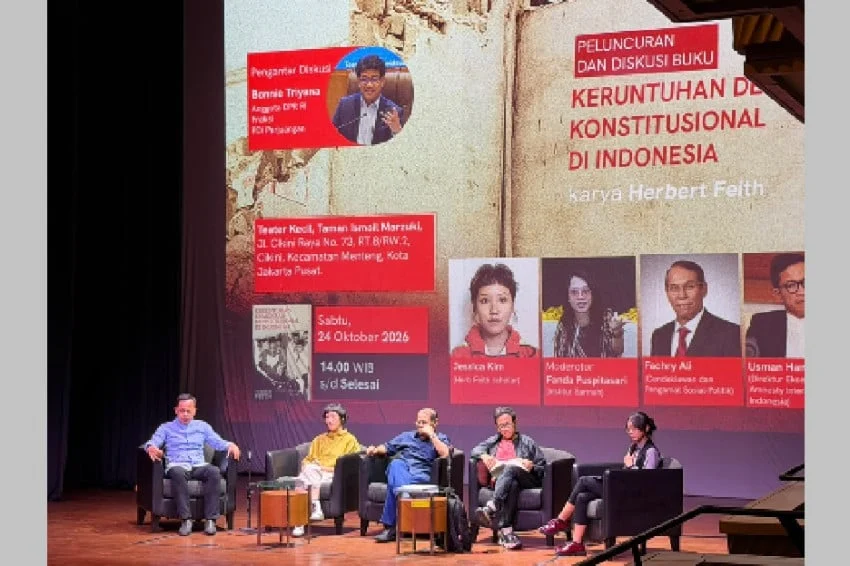
The debate surrounding the decline of constitutional democracy in Indonesia during the 1950s continues to offer profound insights into the nation’s contemporary political landscape. Speaking at the launch and public discussion of Herbert Feith’s seminal work, The Decline of Constitutional Democracy in Indonesia, historian and legislator Bonnie Triyana argued that the historical tensions, theoretical criticisms, and elite dichotomies of that era still resonate strongly today. The event, held at the Teater Kecil in Taman Ismail Marzuki, Central Jakarta, brought together academics, historians, and political observers to re-examine how the foundational years of the Indonesian republic continue to cast a long shadow over modern governance.
The gathering served as both a retrospective on a foundational text of Indonesian political science and a forward-looking forum on the health of the country’s democratic institutions. By revisiting Feith’s exhaustive study, participants sought to understand the structural vulnerabilities that led to the collapse of the parliamentary system in the late 1950s and how those historical lessons apply to contemporary democratic practices.
Contextualizing the Event and Herbert Feith’s Legacy
Herbert Feith’s The Decline of Constitutional Democracy in Indonesia is widely regarded as one of the most comprehensive academic analyses of the post-independence parliamentary era. Originally published following years of meticulous field research, Feith’s work details the rise and fall of Indonesia’s multi-party parliamentary democracy between 1949 and 1957—a period that ultimately gave way to President Sukarno’s "Guided Democracy."
The decision to host a dedicated discussion and launch a renewed edition of the book at Taman Ismail Marzuki underscores a growing academic and public interest in historical accountability and political theory. As Indonesia navigates its post-reformasi democratic consolidation, scholars are increasingly turning to the 1950s to study the mechanics of democratic erosion, the behavior of political elites, and the friction between Western-style liberal models and indigenous political realities.
The Feith-Benda Debate: Eurocentrism Versus Universalism
During his opening remarks, Bonnie Triyana—who is also a member of the House of Representatives (DPR) from the Indonesian Democratic Party of Struggle (PDI-P)—focused heavily on the historical intellectual clash between Herbert Feith and fellow prominent historian Harry J. Benda.
According to Triyana, Benda famously leveled a sharp critique against Feith, accusing him of operating under a Eurocentric worldview. Benda argued that Feith’s analytical framework improperly elevated Western liberal parliamentary democracy as the baseline "normal" condition for political health. From Benda’s perspective, the parliamentary democracy practiced in Indonesia between 1950 and 1957 was an artificial construct—a temporary interlude or import from the West that was only superficially embraced by the broader Indonesian populace, who lacked deep-rooted historical experience with liberal institutions.
Despite Benda’s critiques regarding potential oversimplification, Triyana asserted that the underlying debate remains crucial. "For me, the debate between Feith and Benda, which took place 62 years ago, still continues to disturb the mind and raise many questions," Triyana stated during the panel. This ongoing intellectual friction challenges political scientists to consider whether institutional models are genuinely compatible with local socio-cultural fabrics or if they remain vulnerable to systemic rejection during periods of crisis.
Deconstructing the Elite: Administrators Versus Solidarity Makers
A central pillar of Feith’s thesis is his famous dichotomy of the Indonesian political elite. Feith divided the political actors of the 1950s into two distinct camps: the administrators and the solidarity makers.
- The Administrators (Problem Solvers): This group comprised technocrats, bureaucrats, and leaders focused on economic management, administrative efficiency, state-building, and pragmatic problem-solving. They valued institutional stability, expertise, and measurable policy outcomes.
- The Solidarity Makers (Symbol-Wielders): In contrast, this faction consisted of charismatic politicians, nationalist ideologues, and revolutionary leaders who excelled in rhetoric, mass mobilization, and symbolic politics. They derived their power from their ability to unite diverse populations through emotional appeals, revolutionary myths, and anti-imperialist sentiment.
While critics like Benda argued that this binary categorization oversimplified the fluid and complex nature of Indonesian political actors, Triyana maintained that the framework retains its analytical utility. In modern politics, observers frequently witness a similar tension between technocratic governance—focused on data, fiscal discipline, and institutional reform—and populist politics, which often relies on identity, rhetoric, and symbolic mobilization. The friction between these two approaches frequently dictates the policy trajectory and stability of modern democratic administrations.
Geopolitical Roots and the Birth of Indonesian Pluralism
To fully grasp the fragility of Indonesia’s early democratic experiment, Triyana highlighted the geopolitical context immediately following World War II. The architecture of Indonesia’s early democracy was forged under intense international scrutiny and internal turbulence.
A pivotal moment in this chronology was the issuance of the Government Decree of November 3, 1945 (Maklumat X). Signed by Vice President Mohammad Hatta, this decree officially encouraged the formation of political parties, rapidly opening the floodgates to a multi-party system. The strategic objective at the time was clear: the revolutionary leadership needed to demonstrate to the Allied forces, the United Nations, and the Western powers that Indonesia was a progressive, pluralistic nation deserving of international recognition, rather than a vestige of Japanese fascism or a totalitarian state.
However, this rapid proliferation of political parties laid the groundwork for severe fragmentation. With numerous factions competing for limited state resources and ideological dominance, cabinets proved notoriously unstable. Governments rose and fell with high frequency, failing to secure the long-term parliamentary majorities necessary to enact painful economic reforms or resolve regional rebellions. This paralysis ultimately created the vacuum that allowed the military and President Sukarno to dismantle the parliamentary system in favor of Guided Democracy.
Chronology of Democratic Transitions in Indonesia
To understand the trajectory of constitutional democracy in the archipelago, historians point to several key milestones across different eras:
- 1945–1949 (The National Revolution): The proclamation of independence is followed by the struggle against Dutch colonial re-occupation. The groundwork for a republican constitution is laid, alongside the introduction of the multi-party system via Maklumat X.
- 1950–1957 (The Parliamentary Era): The implementation of the Provisional Constitution of 1950 (UUDS 1950). This period is characterized by intense cabinet instability, ideological polarization, and the historic 1955 general election—widely regarded as Indonesia’s most free and fair election of the 20th century, yet failing to produce stable governance.
- 1957–1965 (Guided Democracy): President Sukarno declares the end of parliamentary democracy, centralizing executive power with the backing of the military and the Indonesian Communist Party (PKI), effectively suspending constitutional checks and balances.
- 1966–1998 (The New Order): President Suharto establishes a centralized, military-backed authoritarian regime under the guise of "Pancasila Democracy," maintaining political stability at the expense of civil liberties and political pluralism.
- 1998–Present (The Reform Era): Following the fall of Suharto, sweeping constitutional amendments re-establish constitutional democracy, direct presidential elections, regional autonomy, and robust press freedom.
Implications for Modern Indonesian Politics
The relevance of Feith’s work to the political reality of the 2020s lies in the enduring challenges of institutional resilience and elite consensus. Modern political analysts frequently debate whether contemporary Indonesian democracy suffers from symptoms similar to those of the 1950s—namely, transactional politics, elite cartels, the weakening of institutional checks and balances, and a growing disconnect between technocratic policy-making and populist demands.
As current administrations work to navigate complex global economic transformations and domestic policy demands, the historical lessons of the 1950s serve as a cautionary tale. The collapse of constitutional democracy in the past was not caused by a single catastrophic event, but rather by the gradual erosion of elite consensus, economic mismanagement, and the inability of democratic institutions to deliver tangible welfare improvements to the population.
By engaging with the works of Herbert Feith and the critiques of scholars like Harry Benda, contemporary Indonesian intellectuals and policymakers are better equipped to identify structural risks. The discourse at Taman Ismail Marzuki reinforces the notion that studying historical failures is not merely an academic exercise, but a vital prerequisite for safeguarding the future of the republic’s democratic institutions.