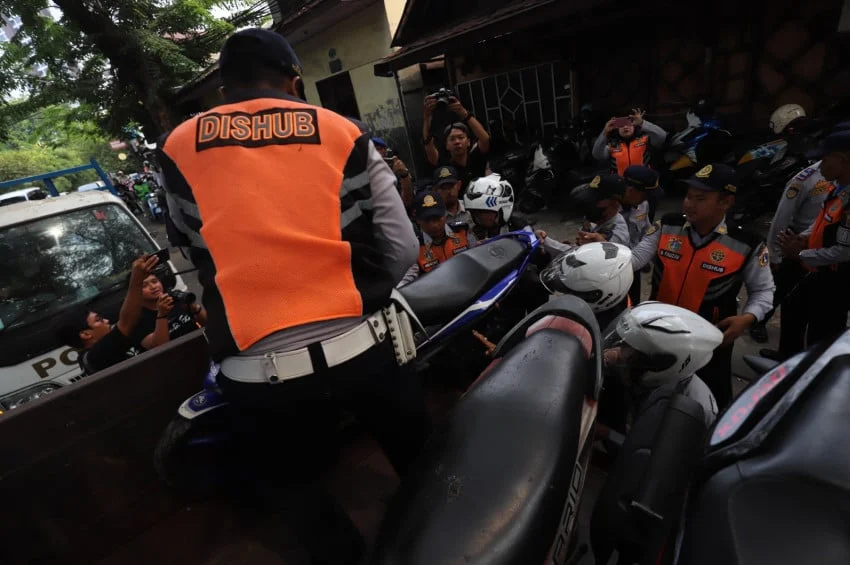
The urban landscape of Jakarta has long grappled with the persistent challenge of vehicular congestion and spatial encroachment, a friction point that came to the forefront once again on Monday, October 26, 2026. In a decisive move to restore public order, streamline traffic flow, and reclaim pedestrian infrastructure, the South Jakarta Transportation Office (Suku Dinas Perhubungan Jakarta Selatan) launched a comprehensive crackdown on illegal motorcycle parking. Operating across key commercial and transit-heavy corridors, enforcement teams targeted motorists who flagrantly disregarded traffic laws by abandoning their vehicles on sidewalks and road shoulders.
The afternoon sweep resulted in the immediate removal and impoundment of 13 motorcycles found parked in unauthorized zones. This operation was not merely a routine enforcement activity, but a direct response to mounting public frustration channeled through modern digital governance tools. By leveraging citizens’ reports, municipal authorities demonstrated a growing reliance on technology-driven civic engagement to tackle localized infrastructural bottlenecks. As urban centers in Indonesia continue to densify, the tension between vehicular convenience and pedestrian rights highlights a critical governance challenge that extends far beyond a single afternoon operation.
Chronology and Execution of the Enforcement Operation
The targeted operation commenced at approximately 13:30 Western Indonesia Time (WIB), deploying a multi-agency task force to strategic hotspots notorious for chronic traffic snarls and pedestrian displacement. The deployment was meticulously planned following days of data aggregation from citizen complaints.
The enforcement caravan concentrated its efforts on two primary thoroughfares: Jalan KH Muhammad Syafi’i Hadzami, specifically surrounding the high-traffic Gandaria City commercial complex, and the bustling Jalan Melawai Raya corridor. Both locations are recognized commercial hubs characterized by high pedestrian footfall, active public transportation nodes, and a high volume of short-term visitors who frequently seek informal, complimentary parking to avoid commercial garage fees.
Upon arrival at the locations, enforcement personnel encountered numerous motorcycles parked directly atop pedestrian pathways—obstructing tactile paving for visually impaired citizens—and spilling onto active vehicular lanes, effectively narrowing the roadway and degrading traffic capacity. Without issuing warnings on-site due to the blatant nature of the infractions, the joint task force systematically loaded the offending vehicles onto transport trucks.
By the conclusion of the operation, 11 motorcycles had been confiscated from Jalan KH Muhammad Syafi’i Hadzami near Gandaria City, while an additional 2 units were secured from Jalan Melawai Raya. The total tally of 13 impounded motorcycles was subsequently transported under guard to the South Jakarta Transportation Office headquarters located at Jalan MT Haryono Kav. 45–46, where owners must undergo administrative processing and pay regulatory fines to retrieve their property.
Deployment of Personnel and Inter-Agency Synergy
The success and security of the midday operation relied on a robust, coordinated deployment of municipal and security assets. The South Jakarta Transportation Office mobilized a total of 22 joint personnel, illustrating a zero-tolerance approach that integrated civilian transport regulators with military and municipal police elements to deter potential confrontations with vehicle owners or local informal parking attendants, commonly known as pak ogah.
The operational composition of the task force included officers from the South Jakarta Transportation Office, field personnel from the Kebayoran Lama Sub-district Transportation Unit (Satpelhub), military police officers from the Military Police Corps (POM TNI), and enforcement officers from the Jakarta Satpol Benpol (Public Order Agency). This multi-agency collaboration is increasingly standard practice in Jakarta’s urban enforcement operations, designed to ensure that civil servants conducting administrative confiscations are adequately protected against resistance in densely populated commercial zones.
To execute the mass removal efficiently, the task force was backed by a specialized fleet of operational vehicles. The convoy comprised two heavy-duty tow trucks, two dedicated patrol automobiles, two transport trucks utilized specifically for hauling the seized motorcycles, and one lead patrol motorcycle to clear pathways for the convoy as it transitioned between the targeted sectors and the central impound facility.
The Role of Digital Governance: The JAKI Application and CRM
A pivotal dimension of the October 26 enforcement action was its origin in civic technology. Ebenezer L. Tobing, the Control Officer for the South Jakarta Transportation Office, confirmed during a post-operation briefing that the sweep was initiated as a direct follow-up to grievances submitted by the community via the Jakarta Kini (JAKI) application and the Cepat Respons Masyarakat (CRM) integrated complaint system.
"This enforcement was conducted as a swift response to citizens’ complaints reported through the JAKI application," Ebenezer stated when confirming the operation details. He further emphasized the multi-dimensional hazards posed by such infractions: "The existence of illegal parking not only disrupts public order but also triggers traffic congestion and deprives pedestrians and other road users of their fundamental rights."
The JAKI application, developed by the Jakarta Smart City initiative, serves as the primary digital conduit for Jakarta residents to report municipal grievances, ranging from uncollected waste and flooded roadways to illegal parking and structural damage. By centralizing these reports through the CRM backend, city agencies can route complaints directly to the relevant sub-district or municipal operational units.
The transition from passive observation to algorithmic dispatching represents a significant evolution in municipal oversight. Instead of relying solely on routine patrols—which are often constrained by limited personnel and vast territorial jurisdictions—transportation authorities can dynamically allocate resources based on real-time spatial data submitted by residents who experience these infrastructural disruptions on a daily basis.
Broader Context and Implications for Urban Mobility in Jakarta
The crackdown in Gandaria and Melawai reflects a chronic urban syndrome plaguing the Indonesian capital: the systematic appropriation of public space by private motor vehicles. Despite extensive investments in mass rapid transit, including the expansion of the MRT, LRT, and integrated bus networks, Jakarta remains heavily automobile- and motorcycle-centric. The proliferation of two-wheeled vehicles has outpaced the development of regulated parking infrastructure, particularly in commercial zones where businesses frequently fail to provide adequate, affordable parking for patrons and delivery couriers.
Informal parking practices generate a cascade of negative externalities. When motorists abandon motorcycles on sidewalks, they force pedestrians—including children, the elderly, and persons with disabilities—to step off the elevated walkways and into active vehicular traffic. This creates severe safety hazards, increases the likelihood of pedestrian-vehicle collisions, and violates national traffic laws regarding pedestrian priority.
Furthermore, roadside parking acts as a severe bottleneck for vehicular throughput. By reducing a four-lane road to two functional lanes, haphazardly parked motorcycles create localized choke points that back up traffic for kilometers, subsequently increasing vehicular emissions through prolonged idling and undercutting the city’s broader climate and air quality objectives.
The involvement of commercial hubs like Gandaria City and Melawai underscores the complex relationship between commercial real estate development and urban spatial planning. While large shopping complexes possess designated basement and multi-story parking structures, high tariffs, long queues during peak hours, or the sheer distance from specific street-front merchants often incentivize motorists to seek informal alternatives on surrounding public streets. Meanwhile, traditional commercial districts like Melawai—characterized by shophouses and older architectural layouts—frequently lack off-street parking entirely, leaving visitors with virtually no legal options for short-term stops.
Analytical Perspective: Challenges in Sustaining Enforcement
Urban planning experts note that while sporadic enforcement actions and mass impoundments serve as necessary deterrents, they represent reactive treatments rather than systemic cures. Temporary sweeps clear the corridors temporarily, but motorists and informal parking syndicates often return to the same locations once enforcement units depart.
To achieve long-term behavioral change, municipal authorities face the challenge of implementing a holistic strategy that combines continuous digital surveillance, structural infrastructural modifications, and economic disincentives. Potential policy directions discussed among urban analysts include the installation of physical bollards and raised curbs to make sidewalk parking physically impossible, the expansion of legal, low-cost short-term drop-off zones, and stricter legal liability targeted at commercial establishments that fail to manage the parking overflow generated by their patrons.
Moreover, addressing the socioeconomic ecosystem surrounding illegal parking requires dismantling the informal security networks or parking extortion rings that often manage these unauthorized spots. These actors frequently collect illegal fees from motorists, creating a shadow economy that resists municipal regulation.
As the Jakarta Provincial Government continues to refine its smart-city infrastructure, operations driven by citizen reporting platforms like JAKI signal a transparent, accountable framework for urban governance. However, the ultimate metric of success for initiatives like the South Jakarta Transportation Office’s crackdown will not be the number of motorcycles impounded in a single afternoon, but the sustained recovery of pedestrian pathways and the permanent restoration of traffic fluidity across the metropolitan area. The October 26 operation serves as a stark reminder that while technology can accelerate the detection of urban decay, maintaining civic order requires unwavering regulatory persistence.