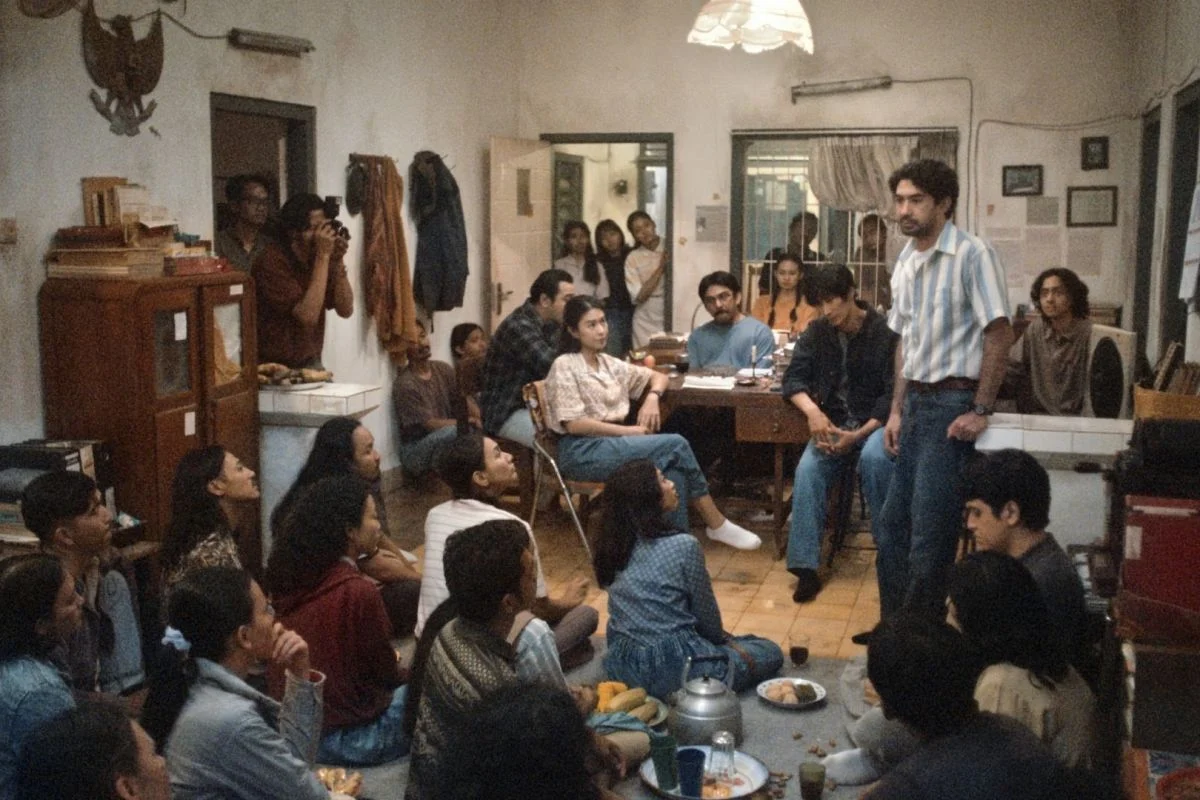
The landscape of Indonesian cinema is preparing for one of its most emotionally resonant and politically significant releases of the decade as the cinematic adaptation of Leila S. Chudori’s modern literary masterpiece, Laut Bercerita, secures its official theatrical premiere date. Set to hit silver screens across the archipelago on October 29, 2026, the film adaptation arrives strategically on the heels of Indonesia’s National Youth Pledge Day, a deliberate scheduling choice by production house Pal8 Pictures to honor the legacy of student activism and the enduring struggle for freedom of expression.
Directed by acclaimed filmmaker Yosep Anggi Noen—who co-wrote the screenplay alongside the novel’s original author, Leila S. Chudori—the two-hour-and-fifteen-minute drama (135 minutes) transports audiences back to the tense socio-political climate of late 1990s Yogyakarta. Through a meticulous blend of historical recreation and deeply human storytelling, the film explores the heavy personal toll exacted by political oppression, the unbreakable bonds of student solidarity, and the agonizing, unending grief borne by families left behind in the wake of forced disappearances.
Main Facts and Production Overview
At its core, Laut Bercerita is a narrative about the collision between youthful idealism and authoritarian suppression. The feature film boasts a stellar ensemble cast led by Reza Rahadian, who steps into the pivotal role of Biru Laut, an idealistic university student whose passion for literature and political discourse sets off a chain of life-altering events. He is joined by an impressive roster of Indonesian cinematic royalty, including Christine Hakim, Arswendy Bening Swara, Yunita Siregar, Kevin Julio, Ben Nugroho, Dewa Dayana, alongside special appearances by prominent actors Dian Sastrowardoyo and Eva Celia.
The project is the culmination of years of development, bringing to life a narrative that has already captured the hearts of millions of readers since the novel’s initial publication in 2017. Translating a dense, emotionally charged historical novel into a visual medium required rigorous adaptation choices. According to Chudori and Noen, the constraints of a standard feature film runtime necessitated trimming certain subplots while striving to preserve the emotional truth and political gravity of the source material. For lead actor Reza Rahadian, the transition from page to screen involved relying heavily on both the original novel and the screenplay to capture the complex interiority of Biru Laut without altering the fundamental integrity of the character.
Chronology of a Tragedy: The Plot and Historical Context
The narrative unfolds against the volatile backdrop of Indonesia’s late 1990s political landscape—a turbulent era marked by economic crisis, widespread student protests, and mounting resistance against the New Order regime. In this charged environment, Yogyakarta serves as a hotbed of intellectual awakening and clandestine political organization.
Biru Laut, a student with an insatiable appetite for reading and writing, finds his intellectual curiosity drawing him toward the Winatra study group. Alongside peers such as Daniel (Kevin Julio), Alex (Ben Nugroho), and Sunu (Dewa Dayana), Laut engages in grassroots activism, viewing the circulation of banned books, public debates, and intellectual discourse as moral duties against a climate of censorship and systemic injustice.
As university campuses become increasingly militarized and monitored, the stakes escalate rapidly. The turning point of the first act arrives when three student activists are violently detained for distributing prohibited literature. Despite the growing perils and the tangible threat of state reprisal, Laut and his comrades refuse to silence their convictions, continuing their clandestine efforts to voice opposition to the regime.
The narrative reaches its devastating emotional climax on a fateful night when Laut and several of his closest associates vanish without a trace. Their sudden disappearance plunges their families into a nightmare of ambiguity. The second half of the narrative pivots away from the campus resistance toward the domestic sphere, focusing on the harrowing aftermath experienced by Laut’s father (Arswendy Bening Swara), mother (Christine Hakim), and younger sister, Asmara Jati (Yunita Siregar).
Years turn into decades as Asmara and her parents endure a protracted, exhausting battle for truth and accountability. Refusing to let her brother become a forgotten statistic, Asmara spearheads a tireless quest—not merely to find a missing person, but to secure historical closure and justice for all victims of state-sponsored violence. Through her journey, the film illustrates the multi-generational trauma of political violence, where the absence of a body or an official explanation prevents healing and condemns loved ones to a perpetual state of uncertainty.
Supporting Data and Adaptational Challenges
Adapting a culturally significant literary work carries immense pressure, particularly when dealing with historical wounds that remain sensitive in contemporary Indonesian society. The novel Laut Bercerita is not merely a work of fiction; it is widely recognized as a tribute to real-life activists who were abducted and either returned or remain missing following the political upheaval of 1997–1998.
Director Yosep Anggi Noen and screenwriter Leila S. Chudori faced the daunting task of balancing artistic expression with historical respect. In interviews regarding the production, Chudori acknowledged that condensing a multi-layered novel into a 135-minute cinematic format required difficult editorial choices. Scenes and minor characters had to be synthesized to maintain a tight narrative rhythm, yet the filmmakers remained fiercely protective of the story’s emotional core.
Reza Rahadian, widely regarded as one of Indonesia’s most versatile actors, approached the role of Biru Laut with extensive preparation, studying period-specific political literature and consulting with individuals who lived through the student movements of the late 90s. The production design team similarly undertook exhaustive research to reconstruct the aesthetic of Yogyakarta in 1998, from vintage typography on protest pamphlets to the distinct fashion and architectural landscape of campus student centers during that era.
Official Responses and Production Vision
Pal8 Pictures has framed the release of Laut Bercerita as a vital cultural milestone. By timing the premiere for late October 2026, the studio aims to connect the historical sacrifices of 1990s student activists with contemporary conversations regarding civil liberties, freedom of speech, and human rights in modern Indonesia.
The producers noted that the film is designed to resonate not only with older generations who lived through the turbulence of the Asian Financial Crisis and the fall of the New Order, but also with Gen Z and millennial audiences who may have only read about these events in history textbooks. By humanizing political history through the lens of family grief, romance, and fierce friendship, the filmmakers hope to foster empathy and historical awareness.
Broader Impact and Implications
The release of Laut Bercerita in October 2026 is poised to trigger significant cultural and social discourse. In a broader socio-political context, cinema in Southeast Asia’s largest economy frequently functions as a vehicle for historical reckoning. Films that tackle sensitive chapters of the nation’s past invite audiences to confront uncomfortable truths about state power, human rights abuses, and the cost of democracy.
From an analytical standpoint, the film’s commercial and critical reception will likely test the box office viability of "prestige drama" and historical political thrillers in an industry often dominated by horror comedies and romantic melodramas. If successful, Laut Bercerita could pave the way for increased investment in cinematic adaptations of significant Indonesian literary works that address complex social issues.
Furthermore, the film’s focus on the unending ordeal of families of the disappeared ensures that the narrative transcends local boundaries, striking a universal chord with international audiences familiar with authoritarian regimes and human rights violations across the globe. As the countdown to October 29, 2026, continues, anticipation remains extraordinarily high, cementing Laut Bercerita as a definitive cinematic event of the year.