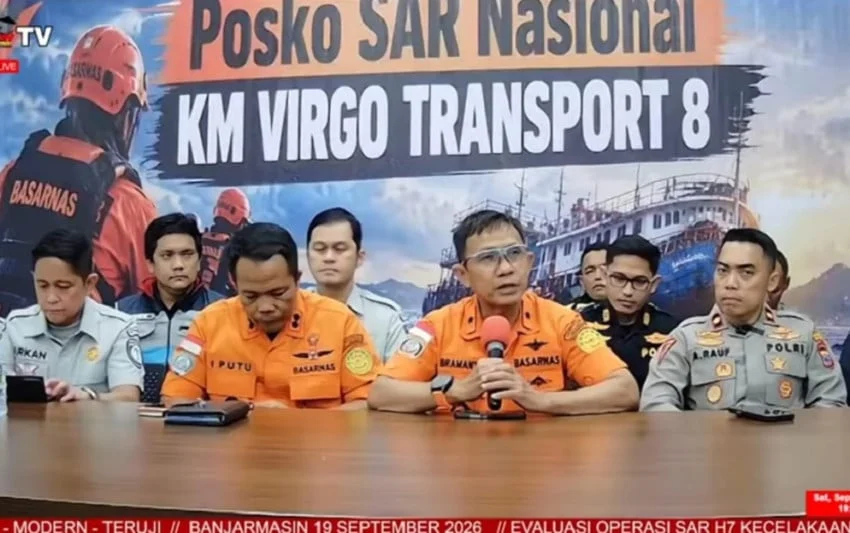
The National Search and Rescue Agency (Basarnas) has officially announced an extension of the search and rescue operation for the victims of the KM Virgo Transport 8 maritime incident. The decision to prolong the mission by an additional seven days underscores the complexity of the ongoing recovery efforts and the commitment of the authorities to locate missing personnel associated with the ill-fated vessel.
Laksamana Pertama Yudhi Bramantyo Nur Sasongko, the Director of Operations for Basarnas, confirmed the extension on Saturday, September 19, 2026. This move follows the initial seven-day standard protocol for search and rescue operations, which typically undergoes review based on the probability of finding survivors or recovering bodies, as well as the operational requirements for salvage missions.
Context and Operational Challenges
The KM Virgo Transport 8 incident has presented significant challenges to maritime authorities. Unlike standard search operations conducted in shallow waters, the salvage operation requires specialized technical expertise and equipment. The recent arrival of a dedicated salvage team at the scene has been identified as a primary factor in the decision to extend the operational window.
The term "salvage" in maritime operations refers to the process of recovering a ship, its cargo, or other property after a shipwreck or other maritime casualty. This process is inherently time-consuming, involving underwater structural analysis, potential debris removal, and the safe extraction of sensitive materials or human remains. Bramantyo indicated that the technical complexity of these tasks means that a definitive timeline for the completion of the salvage operation remains fluid.
"The salvage operation we are about to undertake will likely be a long and protracted process," Bramantyo stated. "We cannot set a precise completion date at this time, as the specific methodology is currently being finalized by a team of experts. Our priority remains the thorough inspection of the vessel and the recovery of those who remain missing."
Chronology of Events
The disappearance and subsequent sinking of the KM Virgo Transport 8 have prompted a massive mobilization of Indonesian maritime assets. While the incident details are currently being processed through official investigative channels, the timeline of the recovery effort has been marked by a transition from initial surface-level search to deep-water recovery.
- Initial Alert: Upon receiving distress signals or the loss of contact with the vessel, the regional Basarnas office deployed Search and Rescue Units (SRU) to the coordinates where the ship was last tracked.
- Phase One (Days 1–7): The initial search focused on surface patrolling and aerial surveillance, covering a wide radius based on drift modeling and prevailing sea currents. During this period, several victims were recovered, and families were notified.
- Transition to Salvage: Following the initial phase, the focus shifted toward underwater operations. The arrival of professional salvage divers and specialized heavy-lifting equipment marked the current phase, necessitating the extension of the search operation.
- Current Status: As of September 19, 2026, the mission has been extended for another seven-day cycle, with provisions for further review depending on the progress of the salvage team.
Broader Implications and Humanitarian Concerns
The impact of the KM Virgo Transport 8 tragedy extends beyond the technical recovery efforts. The socio-economic consequences for the families of the victims have been a focal point for government agencies, including the mandatory insurance provider, Jasa Raharja.
Jasa Raharja recently finalized the disbursement of compensation to the heirs of two identified victims residing in West Java. This move highlights the legal obligations and the humanitarian urgency that often accompanies such maritime disasters. For many families, the closure provided by the recovery of victims is as vital as the financial assistance provided by state insurance schemes.
The incident has also reignited discussions regarding maritime safety standards in Indonesian waters. Experts in the maritime sector suggest that the increase in vessel traffic, combined with varying maintenance standards, necessitates a more rigorous inspection regime. While investigators have yet to issue a final report on the cause of the KM Virgo Transport 8 sinking, industry observers point toward a need for stricter oversight of cargo vessels operating in high-traffic corridors.

Analysis of the Salvage Process
The inclusion of a salvage team indicates that Basarnas is moving toward a more invasive, yet potentially more conclusive, phase of the operation. Salvage operations are governed by international maritime law, which prioritizes the preservation of life and the protection of the marine environment.
In this instance, the salvage team is not only tasked with potential victim recovery but also with assessing the environmental risk posed by the vessel. Should the ship be carrying fuel or hazardous cargo, the salvage team must implement containment protocols to prevent ecological damage. This duality of the mission—humanitarian recovery and environmental protection—adds another layer of complexity to the seven-day extension.
The decision to keep the operation active is a reflection of the government’s policy of "zero-abandonment," where authorities persist in efforts until all avenues of search and recovery have been exhausted. This is particularly significant in the Indonesian context, where the archipelagic geography makes search and rescue operations logistically daunting due to unpredictable weather patterns and deep-sea topography.
Coordination Among Agencies
The success of the extended operation relies on the seamless coordination between various government agencies. Basarnas is currently working in tandem with the Indonesian Navy (TNI AL), the Water Police (Polairud), and the Ministry of Transportation.
The integration of the salvage team into the command structure is a critical component of this coordination. The team of experts, who have been brought in to evaluate the structural integrity of the vessel, are working closely with Basarnas command to ensure that the recovery efforts do not inadvertently destroy evidence that could be vital for the subsequent National Transportation Safety Committee (KNKT) investigation.
Looking Ahead
As the extended seven-day window begins, the maritime community remains focused on the waters surrounding the incident site. The local authorities have issued notices to mariners to remain clear of the area, allowing the salvage team to operate without the interference of commercial or private traffic.
While the extension provides a reprieve for those awaiting news of their loved ones, the mood remains somber. The technical challenges ahead are formidable, and the success of the mission will depend on the stability of sea conditions and the expertise of the salvage crew.
Basarnas continues to provide daily briefings to the families of the victims and the general public, aiming to maintain transparency despite the limitations of the deep-sea environment. The government’s continued dedication to the search underscores a broader commitment to upholding maritime safety standards and ensuring that the families of the missing are not left in uncertainty.
In the coming week, the primary focus will remain on the underwater reconnaissance of the hull and the execution of the salvage plan. If the salvage team encounters significant obstructions or if environmental conditions deteriorate, the possibility of further extensions remains a subject of ongoing discussion among the leadership of the rescue operation.
For now, the effort remains a testament to the resilience of the search and rescue teams who, despite the exhaustion of the initial week, remain committed to the task of bringing closure to the families and maintaining the integrity of Indonesia’s maritime security protocols. The nation watches closely as the specialized team prepares to engage with the wreckage, hoping for clarity and recovery in the days to follow.