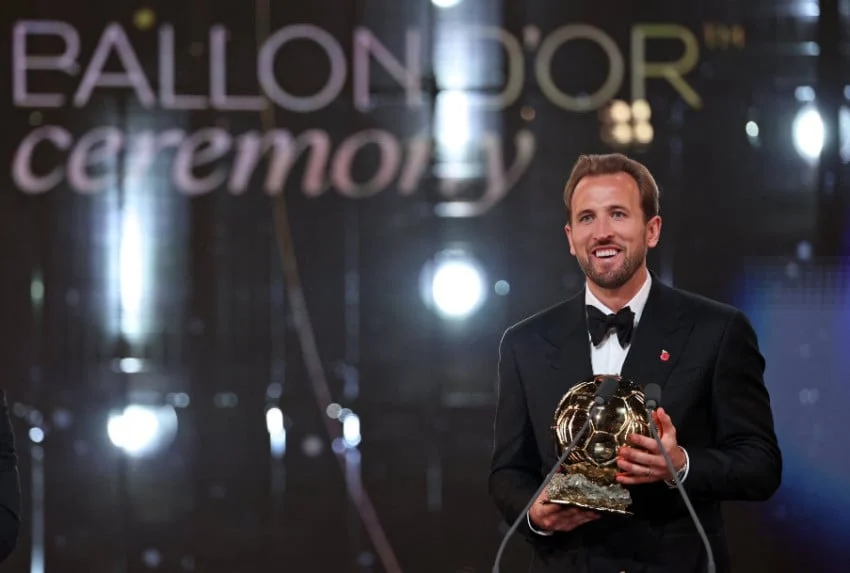
The 70th edition of the Ballon d’Or concluded on Tuesday, October 27, 2026, at the London Palladium Theatre, where English striker Harry Kane was officially crowned the recipient of football’s most prestigious individual honor. The ceremony, which marked a departure from the award’s traditional home in Paris, saw the sport’s elite gather to celebrate a year of exceptional performance, tactical evolution, and record-breaking statistics. Kane’s victory stands as a landmark achievement in his career, cementing his status as one of the most prolific forwards of his generation and validating his transition into a global talisman for both club and country.
A Night of Transition and Prestige
For seven decades, the Ballon d’Or has been synonymous with the glamour of Paris. However, in a strategic move to broaden the global appeal of the event, organizers relocated the 2026 proceedings to the heart of London. The choice of the London Palladium provided a fitting backdrop for an evening defined by high stakes and intense anticipation. The air of uncertainty surrounding this year’s winner was amplified by a high-profile administrative error that had dominated the sporting headlines in the hours leading up to the gala.
Earlier in the day, the official Ballon d’Or website inadvertently published draft articles that prematurely announced Harry Kane, Kylian Mbappé, and Lamine Yamal as the respective winners. This technical mishap, which triggered widespread speculation on social media and international news outlets, required an immediate and formal clarification from the committee. Officials confirmed that the articles were pre-prepared templates—a standard media practice intended to streamline the publication process once the final results were verified—and were accidentally pushed live. The committee categorically denied that these drafts reflected any internal leaks or biased projections, emphasizing that the final voting tally remained strictly confidential until the very moment the envelopes were opened on stage.
The Rise of Harry Kane: A Career Defined by Consistency
Harry Kane’s triumph in 2026 is the culmination of a campaign defined by surgical precision and leadership. Throughout the 2025-2026 season, Kane maintained a goal-scoring frequency that set him apart from his peers. His ability to act as both a traditional number nine and a creative playmaker—often dropping deep to dictate the flow of the game—has redefined the tactical requirements for a modern striker.
Analysts point to his contribution in domestic league competitions and his pivotal role in international tournaments as the primary catalysts for his success. Beyond the raw data of goals scored and assists provided, Kane’s leadership during high-pressure matches played a decisive role in the jurors’ final decisions. Having previously come close to the podium in years past, this victory represents the pinnacle of his professional journey, likely influencing his legacy in the pantheon of footballing greats.
The Women’s Game: Alexia Putellas Reclaims the Throne
While the men’s category captured significant media attention, the women’s Ballon d’Or remained equally competitive. Alexia Putellas, the Barcelona Femeni star, was awarded the trophy for 2026, marking another significant milestone in her illustrious career. Putellas has been a dominant force in women’s football for the better part of a decade, and her technical proficiency, vision, and tactical intelligence remain unmatched.
Her win underscores the continued dominance of Barcelona Femeni, who were also recognized as the Club of the Year in the women’s category. The rise in prestige for the women’s award reflects the broader global trend of increased investment and viewership in women’s sports. The 2026 ceremony highlighted that the gap between the visibility of the men’s and women’s awards is narrowing, as fans and pundits alike now approach both categories with equal seriousness and critical analysis.
Institutional Excellence: PSG and Barcelona
The 2026 Ballon d’Or ceremony also took the opportunity to recognize the collective efforts that underpin individual success. Paris Saint-Germain (PSG) secured the award for the Men’s Club of the Year, a testament to their domestic consistency and strategic recruitment throughout the 2025-2026 period. In the women’s division, Barcelona Femeni’s recognition as the top club solidified their status as the premier institution in European women’s football.
The goalkeeper position, often the most overlooked in individual award ceremonies, saw Unai Simon honored as the Yachine Trophy winner for the best male goalkeeper of 2026. Simon’s reflexes, composure under pressure, and ability to command the defensive line were identified as critical factors in his team’s defensive stability throughout the year. His win highlights the growing appreciation for the specialized skill set required of modern goalkeepers, who are increasingly tasked with initiating offensive transitions from the back.
The Voting Process and Jury Integrity
The Ballon d’Or is decided by a panel of international journalists, with each representative tasked with evaluating candidates based on three primary criteria: individual performance and decisive and impressive character; collective performance and achievements with their team; and the player’s class and fair play.
The 2026 voting process was subjected to rigorous oversight, particularly following the aforementioned technical error on the official website. To ensure transparency, the organizers have stated that the full breakdown of the votes—showing how each journalist cast their ballot—will be published in the coming weeks. This commitment to data transparency is designed to mitigate concerns regarding bias and to uphold the integrity of the award in an era where digital information can be easily manipulated or misunderstood.
Impact and Future Implications
The implications of the 2026 awards are profound. For Harry Kane, this accolade shifts the conversation regarding his place in history, effectively silencing critics who argued that his lack of major silverware in earlier years precluded him from winning the game’s highest individual honor. For the footballing world, the transition to London as a host city signals a potential shift in how the Ballon d’Or will be presented in the future. By moving the event to different global hubs, the organizers are signaling an intent to modernize the brand and move away from the static, tradition-heavy approach that characterized the early decades of the award.
Furthermore, the prominence of younger stars like Lamine Yamal among the top candidates indicates a generational shift in the sport. The 2026 shortlist featured a significant number of players under the age of 23, suggesting that the era of dominance by the previous generation—most notably the duopoly held by Lionel Messi and Cristiano Ronaldo for over a decade—has fully transitioned into a new, more fragmented era of competition.
A Historical Milestone
As the lights dimmed at the London Palladium, the consensus among attendees was that the 2026 Ballon d’Or ceremony had achieved its goal of celebrating excellence in a fair and modern manner. Despite the minor controversy involving the premature publication of candidate profiles, the event succeeded in honoring those who have defined the year.
The 70th anniversary of the award served as more than just a trophy presentation; it was a snapshot of the current state of football. From the tactical brilliance of Harry Kane to the technical mastery of Alexia Putellas, the winners represent a diverse and highly skilled group of athletes who continue to push the boundaries of what is possible on the pitch. As the footballing world turns its attention to the next season, the standards set in London will undoubtedly serve as the benchmark for the coming year, reminding all players that, in the pursuit of the Ballon d’Or, consistency, performance, and character remain the ultimate currency.