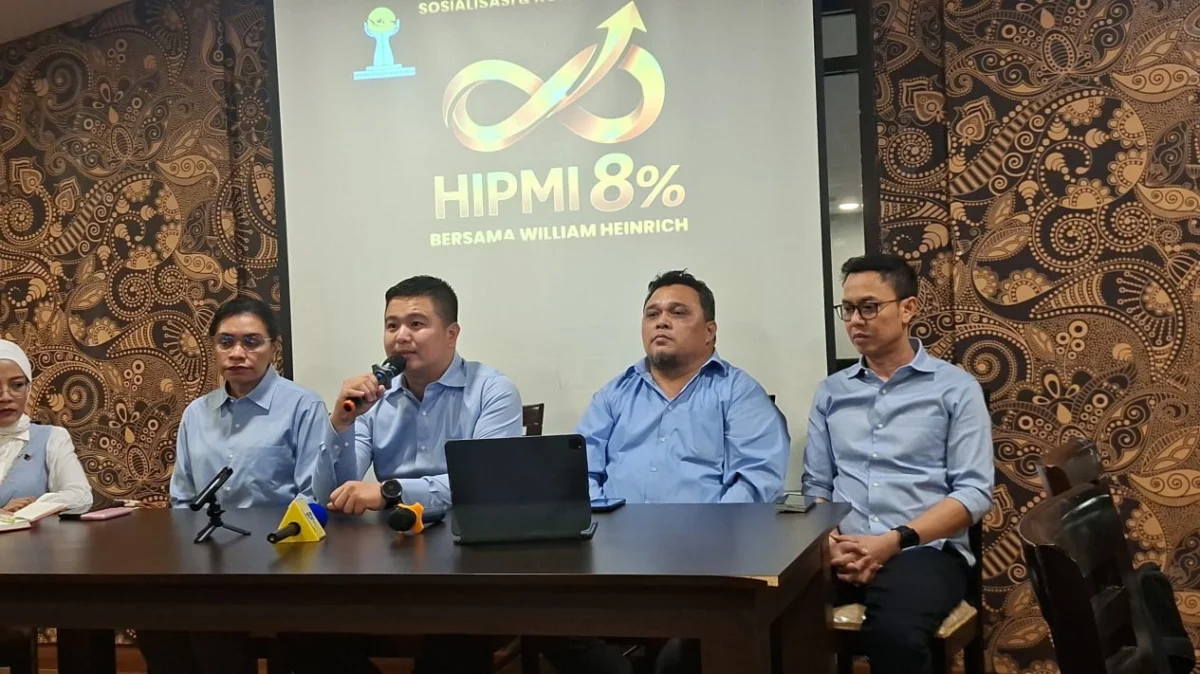
Jakarta, VIVA – In a significant declaration poised to reshape the discourse around Indonesia’s economic future, William Heinrich, a prominent candidate for the chairman of BPP HIPMI (Badan Pengurus Pusat Himpunan Pengusaha Muda Indonesia – Central Board of the Indonesian Young Entrepreneurs Association), has introduced a comprehensive strategic concept dubbed ‘HIPMI 8%’. This ambitious initiative, unveiled during a press conference held at the prestigious SCBD in South Jakarta on Wednesday, April 15, 2026, at 21:46 WIB, is designed as a concrete contribution to accelerate national economic growth, aligning directly with and supporting the economic policy direction championed by President-elect Prabowo Subianto.
Heinrich’s ‘HIPMI 8%’ vision is not merely an aspirational target but is presented as a fundamental necessity for Indonesia to successfully navigate and ultimately escape the pervasive middle-income trap. His assertion underscores the urgency of achieving an 8 percent economic growth rate, a figure he believes is critical for sustained prosperity and structural transformation. The conceptual framework detailed by Heinrich during the event highlighted the critical juncture Indonesia currently faces, emphasizing that the nation’s demographic bonus—a period characterized by a large working-age population—must be strategically leveraged. This period, often seen as a window of immense opportunity, demands proactive and integrated measures involving all societal elements, particularly young entrepreneurs who are positioned as vital drivers of the real sector economy.
The Genesis of ‘HIPMI 8%’: A Bold Economic Vision
The core premise of William Heinrich’s ‘HIPMI 8%’ concept stems from a pragmatic assessment of Indonesia’s current economic limitations and future potential. Heinrich argued that the state’s inherent fiscal constraints mean that the government alone cannot bear the full burden of achieving aggressive economic targets. This recognition necessitates a more active, pivotal role for organizations like HIPMI. He passionately articulated that HIPMI must transcend its traditional function and evolve into a dynamic, productive force capable of generating substantial added value. This transformation, he explained, means moving beyond mere reliance on government projects and instead fostering an ecosystem where young entrepreneurs become independent engines of growth, innovation, and job creation.
The call for an 8 percent economic growth rate is not without precedent in national development discussions. Historically, periods of rapid industrialization and poverty reduction in East Asian tigers were often accompanied by similar growth figures. For Indonesia, which has averaged around 5 percent growth in recent years, achieving an 8 percent target would represent a significant leap, demanding unprecedented levels of investment, productivity gains, and structural reforms. Heinrich’s proposal suggests that HIPMI, through its vast network and entrepreneurial spirit, can catalyze a substantial portion of this required acceleration.
Addressing Economic Inefficiency: The ICOR Challenge
A significant pillar of Heinrich’s strategy focuses on tackling the issue of national economic efficiency, a persistent challenge for Indonesia. He specifically highlighted the country’s high Incremental Capital Output Ratio (ICOR), which he identified as indicative of sub-optimal capital utilization. ICOR measures the additional capital required to generate an extra unit of output; a higher ICOR implies that more investment is needed to produce the same level of economic growth, suggesting inefficiencies in how capital is deployed. Indonesia’s ICOR, which has often hovered above 4 or 5, indicates that investments are not yielding their full potential returns compared to more efficient economies.
To counter this, Heinrich proposed that HIPMI would actively serve as an "agent for ICOR reduction." This would be achieved primarily through enhancing Total Factor Productivity (TFP), a measure of efficiency in the use of capital and labor. His plan outlines several key interventions:
- Digitalization of Businesses: Encouraging and facilitating the adoption of digital tools and platforms across young entrepreneurs’ ventures to streamline operations, reach wider markets, and reduce transactional costs. This includes e-commerce integration, digital marketing, and cloud-based management systems.
- Technology Utilization: Promoting the integration of advanced technologies, from automation in manufacturing to data analytics in service industries, to improve operational efficiency and product quality. This could involve partnerships with tech incubators and research institutions.
- Supply Chain Efficiency: Working to optimize supply chains, reducing waste, improving logistics, and fostering better coordination among various actors. This might involve adopting supply chain management software, developing local sourcing networks, and promoting just-in-time inventory systems.
By implementing these measures, Heinrich posited that investments would yield significantly greater and more sustainable output. This would not only make Indonesian businesses more competitive but also contribute directly to a more efficient national economy, making the 8 percent growth target more attainable with the same or even less capital input relative to current practices.
Strengthening State Revenue and Expanding the Tax Base
Another critical aspect of the ‘HIPMI 8%’ concept addresses the imperative of strengthening state revenue, particularly within a context where the government is committed to safeguarding public purchasing power. Heinrich acknowledged the government’s decision to maintain the Value Added Tax (VAT) at 11 percent, a move aimed at preventing undue inflationary pressures on consumers. In this environment, where increasing existing tax rates might be counterproductive, Heinrich proposed a strategy centered on broadening the tax base through the creation of formal employment opportunities.
HIPMI, under his leadership, would be refocused as a primary platform for developing young entrepreneurs who are not only capable of achieving profitability but also making tangible contributions to state revenue. This means nurturing businesses that are formally registered, compliant with tax regulations, and actively absorbing local labor into formal employment structures. The shift towards formal employment is crucial for expanding the tax base, as formal sector workers typically contribute through income tax, and their employers contribute through corporate taxes and other levies.
As a concrete commitment, William Heinrich set a challenging target: the establishment of 10,000 new productive entrepreneurs who are not only able to survive but thrive, generate profits, and, crucially, absorb local manpower. This cohort of new businesses is envisioned to significantly bolster the formal sector. Furthermore, Heinrich plans a fundamental reform of HIPMI’s organizational performance indicators, shifting the emphasis from purely ceremonial activities to measurable, real economic impact. He projects that if this strategy is optimally executed, the collective contribution of HIPMI members could generate an additional economic output of up to Rp20 trillion in the domestic market. This figure, if realized, would represent a substantial injection into the national economy, reinforcing the proposed 8 percent growth target.
Leveraging New Financial Architectures: The Role of Danantara
Heinrich also touched upon the evolving landscape of national economic architecture, which he believes presents vast opportunities for young entrepreneurs, particularly concerning access to financing. He specifically highlighted the emergence of investment institutions like Danantara, which he sees as a pivotal development for strengthening funding access. Danantara, along with similar initiatives, represents a new wave of financial mechanisms designed to bridge the funding gap often faced by small and medium-sized enterprises (SMEs) and startups, which constitute a significant portion of HIPMI’s membership.
By leveraging these new financial avenues, HIPMI aims to facilitate easier access to capital for its members, enabling them to scale their operations, invest in technology, and expand their market reach. This support for funding is crucial for the successful implementation of the ‘HIPMI 8%’ strategy, as the creation of 10,000 new productive entrepreneurs and the drive for TFP improvement will require significant capital injection. The collaboration between HIPMI and such investment bodies could create a robust ecosystem where promising entrepreneurial ventures receive the necessary financial backing to grow and contribute to the national economy.
Contextualizing the Ambition: Indonesia’s Economic Landscape and Challenges
Indonesia, the largest economy in Southeast Asia, stands at a critical juncture. The nation has made remarkable progress in poverty reduction and economic development over the past decades. However, the aspiration to become a high-income country faces the formidable challenge of the "middle-income trap." This economic phenomenon describes a situation where a country’s growth stalls after reaching middle-income levels, failing to transition to high-income status. This typically occurs when the advantages of cheap labor are exhausted, but the economy has not yet developed the high-value-added industries, innovation capacity, and strong institutions characteristic of advanced economies. For Indonesia, escaping this trap requires sustained high growth rates, significant structural reforms, and a relentless focus on productivity and human capital development.
The country is currently experiencing a "demographic bonus," with a large proportion of its population in the productive age group (15-64 years). This window of opportunity, projected to last until around 2045, presents immense potential for economic growth if effectively harnessed. However, it also poses a challenge: the need to create sufficient quality jobs for millions of new entrants into the workforce each year. Failure to do so could transform the demographic bonus into a demographic burden, leading to social instability and economic stagnation. Heinrich’s emphasis on creating 10,000 new productive entrepreneurs directly addresses this need, aiming to generate meaningful employment opportunities.
Indonesia’s economic growth has averaged around 5 percent in recent years, a respectable figure but one that falls short of the 7-8 percent growth rates often cited as necessary to escape the middle-income trap within a generation. Achieving 8 percent growth would require significant policy coordination, massive public and private investment, and a conducive business environment. The government’s fiscal space, while managed prudently, does have limitations, reinforcing the argument that private sector-led growth, championed by initiatives like ‘HIPMI 8%’, is indispensable.
President-elect Prabowo Subianto’s economic agenda has consistently highlighted themes of national self-reliance, job creation, strengthening micro, small, and medium enterprises (MSMEs), and fostering a robust domestic economy. Heinrich’s ‘HIPMI 8%’ concept aligns seamlessly with these priorities, offering a private-sector-driven mechanism to translate these overarching goals into tangible economic outcomes.
HIPMI’s Strategic Position and Historical Impact
Himpunan Pengusaha Muda Indonesia (HIPMI) was founded in 1972 and has since grown into one of Indonesia’s most influential young entrepreneurs’ associations. Its mission revolves around fostering entrepreneurship, developing business acumen among young Indonesians, and advocating for policies that support the growth of the private sector. HIPMI has historically served as a crucial stepping stone for many prominent business leaders and even political figures in Indonesia, highlighting its significant role in national development.
The election for the chairman of BPP HIPMI is a highly anticipated event, often seen as a barometer of the future direction of young entrepreneurship in the country. Candidates typically present their visions and programs, which are then debated and scrutinized by the association’s vast membership. William Heinrich’s detailed ‘HIPMI 8%’ proposal positions him as a candidate with a clear, data-driven, and ambitious economic agenda, seeking to elevate HIPMI’s role from a networking organization to a strategic economic actor.
Expert Perspectives and Potential Receptions
The ambition of achieving 8 percent economic growth and HIPMI’s proposed role in it will undoubtedly elicit varied reactions from economists, government officials, and the broader business community.
- Economists’ View: While acknowledging the necessity of high growth, many economists might view an 8 percent target as highly challenging, requiring not only increased investment but also fundamental structural reforms in areas like bureaucracy, legal certainty, and infrastructure. The proposed reduction in ICOR through TFP improvement is theoretically sound but practically complex to implement at a national scale through a single organization. Experts would likely emphasize the need for robust data, transparent reporting, and strong collaboration with government agencies to verify the impact of HIPMI’s initiatives.
- Government’s Stance (Inferred): Government officials would likely express general support for private sector initiatives that align with national development goals, particularly those focused on job creation and increasing productivity. However, they might also underscore the need for realistic planning and effective coordination between all stakeholders. The government would likely welcome HIPMI’s commitment but would also stress that the ultimate responsibility for macroeconomic stability and growth lies with the state.
- Business Community Reaction (Inferred): The business community would likely welcome a clear and ambitious roadmap for economic contribution. Many entrepreneurs within HIPMI would likely be energized by the prospect of a more impactful, results-oriented organization. However, there might also be questions regarding the practical implementation, the support mechanisms for achieving the 10,000 new entrepreneurs target, and the sustainability of the Rp20 trillion output projection. Other HIPMI leaders or candidates might offer alternative approaches or critique the feasibility of certain aspects of Heinrich’s plan, contributing to a vibrant internal debate within the association.
Implementation Challenges and Road Ahead
The successful implementation of the ‘HIPMI 8%’ concept hinges on overcoming several significant challenges. The target of creating 10,000 new productive entrepreneurs who are profitable and absorb local labor is a monumental task that requires more than just good intentions. It necessitates robust mentorship programs, access to business development resources, streamlined regulatory processes, and continuous market analysis. Ensuring their sustained profitability and growth beyond the initial phase is equally critical.
The mechanism for HIPMI to effectively reduce the national ICOR through TFP improvement needs to be clearly defined and scaled. While digitalization and technology adoption are crucial, their widespread and effective implementation across a diverse range of young enterprises will require significant investment in education, infrastructure, and access to affordable technology.
Measuring and verifying the projected Rp20 trillion in additional economic output will require a sophisticated monitoring and evaluation framework. Transparency and accountability will be paramount to demonstrate the tangible impact of HIPMI’s transformed key performance indicators.
Ultimately, the success of William Heinrich’s ‘HIPMI 8%’ strategy will depend heavily on robust collaboration—not only among HIPMI members but also with government ministries, financial institutions, academic bodies, and other industry associations. It represents an ambitious yet critical undertaking, reflecting a growing awareness among Indonesia’s young business leaders that their collective action is indispensable for steering the nation towards a future of sustained prosperity and firmly escaping the middle-income trap. The coming months will reveal how this bold vision resonates with the broader entrepreneurial community and its potential to translate into concrete economic transformation.