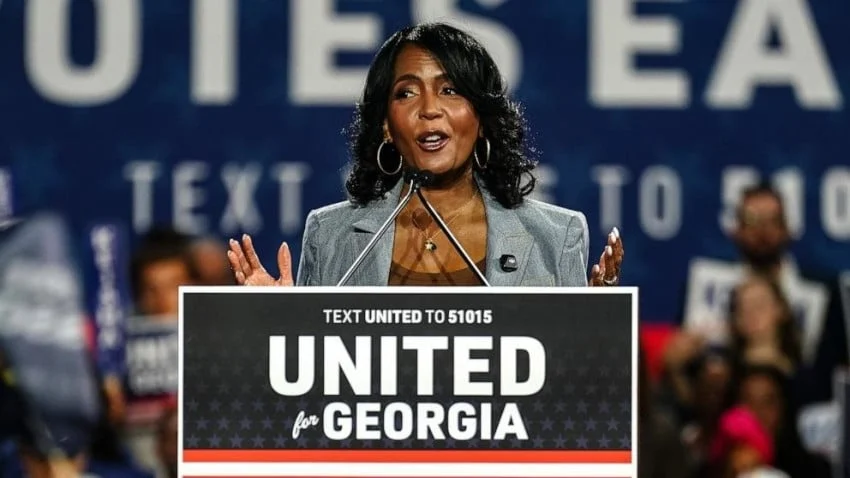
WASHINGTON — In a monumental shift for American politics, Keisha Lance Bottoms secured a historic victory on Tuesday, triumphing over Republican challenger Rick Jackson in the fiercely contested Georgia gubernatorial race. With this decisive win, Bottoms shatters a centuries-old political ceiling, officially becoming the first elected Black female governor in the history of the United States. Furthermore, her victory marks a significant milestone for the state of Georgia, as she becomes both the first woman and the first African American ever elected to the state’s highest executive office—positions historically held exclusively by white men.
Running on the Democratic ticket, Bottoms will succeed outgoing Republican Governor Brian Kemp, who was constitutionally barred from seeking a third consecutive term due to state-mandated term limits. Bottoms’ victory also flips the Georgia governorship back into Democratic hands for the first time in over two decades, marking a major turning point in the political landscape of the American Deep South. The outcome of this race not only alters the balance of power in a crucial swing state but also reverberates across the national political stage, signaling shifting voter demographics and political alignments.
The Path to Victory: A Chronology of the 2026 Georgia Gubernatorial Race
The road to the Georgia governor’s mansion was marked by high-stakes campaigning, record-breaking fundraising, and intense national scrutiny. Georgia has increasingly transformed into a key battleground state over the past several election cycles, culminating in hyper-competitive statewide races.
The primary season set the stage for a dramatic general election. Keisha Lance Bottoms easily navigated the Democratic primary, leveraging her high name recognition and extensive political resume. Meanwhile, Rick Jackson consolidated the Republican base, running a campaign focused on economic conservatism, traditional values, and continuity with the policies of the outgoing Kemp administration.
As the general election progressed into the final months, both campaigns poured millions of dollars into television advertisements, digital outreach, and grassroots organizing. Key issues at the forefront of the debate included economic development, healthcare access, reproductive rights, education funding, and voting laws. Bottoms focused her campaign messaging on moving Georgia forward, expanding economic opportunity for all communities, and protecting fundamental rights. Jackson countered by emphasizing tax cuts, business deregulation, and public safety measures.
The turning point in the final weeks of the campaign involved aggressive voter turnout operations in both the suburban counties surrounding Atlanta—which have trended increasingly blue in recent years—and the traditionally conservative rural regions of the state. When polls closed on Tuesday evening, early returns showed a tight race, but as mail-in ballots and urban precincts reported, Bottoms steadily pulled ahead, ultimately securing a historic and insurmountable lead.
Background Context: Who Is Keisha Lance Bottoms?
To understand the magnitude of Keisha Lance Bottoms’ victory, one must examine her personal background and extensive career in public service. Born and raised in Atlanta, Georgia, Bottoms attended Frederick Douglass High School before pursuing higher education in her home state and neighboring Florida. She earned her Bachelor of Arts degree from Florida A&M University, a prestigious Historically Black University (HBCU), and subsequently obtained her Juris Doctor from the Georgia State University College of Law.
Bottoms’ journey to public service is deeply rooted in her personal history and family background. She is the daughter of the late R&B singer Major Lance and Sylvia Robinson. In various biographical accounts and public speeches, Bottoms has often spoken candidly about how the challenges of her youth—including her father’s struggles with the law and incarceration, alongside her mother’s financial hardships—profoundly shaped her worldview, instilled in her a deep empathy for marginalized populations, and sparked her lifelong commitment to the law and public advocacy.
Before capturing the national spotlight as governor-elect, Bottoms built an impressive resume in local and national governance. She served as a member of the Atlanta City Council, representing a diverse district and gaining hands-on experience in municipal policymaking. In 2017, she was elected as the 60th Mayor of Atlanta, leading the city through a period of significant economic growth as well as unprecedented challenges, including the COVID-19 pandemic and nationwide social justice protests following the murder of George Floyd.
Her leadership during these crises earned her widespread national attention, leading to her selection as a senior advisor to President Joe Biden and the Vice Chair of the Democratic National Committee (DNC). Her transition from municipal leadership and federal advisory roles to the statehouse positions her as one of the most prominent political figures in the country.
Supporting Data and Demographic Shifts in Georgia
Bottoms’ victory is underpinned by profound demographic and political shifts within the state of Georgia over the past decade. Long considered a reliably red, conservative stronghold, Georgia has experienced rapid urbanization, an influx of diverse residents moving from other parts of the country, and highly mobilized grassroots civic engagement organizations.
Data from the U.S. Census Bureau highlights that Georgia’s population has become increasingly diverse, with Black, Hispanic, and Asian American communities growing substantially. Fulton, DeKalb, Gwinnett, and Cobb counties—collectively known as the core Atlanta metropolitan area—have grown not only in population but also in their electoral weight.
Furthermore, voter registration initiatives spearheaded by local activists over the preceding years dramatically increased the number of registered voters across the state, particularly among young voters and communities of color. Turnout statistics from the election indicated robust participation across both urban centers and suburban battleground districts, demonstrating that high civic engagement was central to Bottoms’ electoral coalition.
Official Responses and Reactions
The historic nature of the election prompted immediate reactions from political leaders, civil rights organizations, and citizens across the United States.
From Washington, D.C., presidential statements and congressional leaders from both sides of the aisle acknowledged the historic milestone. Democratic leadership praised Bottoms for her resilience, leadership capabilities, and the symbolic importance of breaking a major glass ceiling in the American South. Supporters gathered at Bottoms’ election night headquarters in Atlanta erupted in cheers as the race was called, waving campaign signs and celebrating what many described as the dawn of a new political era for the state.
Conversely, Republican campaign officials and state party representatives expressed disappointment with the outcome while emphasizing the importance of legislative checks and balances. Given that the Georgia General Assembly maintains a conservative majority in both the state House and Senate, Republican leaders pledged to work constructively with the incoming governor on shared priorities such as economic growth and infrastructure development, while standing firm on conservative policy principles regarding taxation and regulation.
Civil rights groups and historical societies also noted the deep cultural significance of the moment. Organizations dedicated to the legacy of the Civil Rights Movement pointed out the poetic justice of Atlanta—the cradle of the civil rights movement—producing the nation’s first elected Black female governor in a state once defined by racial segregation and disenfranchisement.
Broader Impact and Implications for American Politics
The election of Keisha Lance Bottoms carries wide-ranging implications for the future of American politics, particularly regarding party strategies in the American South and the ongoing evolution of swing-state dynamics.
First, the return of the Georgia governorship to the Democratic Party challenges the traditional map of Southern politics. It proves that statewide victories for Democrats are sustainable in the region when candidates can successfully coalition-build across urban, suburban, and rural divides. This outcome will likely influence campaign strategies for upcoming midterm and presidential election cycles, forcing national parties to heavily invest in Southern battlegrounds.
Second, Bottoms’ ascension to the governorship places her immediately into the upper echelon of national Democratic leadership. As a former mayor, federal advisor, and now state governor, she joins a select group of executives managing major state economies and governance structures. Observers suggest that her tenure will be closely watched by national political analysts evaluating executive competence, fiscal management, and the ability to govern in a politically divided legislative environment.
Finally, the symbolic weight of the achievement cannot be overstated. By breaking the dual barriers of race and gender in Georgia’s highest office, Bottoms provides a powerful role model for a new generation of diverse leaders across the United States. Her journey from the daughter of an R&B artist navigating financial hardship to the chief executive of the ninth-most populous state in the nation stands as a testament to the changing contours of American democracy.
As Governor-elect Bottoms prepares for her upcoming inauguration, her administration will face immediate policy challenges, including state budget allocations, healthcare policy negotiations, and infrastructure planning. However, Tuesday night belonged to history, as voters in Georgia charted a definitive new course for their state and the nation as a whole.