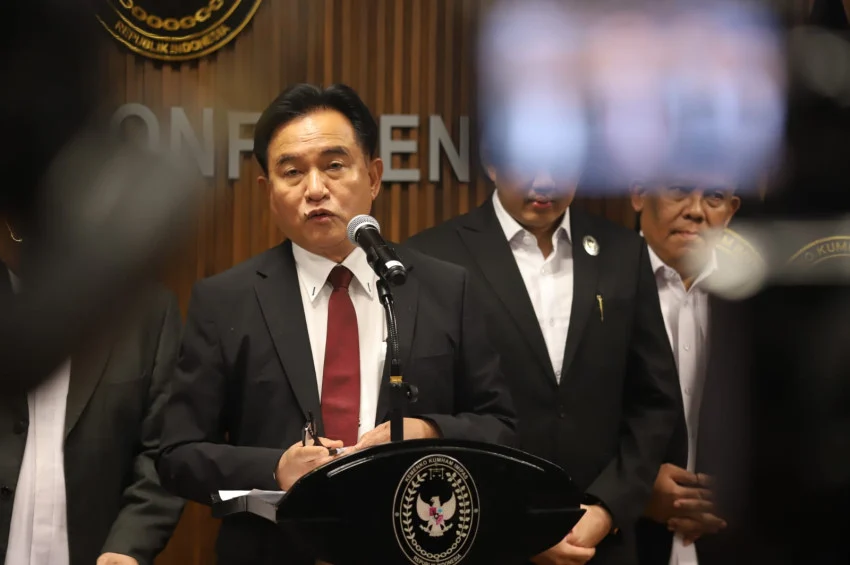
JAKARTA — Coordinating Minister for Legal, Human Rights, Immigration, and Corrections Yusril Ihza Mahendra addressed the media late Tuesday evening regarding the escalating national security crisis surrounding an unprecedented illegal wiretapping operation targeting the highest levels of the Indonesian government. Speaking in Jakarta on November 3, 2026, Minister Yusril stated that he has not yet received any formal reports indicating whether Vice President Gibran Rakabuming Raka was included among the high-profile targets of the covert surveillance operation.
When questioned by reporters on whether the Vice President’s communications had also been compromised, Yusril offered a cautious response. "Wallahualam bissawab," Yusril remarked, using the Arabic phrase denoting that only God knows the absolute truth of matters beyond human knowledge at present.
The Coordinating Minister clarified that official briefings and investigative disclosures presented to him thus far have explicitly named President Prabowo Subianto, a select group of cabinet ministers, and various prominent politicians as primary targets of the illicit interception. Consequently, he emphasized that he cannot definitively confirm or deny whether Vice President Gibran was monitored by the perpetrators.
"What I have heard so far involves President Prabowo, a number of ministers, and several politicians. Therefore, I do not know yet whether the Vice President was also subjected to wiretapping," Yusril explained to the press corps.
The explosive revelations come in the wake of a sweeping criminal investigation led by the Indonesian National Police’s Criminal Investigation Agency (Bareskrim Polri). Bareskrim officially announced the designation of three high-ranking figures as suspects in a sprawling conspiracy involving illegal wiretapping, the malicious destruction of electronic data, and unauthorized computer access.
Among the primary suspects is former National Police Chief and current Chief of Staff to the President, Listyo Sigit Prabowo. The involvement of such a senior state official has sent shockwaves through the nation’s political landscape, raising urgent questions regarding institutional loyalty, internal security vulnerabilities, and the integrity of Indonesia’s top-tier governance structures. Alongside Listyo Sigit Prabowo, Bareskrim has named two other active-duty high-ranking police officials as suspects: Head of the National Police Legal Division Inspector General Ahrie Sonta, and Inspector General Eko Hadi Santoso.
According to preliminary findings released by law enforcement authorities, the suspects allegedly orchestrated a systematic operation to intercept telecommunications across numerous sensitive phone numbers. The targeted network reportedly extended far beyond executive branch leadership, encompassing key state officials, influential political figures, media executives, and leading business tycoons.
Chronology and Background of the Wiretapping Investigation
The unfolding scandal represents one of the most severe breaches of state security in modern Indonesian history. Whispers of compromised communications networks began circulating within elite political circles in Jakarta several weeks prior to the formal police announcements. Security analysts noted unusual anomalies in secure communication channels used by top policymakers, prompting an internal counter-intelligence sweep.
By late October 2026, initial digital forensics conducted by specialized cybercrime units uncovered unauthorized interception hardware and software proxies linked to rogue elements within state apparatuses. The trail eventually led investigators to the doorstep of high-ranking law enforcement and administrative officials.
On Tuesday, November 3, 2026, the National Police’s Bareskrim division held a heavily attended press conference to detail the initial findings and formally announce the criminal charges against Listyo Sigit Prabowo and his co-conspirators. The charges—spanning illegal interception under the Electronic Information and Transactions (ITE) Law, unauthorized data destruction, and systemic abuse of administrative authority—carry severe potential penalties under Indonesian criminal jurisprudence.
As the investigation widens, federal investigators are working around the clock to determine the full scope of the intelligence gathered by the conspirators, the ultimate destination of the intercepted data, and whether foreign or domestic non-state actors were involved in commissioning or abetting the operation.
Implications for National Security and Executive Stability
The revelation that the sitting President of the Republic of Indonesia, along with key cabinet ministers, was targeted by illegal surveillance has triggered immediate ramifications across the political and economic spheres. Experts in constitutional law and state security have pointed out several critical areas of concern arising from the scandal.
First, the crisis exposes vulnerabilities within the nation’s secure communication infrastructure. Protecting the private communications of the head of state and the executive cabinet is a paramount function of national intelligence agencies. The fact that high-ranking security officials themselves allegedly spearheaded the wiretapping points to a profound failure of internal oversight and institutional vetting.
Second, the involvement of the Chief of Staff to the President complicates executive branch operations. President Prabowo Subianto’s administration now faces the delicate task of purging compromised elements from critical advisory positions while maintaining governmental continuity and public trust.
Third, the ambiguity surrounding Vice President Gibran Rakabuming Raka’s status highlights the fluid and incomplete nature of the ongoing Bareskrim investigation. As law enforcement agencies continue to audit the seized digital evidence and server logs, further disclosures are expected in the coming days. The potential inclusion of the Vice President in the wiretapping logs would dramatically escalate the constitutional implications of the case, suggesting a total compromise of the executive leadership duo.
Official Responses and Expected Developments
In the wake of the Bareskrim announcement, representatives from various political parties, civil society organizations, and human rights watchdogs have called for absolute transparency and a thorough, unhindered judicial process. Lawmakers in the House of Representatives (DPR) have indicated plans to summon relevant security chiefs to a hearing to demand accountability and legislative oversight regarding state intelligence protocols.
Meanwhile, the Ministry of Law, Human Rights, Immigration, and Corrections, under the leadership of Yusril Ihza Mahendra, is coordinating with legal defense and administrative bodies to ensure that state protocols are strictly adhered to as the legal proceedings advance against the accused officials.
As the investigation progresses, the primary focus for prosecutors will be establishing the motive behind the widespread surveillance. Whether driven by political leverage, corporate espionage, or broader factional maneuvering within the state apparatus, the illegal wiretapping case stands as a defining test of Indonesia’s legal institutions and their ability to uphold the rule of law without fear or favor.