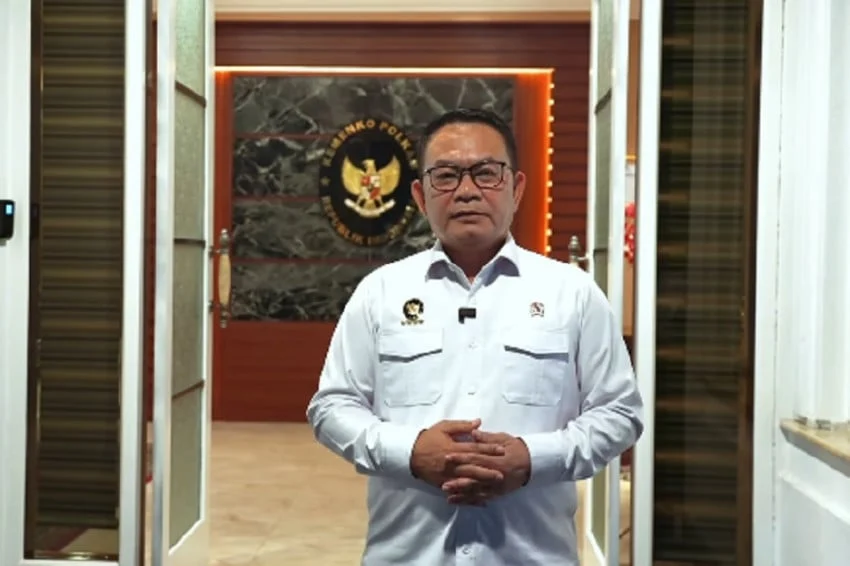
The political and security landscape of Indonesia was recently shaken by an unprecedented institutional crisis within the Indonesian National Police (Polri), following the official naming of three high-ranking police generals as suspects in a high-stakes presidential wiretapping scandal. The gravity of the allegations—involving the clandestine interception of communications targeting the nation’s highest office—has prompted swift reactions from the highest levels of government, most notably from the Coordinating Minister for Political and Security Affairs (Menko Polkam), General TNI (Ret.) Dudung Abdurachman. In a formal address issued in Jakarta, Minister Dudung sought to reassure the public that despite the severity of the charges and the unprecedented nature of the internal investigation, the overarching stability, security, and public order of the republic remain firmly intact.
The revelation has sent shockwaves through both political and legal circles across the archipelago, triggering widespread public debate regarding institutional oversight, cybersecurity, and the limits of intelligence operations within state agencies. As investigators work diligently to unravel the complexities of the alleged conspiracy, government officials, legal experts, and civil society organizations are closely monitoring developments to gauge the broader implications for Indonesia’s democratic institutions and the rule of law.
National Security Assurances Amid Institutional Turmoil
Addressing the nation following the confirmation of the charges, Menko Polkam Dudung Abdurachman emphasized that the government is maintaining strict oversight of the situation. He directly appealed to the Indonesian populace to remain calm, exercise restraint, and avoid spreading or reacting to unverified information circulating across digital platforms and traditional media channels.
"We want to convey to the entire Indonesian community that the situation regarding national security and public order remains well-maintained and under control. The public does not need to feel anxious or worried," Minister Dudung stated in an official release.
The minister framed the unfolding legal crisis not as a systemic failure of the state apparatus, but rather as a profound internal reckoning within a major organization. According to Dudung, the legal proceedings against the three generals represent a necessary phase in institutional life—one that serves as a critical momentum for comprehensive self-evaluation, internal cleansing, and institutional strengthening. He reiterated that the government remains fully committed to upholding transparency and accountability, stressing that no individual, regardless of rank or uniform, stands above the law.
Background Context of the Wiretapping Scandal
The roots of this unprecedented scandal trace back to mounting tensions regarding intelligence operations, institutional boundaries, and the security protocols protecting state leaders. The allegations of presidential wiretapping surfaced during a period of heightened political sensitivity, where intelligence-gathering capabilities and state surveillance technologies became subjects of intense internal scrutiny.
In democratic states, the protection of the head of state from unauthorized surveillance is paramount. The alleged compromise of presidential communications by senior law enforcement officials represents a severe breach of national security protocols and a direct challenge to the constitutional hierarchy. Wiretapping, when conducted outside the strict parameters of legal authorization and judicial oversight, constitutes a grave violation of privacy laws and criminal statutes. The involvement of high-ranking generals—individuals entrusted with the command and oversight of national law enforcement and intelligence assets—adds a layer of institutional betrayal that has deeply troubled security analysts.
Prior to the formal naming of the three generals as suspects, internal security audits and preliminary investigations conducted by specialized oversight bodies detected unauthorized communication intercepts directed toward high-profile state targets. The trail of digital evidence and internal whistleblowing eventually pointed toward high-level command structures within Polri, compelling investigators to escalate the case from an internal disciplinary inquiry to a full-scale criminal investigation.
Chronology and Timeline of the Investigation

The progression of the case has moved swiftly, capturing the sustained attention of the Indonesian public. While full operational details remain shielded due to ongoing investigations, the general timeline of events underscores the gravity of the institutional response:
- Initial Detection and Internal Audits: Months prior to the public announcement, specialized internal security and cyber-forensic units detected anomalies in secure communication channels used within government circles, prompting a confidential counter-intelligence sweep.
- Escalation to Criminal Probe: As preliminary evidence mounted, indicating the potential involvement of high-ranking personnel, the case was handed over to specialized investigative teams tasked with maintaining absolute neutrality and professional integrity.
- Formal Suspect Designation: In early November 2026, investigative authorities formally announced the designation of three high-ranking police generals—including prominent figures within the command structure such as General Listyo Sigit and two other high-ranking officers—as suspects in the illegal wiretapping of the president.
- Government Response and Public Reassurance: Immediately following the public disclosure, the Ministry for Political and Security Affairs, alongside police headquarters, issued coordinated statements to confirm the ongoing legal process while guaranteeing institutional continuity and internal solidarity.
Official Responses and Polri’s Stance on Internal Solidary
The leadership of the Indonesian National Police has moved quickly to manage the fallout from the scandal, emphasizing that the institution remains united and focused on its core duties despite the legal troubles facing some of its most senior officers. In statements released alongside the government’s briefings, Polri leadership assured the public that the organization’s operational readiness, regional commands, and public service delivery will not be compromised by the ongoing criminal proceedings.
Internal affairs divisions have pledged full cooperation with the investigative teams, signaling a departure from historical tendencies to shield high-ranking personnel from legal accountability. Legal experts have noted that this transparent handling of the case is crucial for restoring public trust in an institution that relies heavily on community confidence to maintain law and order.
Furthermore, legislative members from the House of Representatives (DPR RI) have called for comprehensive parliamentary oversight to ensure that the investigation proceeds without political interference. Lawmakers stressed the importance of modernizing and strictly regulating surveillance technologies used by state agencies to prevent future abuses of power.
Broader Impact and Implications for Indonesian Governance
The inclusion of three police generals in a presidential wiretapping investigation carries profound implications for the future of civil-military and law enforcement governance in Indonesia. First and foremost, it tests the resilience of the nation’s democratic checks and balances. The willingness of state investigators to pursue criminal charges against individuals holding the highest ranks within the police force demonstrates a strengthening of the rule of law, signaling that accountability mechanisms are functioning even at the apex of power.
From a technological and security perspective, the scandal highlights urgent vulnerabilities in Indonesia’s critical infrastructure and state communication networks. Cybersecurity experts have emphasized the imperative need to upgrade encryption standards, enforce strict access controls, and establish independent oversight bodies to monitor the deployment and utilization of interception technologies by state actors. Without robust institutional safeguards, the misuse of advanced surveillance tools poses a latent threat to democratic freedoms and political stability.
Economically and socially, maintaining calm—as urged by Menko Polkam Dudung Abdurachman—is vital for preserving investor confidence and domestic tranquility. Financial markets and foreign investors closely monitor political stability and the predictability of legal systems when assessing risk in emerging markets. By projecting an image of resolute adherence to legal due process rather than attempting to conceal institutional misconduct, the Indonesian government aims to reassure stakeholders that the state remains stable and governed by established legal norms.
Conclusion and Outlook
As the legal process moves forward, the case involving the three generals will undoubtedly serve as a watershed moment for the Indonesian National Police and the broader security sector. The unfolding investigations will require absolute transparency, rigorous adherence to due evidence, and unwavering commitment from all state institutions to ensure justice is served impartially.
While the short-term impact involves navigating significant institutional shock and media scrutiny, the long-term outcome could pave the way for a more accountable, modernized, and structurally sound law enforcement apparatus. For now, the primary focus remains on preserving public order, ensuring the unhindered functioning of state governance, and allowing the judicial process to run its course without external pressure or disruption.