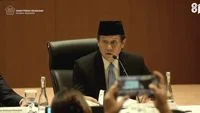
The internal stability of the National Mandate Party (PAN) has become a focal point of political discourse following the circulation of unverified reports alleging an imminent leadership transition. Viva Yoga Mauladi, the Deputy Chairman of PAN, has issued a definitive rebuttal regarding claims that Zulkifli Hasan, commonly known as Zulhas, is being ousted from his position as Chairman. These reports, which gained traction on various social media platforms following a meeting of the Forum for PAN Cadre Silaturahmi on November 9, were characterized by party leadership as "malicious misinformation" designed to sow discord within the organization.
The denial from the party’s central leadership serves as a strategic attempt to maintain unity as the party navigates a critical post-election cycle. With Zulkifli Hasan having recently secured his third consecutive term as Chairman during the party’s sixth national congress, the allegations of an internal coup have been framed by the party as a direct assault on the cohesion of its grassroots and elite structures.
The Anatomy of the Rumor and Official Rebuttal
The controversy originated from discussions surrounding the Forum Silaturahmi Kader PAN, a gathering that appeared to have been misinterpreted or intentionally mischaracterized in digital spaces. According to Viva Yoga Mauladi, the rumors suggested a fracture in the party’s top hierarchy, specifically implying that influential figures such as Hatta Rajasa, Drajad Wibowo, and Bima Arya were involved in a movement to challenge Zulhas’s authority.
In a formal statement released on Tuesday, November 10, Viva clarified that he had personally communicated with these figures to verify the claims. The response was unanimous: no such movement exists. "We have conducted direct confirmation with Bang Hatta Rajasa, Mas Drajad Wibowo, Mas Bima Arya, and others. The news is a hoax, completely untrue, and constitutes garbage reporting that pollutes the democratic space in Indonesia," Viva stated.
The party leadership views these rumors not merely as misinformation, but as a calculated political tactic. By framing the rumors as an "attempt to divide and conquer," PAN officials are signaling to their base that the party remains unified under the current mandate. Viva emphasized that the party’s strategic focus remains fixed on organizational consolidation and the execution of populist programs intended to propel PAN into the top three electoral powerhouses in the next general election.
A Chronology of Zulkifli Hasan’s Tenure
To understand the weight of these rumors, it is necessary to examine the evolution of Zulkifli Hasan’s leadership, which has defined the trajectory of PAN for nearly a decade.
Zulhas first ascended to the chairmanship of PAN in 2015 during the Fourth PAN Congress. His tenure marked a period of significant transition for the party, as it balanced its position within the broader Indonesian political landscape. By 2020, his influence was tested during the Fifth PAN Congress. In a highly contested race, Zulhas faced off against Mulfachri Harahap and Drajad Wibowo. The election, which was characterized by intense internal debate, saw Zulhas emerge victorious, securing 331 out of 562 valid votes, thereby cementing his mandate for a second term.
Most recently, the Sixth PAN Congress held in 2024 reaffirmed his position. Zulkifli Hasan was re-elected to lead the party for the 2024–2029 period. This confirmation is particularly significant as Zulhas concurrently serves as the Coordinating Minister for Food, a role that places him at the heart of the current administration’s policy-making apparatus. His third consecutive term suggests a consolidation of power that has left little room for internal opposition, at least according to the official party line.
Fact-Based Analysis of Internal Dynamics
The persistence of such rumors in Indonesian politics is rarely accidental. Analysts suggest that whenever a political party gains significant executive influence—as PAN has through its inclusion in the current cabinet—it becomes a target for external and internal friction.
From an analytical standpoint, the strength of Zulkifli Hasan’s leadership is derived from his dual role as both a party chairman and a high-ranking cabinet official. This position provides him with significant patronage power, which typically serves to suppress dissent. However, the mention of figures like Drajad Wibowo and Bima Arya in the rumors is notable. Both are seasoned party veterans with distinct political footprints. While there is no evidence of a formal mutiny, the inclusion of their names in online discourse suggests a segment of the party base may be sensitive to the internal power dynamics or the party’s current strategic direction under the Prabowo-Gibran administration.
The party’s aggressive dismissal of these rumors serves two purposes:
- Deterrence: By labeling the reports as "garbage," the party leadership is attempting to discourage the spread of similar narratives in the future, warning that such misinformation will not gain traction or legitimacy.
- Signal of Stability: For coalition partners and the public, the prompt denial is an effort to project an image of a party that is "business as usual," focusing on governance rather than internal power struggles.
Strategic Implications for the Future
The "three-tier" strategy mentioned by Viva Yoga Mauladi—focusing on organizational consolidation, populist programs, and electoral growth—is the core framework through which PAN aims to navigate the next five years. As the party currently sits in a favorable position within the government coalition, the cost of internal instability would be high.
Historically, parties that undergo leadership crises during periods of executive influence often suffer at the ballot box. By swiftly suppressing the rumors, PAN is attempting to mitigate any potential perception of weakness that could be exploited by political rivals.
Furthermore, the integration of party leadership with government policy, specifically in the food security sector, makes the stability of PAN a matter of national interest. As the Coordinating Minister for Food, Zulkifli Hasan is tasked with navigating complex issues such as agricultural production, food distribution, and price stabilization. Any distraction at the party level could arguably hamper his effectiveness in the cabinet, or conversely, his cabinet duties could be used as a platform to bolster his party’s standing.
Conclusion
The episode involving the rumors of a leadership change serves as a case study in the vulnerability of political organizations to digital disinformation. While the party has succeeded in shutting down the speculation for now, the underlying tensions inherent in any large political entity remain.
The unequivocal stance taken by the PAN leadership, bolstered by the confirmation of party heavyweights, suggests that Zulkifli Hasan’s grip on the party remains firm. As the party moves toward the next electoral cycle, the challenge will not only be to fend off external rumors but to manage the internal expectations of a party that is increasingly defined by its central role in the current administration. For now, the narrative from the PAN headquarters in Jakarta is clear: the party is focused, unified, and operating under the singular direction of its elected Chairman. Whether this consolidation will lead to the targeted electoral growth remains to be seen, but for the immediate future, the structure of the National Mandate Party appears unyielding.