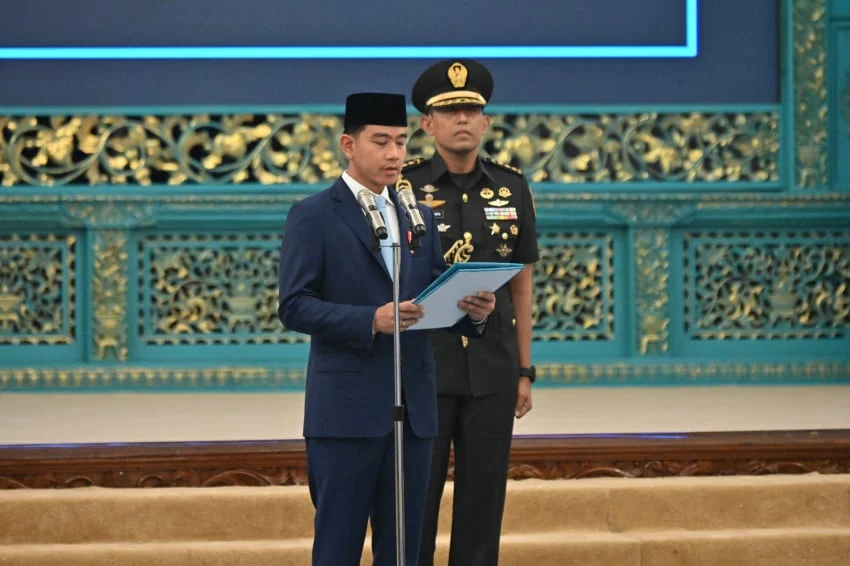
Constitutional law expert Denny Indrayana has issued a formal caution to Vice President Gibran Rakabuming Raka, advising him against misinterpreting President Prabowo Subianto’s courteous political response regarding his resignation intentions as an endorsement to remain in office. The warning comes in the wake of public statements made by Gibran, wherein he declared his intention to fiercely contest and legally prove the validity of his educational background—a topic that has remained a persistent subject of public scrutiny and debate across Indonesia.
Speaking on Tuesday, November 10, 2026, Denny emphasized that President Prabowo’s traditional courtesy and diplomatic temperament must not be twisted or manipulated into a formal refusal of a resignation offer. According to the constitutional scholar, Prabowo’s measured approach to the unfolding controversy reflects his characteristic demeanor of avoiding direct confrontation and making interlocutors feel at ease, rather than offering a substantive legal or political veto against a voluntary departure from executive power.
The controversy surrounding Vice President Gibran Rakabuming Raka’s academic credentials has steadily escalated into a major institutional discourse within the current administration. As the executive branch navigates these choppy political waters, the intersection of constitutional ethics, political etiquette, and administrative law has taken center stage. Observers, legal scholars, and political parties alike are closely monitoring the developments, as the unfolding situation carries profound implications for the stability and perceived legitimacy of the current executive leadership team.
Background Context of the Controversy and Educational Scrutiny
The roots of the current political friction trace back to prolonged public discussions and skepticism concerning the educational history of Vice President Gibran Rakabuming Raka. Questions regarding specific academic milestones and institutional attendance have circulated across social media platforms and independent investigative outlets for months. While supporters have repeatedly dismissed the allegations as politically motivated smears designed to undermine the administration, critics and transparency advocates have continually pushed for definitive, verifiable proof of graduation and academic attainment.
In political systems worldwide, and particularly within Indonesia’s evolving democratic landscape, the educational qualifications of high-ranking public officials serve as a cornerstone of public trust. When doubts are cast upon the credentials of leaders holding the second-highest office in the land, the repercussions extend far beyond personal reputation, touching upon institutional integrity and public confidence in state governance. The decision by Gibran to address these matters publicly and announce his intent to pursue legal recourse through institutions such as the State Administrative Court (PTUN) marks a critical juncture in the ongoing saga.
Chronology of Events and Recent Developments
The timeline leading up to Denny Indrayana’s recent cautionary statement is marked by a series of high-stakes political maneuvers and public announcements:
- Initial Public Discourse: Over the past year, queries regarding Gibran’s academic background intensified, prompting various civic groups and legal advocates to demand transparency and official documentation.
- Escalation of Resignation Rumors: Amid mounting pressure, discussions regarding a potential resignation by the Vice President began to circulate within political circles, raising questions about constitutional continuity and executive stability.
- Gibran’s Declaration of Defense: In response to the persistent scrutiny, Vice President Gibran publicly stated his intention to "fight" to prove the legitimacy of his educational history, indicating a preference for judicial validation through venues like the PTUN.
- President Prabowo’s Response: Confronted with the situation, President Prabowo Subianto adopted a polite, non-confrontational stance, reportedly offering no strict administrative barrier to Gibran’s pursuit of legal clarity while maintaining a diplomatic posture.
- Expert Interventions: Constitutional experts, including Denny Indrayana, stepped into the public sphere to dissect the legal and political nuances of the interaction between the President and the Vice President, warning against dangerous misinterpretations of executive politeness.
Decoding Executive Etiquette Versus Constitutional Action
At the heart of Denny Indrayana’s warning is a crucial distinction between personal politeness and constitutional procedure. In Indonesian political culture, senior leaders often utilize soft-spoken diplomacy and polite deference to maintain social harmony, even amid profound crises. Denny argued that President Prabowo’s inclination to allow Gibran to test his claims in court—characterized by a permissive "silakan" (please go ahead)—was an expression of personal courtesy rather than an administrative decree blocking a resignation.
"We must ensure there is no manipulation here, where what is merely the polite demeanor of President Prabowo is misconstrued as an attitude granting permission not to resign and rejecting the resignation outright," Denny stated explicitly.
From a constitutional law perspective, a resignation from the office of the Vice President is a formal, unilateral declaration of intent that initiates specific legal and administrative mechanisms under the Indonesian Constitution (UUD 1945). It is not contingent upon the personal comfort or diplomatic phrasing of the sitting President. By conflating Prabowo’s polite acquiescence regarding a legal challenge with a rejection of the resignation itself, Gibran risks signaling a misunderstanding of constitutional boundaries and executive accountability.
Reactions from Political Parties and Legislative Bodies
The political ripples of Gibran’s contested status and intended resignation have predictably reached the halls of the House of Representatives (DPR). Lawmakers and party leaders have been forced to navigate the delicate balance between coalition loyalty and adherence to constitutional norms.
Prominent political figures, such as Ahmad Doli Kurnia, have weighed in on the legislative implications of the unfolding events. Doli recently emphasized that any contemplation of resignation or legal battles by the Vice President should not disrupt or improperly influence ongoing legislative initiatives, such as proposals concerning the House Consultative Mechanism (HMP) within the DPR. According to parliamentary leaders, the legislature must maintain its institutional independence and focus on its oversight duties, regardless of the internal executive tensions playing out between the President and his deputy.
Other political factions have adopted varying stances. Opposition figures have seized upon the situation to demand greater transparency, arguing that the controversy surrounding the Vice President’s credentials undermines the credibility of the executive branch as a whole. Meanwhile, coalition loyalists have urged calm, emphasizing that legal avenues such as the PTUN should be allowed to run their course without premature political interference or sensationalized speculation.
Legal Pathways: The Role of the State Administrative Court (PTUN)
Central to Gibran’s defense strategy is the utilization of the State Administrative Court (PTUN) to adjudicate disputes regarding administrative decisions and official records. Legal analysts note that while the PTUN possesses jurisdiction over certain administrative disputes involving state bodies and official credentials, utilizing it to resolve a generalized public controversy over personal educational history presents unique procedural hurdles.
For a PTUN challenge to be effective, there must typically be a concrete object of dispute—such as a specific administrative decree issued by an educational authority or government body—that directly impacts the rights of the plaintiff. Navigating this judicial route requires meticulous legal framing to ensure that the court can legitimately rule on the substantive merits of the educational records in question.
Moreover, legal scholars point out that judicial validation through the PTUN addresses only the narrow administrative legality of documents, whereas the broader political and ethical dimensions of the Vice Presidency require a standard of accountability that transcends courtroom victories. Even a favorable ruling by the PTUN may not fully resolve the public confidence deficit if the underlying political consensus surrounding the administration continues to fray.
Broader Impact and Implications for Indonesian Governance
The unfolding crisis surrounding Vice President Gibran Rakabuming Raka carries significant implications for the future of Indonesian governance, institutional stability, and the separation of powers. As the administration works to implement its national development agenda, prolonged distraction at the executive summit poses a tangible risk to policy execution and bureaucratic focus.
- Executive Cohesion: The dynamic between President Prabowo and Vice President Gibran is under intense public microscope. Miscommunications or perceived divergences in handling high-profile controversies can project an image of internal vulnerability, potentially emboldening political rivals and creating uncertainty among foreign and domestic investors.
- Public Trust in Educational and State Institutions: The debate over credentials highlights broader systemic questions regarding document verification, institutional integrity, and the enforcement of transparency standards for holders of high public office. How the state resolves this challenge will set a critical precedent for future accountability measures.
- Constitutional Precedents: The discourse sparked by experts like Denny Indrayana reinforces the primacy of constitutional law over political convenience. Clarifying the exact legal mechanics of resignation and executive oversight helps safeguard the foundational rules of the Indonesian republic against informal political maneuvering.
Conclusion and Future Outlook
As the situation continues to develop, all eyes remain fixed on the executive branch and the legal maneuvers planned by Vice President Gibran. Whether the Vice President will ultimately proceed with a formal resignation in alignment with constitutional expectations, or whether he will attempt to ride out the storm through protracted legal battles in the PTUN, remains one of the most pressing questions in Indonesian politics today.
Denny Indrayana’s intervention serves as a timely reminder that political courtesy must never be allowed to obscure constitutional duties. In a maturing democracy like Indonesia, adherence to transparent, rule-bound governance is paramount. As lawmakers, legal scholars, and citizens await the next chapter in this unfolding political narrative, the ultimate test will be whether institutional integrity and constitutional fidelity prevail over political expediency.