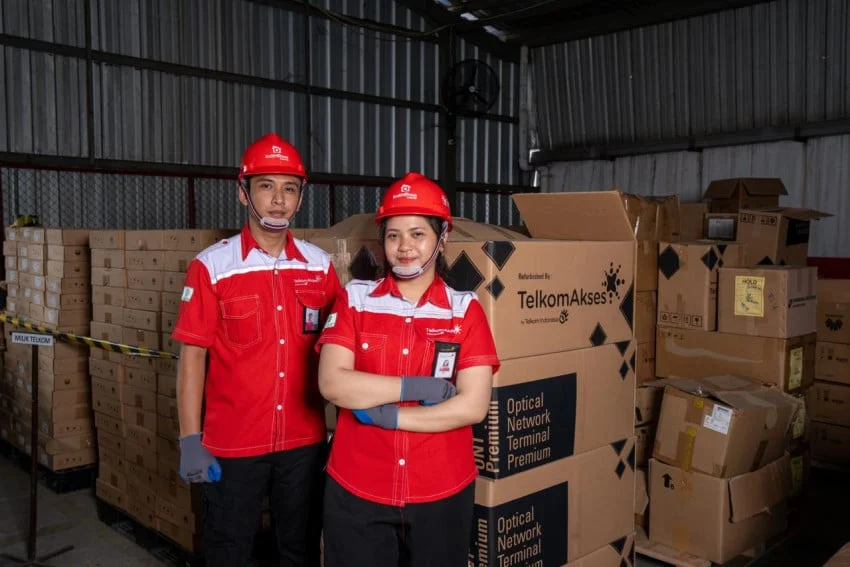
PT Telkom Indonesia (Persero) Tbk (Telkom) has officially initiated a new phase in its corporate restructuring roadmap, announcing the merger of four of its subsidiary entities to enhance operational efficiency and consolidate its business portfolio. The move involves the integration of PT Infrastruktur Telekomunikasi Indonesia (Telkominfra) into PT Telkom Akses, alongside the merger of PT Nusantara Sukses Investasi (NSI) into PT Graha Sarana Duta (GSD). These strategic actions, which have been formally disclosed in accordance with the Law on Limited Liability Companies, represent a critical milestone in Telkom’s ongoing transition from an operating holding company to a strategic holding firm under the ambitious TLKM 30 strategic initiative.
The streamlining program is a direct response to the directives issued by the company’s shareholders, represented by the PT Danantara Asset Management (Persero), aimed at reducing organizational complexity and optimizing capital allocation across the vast TelkomGroup ecosystem. With a total of 68 subsidiaries under its current umbrella, Telkom has set an aggressive target to rationalize its portfolio, with 50 entities identified for streamlining measures. As of the latest disclosure, 28 entities have successfully completed the restructuring process, leaving 22 remaining targets that the management aims to finalize by the end of 2026.
Chronology and Strategic Context of the Transformation
The journey toward a leaner, more agile Telkom began in earnest as the telecommunications giant recognized the need to adapt to a rapidly evolving digital landscape. In recent years, the proliferation of digital services, the shift toward cloud computing, and the increasing demand for high-speed fiber-optic infrastructure required a more unified approach to resource management.
Telkom’s corporate restructuring was not an overnight decision but rather a systematic effort spanning several years. The TLKM 30 initiative, which serves as the guiding North Star for this transformation, emphasizes the necessity of moving away from fragmented business units that often result in overlapping functions and redundant capital expenditure. By consolidating entities like Telkominfra into Telkom Akses, Telkom aims to create a singular, robust powerhouse for infrastructure deployment and maintenance. Similarly, merging NSI into GSD—a company traditionally focused on building management and facility services—is designed to centralize investment management and property assets, thereby improving financial transparency and asset utilization.
The progression of this strategy can be viewed as a multi-stage process:
- Phase 1: Portfolio Audit (2022-2023): Telkom conducted a comprehensive review of all 68 subsidiaries to identify core versus non-core business activities.
- Phase 2: Initial Consolidation (2023-2024): The initial waves of mergers were executed, focusing on entities with the highest degree of operational overlap.
- Phase 3: Current Acceleration (2024-2025): The current phase, marked by the merger of Telkominfra, Telkom Akses, NSI, and GSD, signifies the move toward scaling the impact of these changes.
- Phase 4: Completion (2026): The final integration phase aimed at finalizing the status of the remaining 22 subsidiaries.
The Logic Behind the Consolidation
The decision to merge Telkominfra into Telkom Akses is particularly significant. Telkom Akses has long served as the primary arm for the deployment and maintenance of the Indihome and fixed-broadband network. Telkominfra, conversely, has provided specialized engineering and technical support. By combining these, Telkom is creating a unified entity capable of end-to-end management of the nation’s physical telecommunications infrastructure. This integration is expected to reduce the time-to-market for new network rollouts and lower the overall cost of maintenance through economies of scale.
Regarding the merger of NSI into GSD, the logic is rooted in financial efficiency. GSD manages a significant portion of Telkom’s real estate and corporate facilities. Incorporating NSI—which specializes in investment management—allows for a more strategic approach to property monetization and facility investment, ensuring that Telkom’s capital is not unnecessarily tied up in siloed investment vehicles.
Leadership Perspective on Governance
Addressing the public and stakeholders, Telkom’s President Director, Nanang Hendarno, emphasized that these corporate actions are underpinned by strict adherence to Good Corporate Governance (GCG) principles. The streamlining process is not merely an exercise in reducing numbers but a rigorous, evidence-based strategy.
"Streamlining is a mandate from the shareholders that we are executing with full responsibility," Nanang stated. He noted that every merger decision undergoes a comprehensive evaluation, including independent due diligence and multi-layered approval processes that comply with both the company’s articles of association and national laws. This ensures that the consolidation is not just a bookkeeping exercise, but one that provides measurable value to the TelkomGroup, its shareholders, and its diverse stakeholder base.
Market Implications and Future Outlook
The financial and operational implications of this streamlining are substantial. From a market perspective, the consolidation is expected to improve Telkom’s consolidated financial statements by reducing inter-company eliminations and streamlining reporting structures. Investors generally view such moves favorably, as they typically lead to improved Return on Invested Capital (ROIC) and clearer visibility into the core profitability of the business.
Furthermore, the streamlining allows for a more focused management team. Instead of overseeing dozens of small, potentially underperforming entities, leadership can concentrate on the core pillars of Telkom’s business: mobile connectivity, fixed-line broadband, and the burgeoning B2B digital services segment.
However, the process is not without its challenges. Integrating corporate cultures, aligning IT systems, and managing human resources across merged entities are complex tasks. Telkom has stated that it is handling these transitions with careful attention to employee welfare and operational continuity. The target of 2026 serves as both a deadline and a guiding pressure point to ensure that the momentum of the transformation is maintained.
Analysis: Telkom’s Shift Toward a Strategic Holding Model
The evolution of Telkom from an operating holding to a strategic holding company is a major pivot. In an operating holding model, the parent company is heavily involved in the day-to-day management of its subsidiaries. In contrast, a strategic holding model focuses on capital allocation, long-term vision, and group-wide synergy, while delegating operational autonomy to specialized sub-holdings.
This change is essential for Telkom to compete against global digital giants and agile, tech-native competitors. By consolidating its infrastructure and support services, Telkom is effectively "de-cluttering" its operations. This creates a clearer value proposition for investors who seek exposure to the growth of Indonesia’s digital economy without the drag of inefficient legacy structures.
Supporting data provided by industry analysts suggests that large-scale infrastructure providers often see a 10% to 15% improvement in operational efficiency post-merger due to the elimination of redundant roles in procurement, human resources, and back-office accounting. If Telkom achieves similar results, the impact on its bottom line by 2027 could be significant, providing the company with more dry powder for investments in 5G, data centers, and artificial intelligence infrastructure.
Conclusion
The latest merger announcement from PT Telkom Indonesia is a clear signal that the company is committed to its long-term strategic goals. By systematically dismantling the barriers between its subsidiaries, Telkom is building a more resilient, efficient, and forward-looking organization. As the company works through the remaining 22 entities in its restructuring pipeline, the industry will be watching closely to see how these changes translate into sustained growth and improved service delivery for the millions of Indonesians who rely on Telkom’s network.
The path toward 2026 is clearly defined, and the mandate from shareholders remains consistent: to build a leaner, more capable digital leader that is prepared for the challenges of the next decade of telecommunications evolution. With a disciplined approach to governance and a clear strategic vision, Telkom is positioning itself not just as an Indonesian telecommunications leader, but as a robust, globally competitive digital conglomerate.