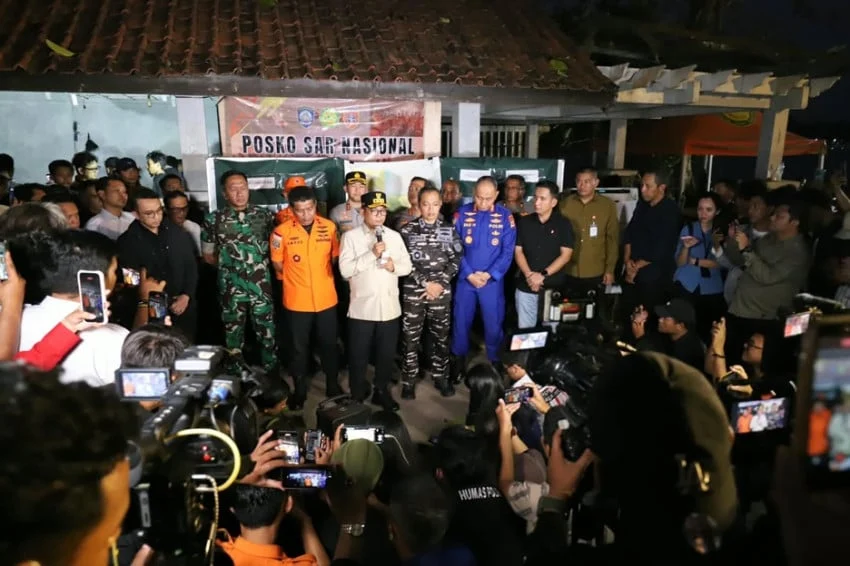
The official search and rescue operation for five journalists and three crew members missing in the waters of the Sunda Strait has officially concluded after a ten-day exhaustive deployment. In response to the cessation of the official government-led search, Aiman Witjaksono, Editor-in-Chief of iNews, extended profound appreciation to the multi-agency SAR personnel who spearheaded the mission. Despite the official closure of the search phase by authorities on Thursday, September 17, 2026, iNews management and the families of the missing individuals continue to hold onto hope for their safe return.
The tragic incident has cast a somber shadow over the Indonesian media landscape, emphasizing the inherent risks faced by journalists operating in challenging maritime environments. The missing group comprises five reporters—including representatives from iNews alongside colleagues from other media networks—and three crew members aboard the ill-fated vessel. As the rescue mission transitions from active deployment to monitoring and community-based observation, industry stakeholders, maritime authorities, and press freedom advocates are reflecting on the broader implications of marine safety, disaster journalism, and the psychological toll borne by the families of those missing at sea.
Chronology and Background of the Maritime Incident
The maritime tragedy unfolded during a routine assignment covering environmental and geographical conditions around the Sunda Strait, a critical and notoriously unpredictable body of water connecting the Java Sea to the Indian Ocean. Known for its complex currents, volatile weather patterns, and heavy maritime traffic—largely due to its position between the major islands of Java and Sumatra—the Sunda Strait presents severe operational challenges for marine navigation.
According to initial reports, the vessel carrying the eight individuals encountered extreme weather conditions characterized by high swells and reduced visibility. Contact with the boat was lost abruptly, prompting an immediate alert within local maritime networks. Upon receiving notification of the missing vessel, the regional disaster management agency and local port authorities initiated a preliminary tracking protocol. Within hours, a full-scale emergency response was mobilized, marking the official commencement of a joint search and rescue operation.
Over the subsequent ten days, the search operation expanded significantly. The deployment area covered vast expanses of the Sunda Strait, stretching from the coastal waters of Banten toward the southern coast of Lampung and extending as far as the maritime boundaries near Bengkulu. The operation utilized a multi-layered approach involving surface sweeps by patrol boats, aerial surveillance via helicopters and drones, and underwater sonar mapping deployed by specialized marine units.
Multi-Agency Response and Coordination Efforts
The scale of the operation required extensive coordination among various governmental and military branches. Speaking on the conclusion of the active phase, Aiman Witjaksono specifically acknowledged the tireless dedication of the National Search and Rescue Agency (Basarnas), the Indonesian Navy’s Banten Naval Base (Lanal Banten), regional Basarnas divisions from Lampung and Bengkulu, as well as personnel from the Indonesian National Armed Forces (TNI) and the Indonesian National Police (Polri). Furthermore, Aiman highlighted the instrumental support provided by the Provincial Government of Banten in mobilizing local resources, facilitating logistics, and coordinating with coastal communities.
"This has been an extraordinary effort, and it holds profound meaning for us, our colleagues, and the families of the journalists and crew members whom we still hold hope of seeing safe," Aiman stated following the official announcement of the search’s conclusion.
Throughout the ten-day mission, hundreds of personnel worked under arduous conditions. Marine weather hazards, including sudden squalls, strong undertows, and unpredictable wind shifts, frequently hampered search efforts, forcing temporary suspensions for the safety of the rescue workers. Despite these physical limitations, the joint task force exhausted standard operational protocols, utilizing drift modeling software to predict the movement of debris and potential survivors based on oceanographic data.
Adherence to Safety Protocols and Journalistic Standards
In the wake of the incident, questions regarding safety protocols during field reporting have naturally emerged within newsrooms across Indonesia. Aiman firmly addressed these concerns, emphasizing that iNews maintains stringent Standard Operating Procedures (SOPs) for all reporting assignments, particularly those involving high-risk environments such as disaster zones, remote territories, and open waters.
Aiman assured stakeholders that the journalists deployed to the Sunda Strait were equipped with necessary safety gear and operated under established risk-assessment guidelines. However, he noted that the unpredictable nature of maritime incidents underscores the reality that even with comprehensive planning and strict adherence to safety protocols, natural elements can present overwhelming challenges. The editorial board of iNews has committed to conducting a comprehensive internal review of the mission’s logistics and safety measures once definitive information becomes available, ensuring that lessons learned are integrated into future field deployment policies.
Implications for Media Organizations and Maritime Safety
The disappearance of the five journalists and three crew members serves as a poignant reminder of the physical dangers journalists routinely encounter in the line of duty. While war correspondents and conflict-zone reporters are often the focus of safety discussions, environmental reporters, investigative journalists covering maritime issues, and disaster-response chroniclers face severe, albeit distinct, occupational hazards.
Media safety organizations and press councils in Indonesia have closely monitored the situation, using the incident to reiterate calls for enhanced safety training, mandatory insurance coverage for field reporters, and tighter communication protocols between newsrooms and teams operating in remote or volatile areas. The tragedy has also sparked discussions among maritime authorities regarding the implementation of real-time tracking devices for all vessels operating in high-risk zones, regardless of whether they are commercial, governmental, or media-chartered boats.
Furthermore, the economic and psychological impact on the families of the missing individuals remains a primary concern. Both iNews and affiliated media institutions have established support mechanisms to assist the families during this prolonged period of uncertainty. Counseling services, administrative assistance, and continuous updates regarding any new maritime developments are being provided to alleviate the acute stress experienced by the next of kin.
The Transition from Active Search to Extended Monitoring
While the official, high-intensity SAR operation concluded on September 17, 2026, maritime authorities have clarified that the closure does not mean a complete abandonment of the area. Standard maritime broadcast alerts—known as Navigational Warnings (Navwarn)—remain active across the Sunda Strait and adjacent coastal sectors. Commercial vessels, local fishermen, and regional patrol units have been instructed to maintain a vigilant watch and report any unusual sightings, debris, or floating objects to local authorities immediately.
For the journalism community and the families affected, the conclusion of the official search marks a difficult transition. The collective hope expressed by Aiman Witjaksono and other media leaders reflects a resilient desire for a positive outcome, even as authorities prepare to navigate the administrative and legal realities associated with prolonged missing-person cases at sea.
As the industry reflects on this tragedy, the legacy of the missing journalists and crew members remains tied to their dedication to informing the public. The incident stands as a solemn testament to the risks borne in the pursuit of truth and news reporting, reinforcing the vital importance of safety, solidarity, and continuous vigilance within the Indonesian media sector.