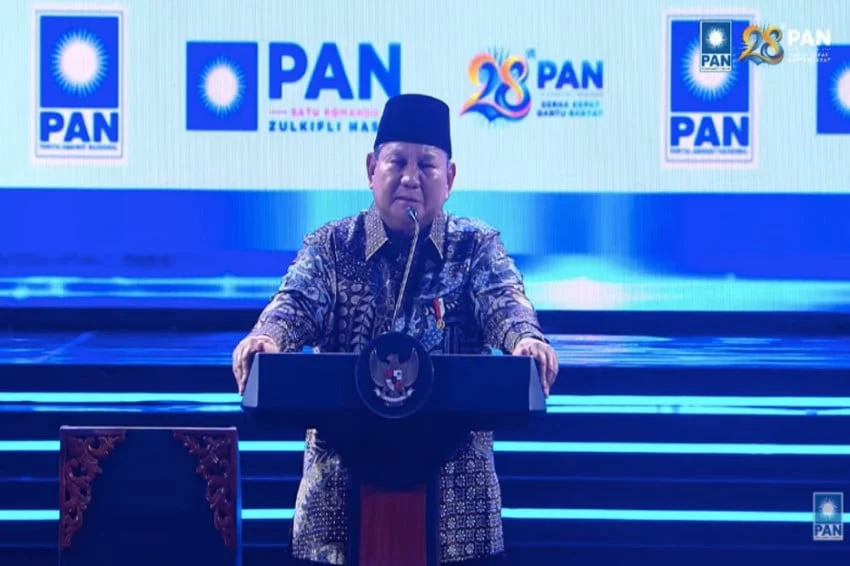
JAKARTA — Indonesian President Prabowo Subianto issued a stern warning regarding the vulnerability of modern democratic systems, asserting that the pillars of governance and sovereignty can be compromised, hijacked, and purchased by individuals and syndicates wielding immense economic power, particularly those operating through illicit means. The head of state made these remarks during the silver jubilee and 28th-anniversary celebration of the National Mandate Party (PAN), held at the Jakarta International Convention Center (JICC) in Senayan, Jakarta.
Addressing a packed auditorium of loyal party cadres, political elites, and high-ranking government officials, President Prabowo emphasized that while democracy remains the most viable system for national representation, it carries inherent systemic risks if left unguarded. His speech underscored a growing apprehension within the executive branch regarding the corrosive influence of "black money" and corporate overreach in the political sphere.
The Vulnerability of Democratic Institutions to Illicit Wealth
Elaborating on his central thesis, President Prabowo articulated a clear and present danger facing the republic: the systematic subversion of public institutions through financial coercion. He pointed out that accumulation of wealth, especially when derived from corrupt, criminal, or underground economies, poses a direct threat to the integrity of the nation-state.
"We must be extremely cautious because democracy can be hijacked. Democracy can be bought by those who possess massive economic power, those who have vast amounts of money, and especially those whose fortunes are acquired through unlawful means," President Prabowo stated during his keynote address.
The President did not mince words regarding the breadth of this alleged infiltration. He detailed how heavily financed networks attempt to manipulate every layer of governance, from the legislative halls to the highest offices of the judiciary and executive branches. According to Prabowo, these economic actors utilize bribery as a primary tool for state capture, targeting critical pillars of the justice system and national leadership.
"They want to hijack our democracy. They want to bribe our political figures. They want to buy them off—bribing judges, bribing prosecutors, bribing generals, bribing ministers, they even want to bribe the President!" he declared to an attentive audience, drawing sharp focus to the vulnerability of state officials to corrupting influences.
Digital Manipulation, Algorithms, and the Weaponization of Information
Beyond traditional forms of political corruption involving direct bribery and financial lobbying, President Prabowo drew attention to modern vectors of democratic erosion. He highlighted the sophisticated use of technology, digital architecture, and social media platforms as mechanisms designed to sway public opinion and distort democratic discourse.
The President specifically pointed to the deployment of algorithms, coordinated networks of automated accounts commonly known as "bots," and paid influencers or "buzzers" as instruments capable of inflicting severe psychological and social damage on the electorate. In an era where information travels instantaneously, Prabowo warned that the deliberate dissemination of targeted misinformation and polarization tactics by deep-pocketed entities can manipulate election outcomes and erode public trust in foundational democratic institutions.
This technological dimension reflects an evolving global concern over information warfare. Observers note that digital campaigns, often financed anonymously through cross-border financial channels or opaque domestic funds, have become potent weapons in shaping political landscapes across emerging and established democracies alike.
Background Context: PAN’s 28th Anniversary and Political Solidarity
The setting of the President’s remarks carried significant political weight. The event marked the 28th anniversary of the National Mandate Party (PAN), a prominent political entity within Indonesia’s ruling coalition. Founded in the wake of the 1998 Reformasi movement—which ushered in Indonesia’s democratic era—PAN has historically positioned itself as a champion of reform, civic pluralism, and institutional transparency.
President Prabowo’s presence at the JICC underscored his administration’s reliance on cohesive coalition politics and grassroots party support. Earlier in the program, the President remarked on his deep-rooted ties with the party’s leadership and membership, framing his attendance as a gathering among steadfast companions in the long-term struggle for national development.
The juxtaposition of a celebratory political milestone with a grave warning about the fragility of democracy created a striking moment. Analysts suggest that by addressing these systemic threats at a partisan gathering, Prabowo aimed to rally political elites around a shared defense of institutional integrity, signaling that anti-corruption efforts and the safeguarding of sovereignty remain central tenets of his governance framework.
Economic Power and State Capture: Analytical Implications
Political scientists and governance experts have long debated the phenomenon of "state capture"—a situation where powerful individuals, corporations, or criminal syndicates use corruption to influence a nation’s laws, formation of rules, laws, and economy to their own private benefit. President Prabowo’s recent statements directly mirror these academic concerns, translating complex political economy theories into stark public warnings.
Indonesia has made substantial strides in economic development over recent decades, solidifying its position as Southeast Asia’s largest economy and a member of the G20. However, rapid economic expansion has also led to the concentration of wealth in the hands of oligarchic networks. Critics and watchdogs have frequently raised concerns over the nexus between big business and electoral politics, particularly regarding the high cost of campaigning for regional heads, legislative seats, and the presidency.
The financial burden of modern political campaigns often creates an implicit dependency on wealthy donors, raising questions about potential conflicts of interest once candidates assume office. Prabowo’s acknowledgment of these pressures from the highest office suggests an internal recognition of the structural reforms needed to decouple political power from economic patronage.
Institutional Safeguards and Legal Frameworks
In response to the growing risks of democratic subversion, Indonesia maintains various institutional safeguards, including the Corruption Eradication Commission (KPK), the Constitutional Court (MK), the Supreme Court (MA), and the General Elections Commission (KPU). However, these institutions have themselves faced intense public scrutiny regarding their independence and resilience against external pressures.
Legal experts note that safeguarding democracy against the influx of illicit funds requires rigorous enforcement of campaign finance laws, enhanced transparency in political party funding, and stringent asset-disclosure requirements for public officials. Furthermore, regulatory frameworks governing digital spaces and social media platforms are increasingly viewed as vital to countering algorithmic manipulation and foreign or domestic interference in domestic politics.
While the President’s speech served primarily as a cautionary advisory rather than the unveiling of a specific new policy package, it sets a definitive tone for his administration’s legislative and administrative priorities. Observers anticipate heightened scrutiny on regulatory enforcement concerning money laundering, illicit mining, illegal taxation, and corporate compliance in the coming fiscal quarters.
Broader Public and Political Reactions
The remarks delivered by President Prabowo have elicited varied responses across the political spectrum. Representatives from various political parties, civil society organizations, and academic institutions have weighed in on the implications of the President’s diagnosis of the nation’s political health.
Civil society groups focused on anti-corruption and electoral integrity, such as Indonesia Corruption Watch (ICW) and Perludem (Association for Elections and Democracy), have historically advocated for stricter limits on political donations and greater accountability in campaign spending. Representatives from these organizations noted that the President’s public validation of the threat posed by money politics reinforces the urgency of comprehensive electoral reform.
Conversely, some economic analysts and business associations have emphasized the necessity of distinguishing between legitimate private sector investment and illicit economic actors. They argue that while the eradication of corruption and illegal financing is paramount, maintaining an investment-friendly climate and robust economic growth remains equally critical for national stability.
Within the legislative branch, members of the House of Representatives (DPR) from both coalition and opposition camps have expressed a willingness to review existing statutes concerning political financing and cyber governance. Lawmakers acknowledged that legislative oversight must be strengthened to prevent systemic vulnerabilities from undermining public trust in democratic processes.
Conclusion and Future Outlook
As Indonesia continues to navigate its path as a major global democracy, President Prabowo Subianto’s warnings at the PAN anniversary event serve as a stark reminder of the internal and external pressures facing modern governance systems. The intersection of immense capital, sophisticated digital technologies, and traditional political ambitions creates a complex matrix of challenges that requires constant vigilance from both state authorities and civil society.
Whether these verbal admonitions will translate into concrete structural reforms, enhanced law enforcement, and more robust regulatory frameworks remains to be seen. However, by bringing the concepts of democratic hijacking, institutional bribery, and digital manipulation to the forefront of national discourse, the administration has signaled that the defense of Indonesia’s sovereignty extends far beyond physical borders into the very integrity of its democratic institutions.