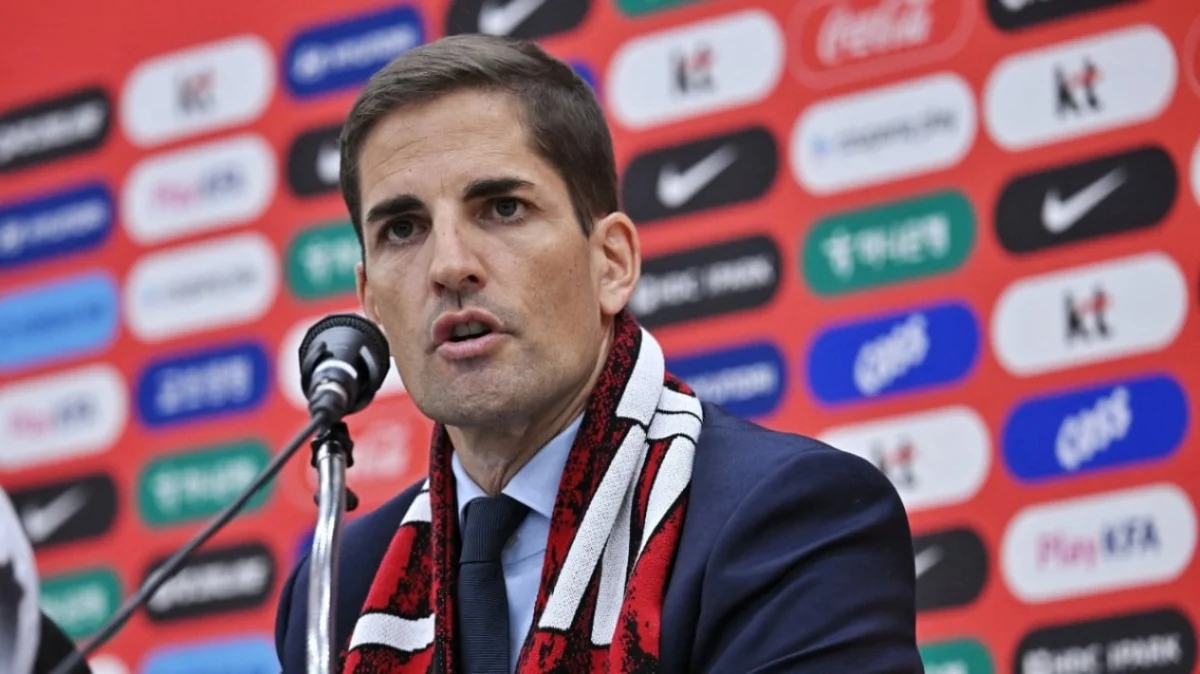
The landscape of modern association football has increasingly intertwined with advanced technology, data analytics, and artificial intelligence, yet few managers have found themselves directly defending their tactical integrity against viral claims of algorithmic reliance. Robert Moreno, the newly appointed head coach of the South Korea national team, faced this exact scenario during his inaugural press conference on Monday, September 14, 2026. Stepping up to the podium in Seoul just a day prior to the official announcement timestamp of Tuesday, September 15, 2026, the Spanish tactician firmly dismissed persistent media narratives suggesting that he overly relied on artificial intelligence programs such as ChatGPT during his previous managerial tenure at Russian club FC Sochi.
The controversy, which had swirled in various sporting publications following his departure from Sochi in September 2025, threatened to overshadow his high-profile appointment by the Korean Football Association (KFA). However, Moreno used the platform to clarify his stance on technological integration in sports science, pivot toward the formidable challenges awaiting the Taegeuk Warriors, and outline his immediate sporting objectives. With a short-term contract extending through late November 2026—and an implicit eye toward the AFC Asian Cup 2027 in Saudi Arabia—Moreno steps into an environment demanding immediate stabilization, tactical discipline, and restored public faith.
Origins of the AI Controversy and Moreno’s Clarification
The narrative linking Robert Moreno to artificial intelligence began gaining traction during his stint in the Russian Premier League with FC Sochi. Tabloid reports and select sports media outlets alleged that the former Spain national team manager utilized generative AI tools, specifically ChatGPT, to formulate pre-match tactical game plans and assist in player recruitment evaluations. In the fast-paced ecosystem of digital sports journalism, these claims quickly snowballed, framing the manager as a novice outsourcing core managerial duties to machine learning models.
Addressing journalists directly during his introductory media session, Moreno did not mince words when categorizing these reports. "The news story was entirely false and became viral," Moreno stated, responding to questions posed by international press agencies.
While refuting the notion that algorithms dictated his tactical choices on the pitch, Moreno openly acknowledged that technological tools form an indispensable element of contemporary football coaching. In an era where data tracking, physical performance monitoring, and video analysis software dominate elite training grounds, Moreno argued that his utilization of modern tools had been drastically misrepresented.
"Obviously, I use technology. Anyone who takes 10 minutes to research it can see that everything has been taken completely out of context," he elaborated.
In elite football, coaching staffs regularly harness massive data sets—covering everything from an opponent’s high-pressing triggers to player metabolic loads—via proprietary software. Moreno’s defenders have pointed out that parsing vast amounts of scouting data inevitably involves advanced software assistance, but drawing a line between data-driven analysis and surrendering managerial decisions to an AI chatbot is a distinction the coach felt crucial to establish before commencing his tenure in East Asia.
Contextualizing South Korea’s Search for Stability
Moreno’s arrival in Seoul arrives at a critical juncture for South Korean football. The national team has endured a turbulent period characterized by administrative scrutiny, tactical stagnation, and underperformance on the global stage.
The roots of the current instability trace back to the aftermath of the 2026 FIFA World Cup, where the Taegeuk Warriors suffered a disappointing group-stage elimination. The early exit sealed the fate of then-head coach Hong Myung-bo, whose tenure had already been mired in controversy. Hong’s appointment in 2024 by the KFA had sparked widespread public protests and intense parliamentary questioning over transparency and fairness within the governing body’s recruitment procedures. When the team failed to meet expectations at the global showcase, mounting pressure forced leadership changes, leaving the KFA scrambling to restore credibility and competitive edge.
Recognizing the urgency of the situation, the KFA turned to the international market, identifying Moreno as a candidate with the tactical pedigree and psychological resilience required to steady a fractured dressing room. The association secured the 48-year-old manager on a mandate running through November 27, 2026. Crucially, this agreement contains performance-based clauses that could see Moreno retain his position through the upcoming AFC Asian Cup 2027, hosted by Saudi Arabia, provided he successfully navigates the upcoming international fixtures.
A Journey Through Elite European Football
Robert Moreno brings a wealth of high-level experience to the South Korean dugout, making him the first Spanish manager in the history of the national team. His resume reflects a diverse career spanning elite clubs and international competition.
Moreno’s ascent in professional football began largely through analytical and assistant coaching roles. He served as a trusted tactical assistant to Luis Enrique across multiple high-profile projects, notably at Spanish powerhouse FC Barcelona, where the club secured historic trebles and domestic dominance, as well as during Enrique’s tenure leading the Spanish national team (La Roja). When Enrique stepped down temporarily due to personal reasons, Moreno took the reins as head coach of Spain, successfully guiding the national side through their UEFA Euro 2020 qualifying campaign.
Following his stint with the Spanish national team, Moreno transitioned into club management across Europe. His career path included managerial positions at La Liga side Granada, French Ligue 1 outfit AS Monaco, and most recently, Russian side FC Sochi. This varied background exposes him to distinct tactical philosophies, dressing room cultures, and organizational pressures—assets that will prove vital as he adapts to the demands of Asian international football.
Squad Composition and Tactical Vision
One of Moreno’s immediate priorities upon taking the job was establishing communication with the team’s veteran core and brightest talents. Despite transitioning to a new tactical regime, Moreno confirmed that veteran forward and national team captain Son Heung-min remains central to his sporting project.
Son, who currently plies his trade in Major League Soccer with Los Angeles FC, continues to be the emotional and tactical heartbeat of the squad. Now 34 years of age, Son’s longevity at the elite level has necessitated smart workload management and adaptable tactical deployment. Moreno noted that he views Son’s versatility as a major asset rather than a limitation, emphasizing that he does not intend to pigeonhole the veteran attacker into a single, rigid role on the pitch. Alongside established European-based stars such as Bayern Munich defender Kim Min-jae and Paris Saint-Germain playmaker Lee Kang-in, Son will anchor the spine of Moreno’s tactical framework.
Moreno’s coaching philosophy historically emphasizes positional play, structural organization, and high-intensity pressing—elements that align well with the physical capacities of South Korean players. However, implementing these principles within a compressed timeline remains his primary logistical challenge. With international friendlies and competitive qualifiers looming on the horizon, the Spaniard has limited training sessions to instill his methodology before results demand validation.
Implications and Future Outlook
The appointment of Robert Moreno represents a calculated gamble by the KFA. By bringing in a European manager with extensive tactical expertise, the association hopes to insulate the national team from domestic administrative controversies and elevate the squad’s tactical sophistication ahead of continental competitions.
However, the shadow of the artificial intelligence controversy, though largely dismissed by the coach himself, underscores the intense scrutiny modern football managers face. In the digital age, a stray quote or speculative report can quickly ossify into a prevailing narrative, requiring immediate and decisive media management. Moreno’s swift rebuttal in Seoul signaled his desire to close the chapter on his time in Russia and direct all public attention toward athletic performance.
The ultimate barometer of Moreno’s success will not be found in press conference soundbites or debates over technological integration, but on the pitch. As he prepares the Taegeuk Warriors for their upcoming autumn fixtures, the immediate task is twofold: restoring psychological confidence to a squad scarred by recent tournament disappointments, and laying the groundwork for a successful campaign at the 2027 AFC Asian Cup. If Moreno can harness the undeniable talent of players like Son Heung-min, Kim Min-jae, and Lee Kang-in into a cohesive, winning unit, the early noise surrounding algorithms and chatbots will quickly fade into an irrelevant footnote of a much larger footballing redemption story.