
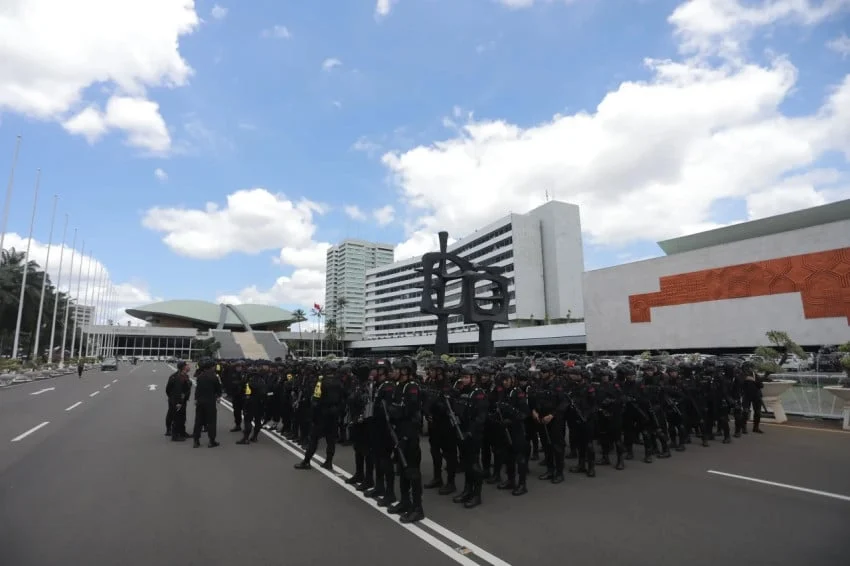
The Directorate of Traffic (Ditlantas) of the Polda Metro Jaya has officially announced the implementation of strategic traffic management measures surrounding the Parliament Complex in Senayan, Jakarta, in anticipation of mass demonstrations scheduled for Tuesday, November 10, 2026. As the capital city prepares for potential large-scale public gatherings, law enforcement authorities have emphasized that traffic flow adjustments will be applied on a situational basis, contingent upon the density of protesters and the physical presence of crowds near the legislative hub.
According to an official statement disseminated via the Polda Metro Jaya’s Traffic Management Center (TMC) social media channels, commuters and motorists are strongly advised to exercise caution and plan their journeys accordingly to avoid the congestion typically associated with political protests in the Gatot Subroto corridor. The initiative serves as a proactive measure to ensure that essential urban mobility is maintained despite the disruption caused by the exercise of the constitutional right to freedom of assembly.
Contextualizing the November 10 Demonstrations
The date holds significant symbolic weight in the Indonesian calendar, as November 10 marks National Heroes Day (Hari Pahlawan). Historically, this date has frequently been chosen by civil society organizations, student unions, and labor groups to voice grievances or advocate for policy shifts, leveraging the historical momentum of the day to draw attention to their causes.
The planned assembly at the DPR/MPR RI building is reportedly driven by a coalition of interest groups concerned with current legislative agendas. While the specific demands vary, common themes in recent protests at the complex have included debates over labor regulations, economic policy, and institutional reforms. The police have confirmed that they are monitoring the mobilization of various groups, acknowledging that the density of participants often dictates the severity of traffic disruptions along major arterial roads, including the inner-city toll routes that flank the Parliament complex.
Tactical Preparedness and Police Strategy
The security framework for this operation is led by the Polda Metro Jaya, with oversight from the Head of Public Relations, Senior Commissioner Budi Hermanto. To ensure the safety of both demonstrators and the general public, the police conducted a comprehensive Tactical Floor Game (TFG) prior to the event. This simulation exercise is a standard operational procedure for the Indonesian National Police, designed to synchronize the perceptions and actions of field commanders across different security divisions.
The TFG involves mapping out potential scenarios, ranging from peaceful processions to escalated tensions, ensuring that personnel deployed on the ground are well-versed in human rights-based crowd control tactics. The goal, as stated by the department, is to guard, escort, and secure the expression of aspirations while maintaining public order. "Our mandate is to ensure that the voices of the public are heard without compromising the safety and security of the city’s critical infrastructure," Commissioner Hermanto noted.
Strategic Traffic Management and Public Impact
The traffic management plan is not a blanket closure but a dynamic system. As the situation evolves throughout the day, the police are prepared to implement specific diversions at several key points:
- Gatot Subroto Corridor: Potential lane restrictions or full closures of the lanes facing the Parliament building, with traffic diverted toward side streets or alternative arterial roads like Jalan Palmerah and Jalan Tentara Pelajar.
- Flyover Adjustments: Strategic control of the flyovers leading into the Senayan area to prevent gridlock.
- Public Transport Integration: Coordination with TransJakarta and other public transit providers to adjust routes that usually pass through the demonstration zone, ensuring that commuters can still access essential transit hubs despite the disruptions.
Authorities have urged the public to utilize real-time navigation applications and monitor the official TMC Polda Metro Jaya social media accounts for live updates regarding road closures. Employers in the Sudirman and Gatot Subroto business districts have been advised to consider flexible working arrangements for their staff, acknowledging that the demonstration may cause significant delays for those commuting during peak hours.
Analysis: The Balancing Act of Democracy and Mobility
The recurring need for traffic engineering during protests at the DPR/MPR building underscores the ongoing challenge of balancing the right to assembly with the logistical realities of a sprawling, traffic-congested metropolis like Jakarta. From a socio-political standpoint, the presence of security forces and the implementation of TFG suggest a high level of preparedness for potential civil unrest.
Observers point out that the professionalization of crowd management by the Polda Metro Jaya has evolved significantly over the past decade. The shift from reactive responses to systematic, intelligence-led planning—exemplified by the TFG—is intended to minimize the "demonstration effect" on the city’s economy. However, the recurring nature of these protests also highlights a deeper tension between the legislative branch and certain sectors of the public regarding the pace and direction of parliamentary lawmaking.
Historical Precedents and Economic Implications
Data from previous large-scale protests in the Senayan area suggests that such events can lead to a temporary drop in local economic activity, particularly for small-to-medium enterprises located near the protest site. Furthermore, the closure of key arterial routes often leads to a "spillover effect," where traffic congestion spreads to neighboring districts such as Slipi, Kebayoran Baru, and even parts of Central Jakarta.
Economists often highlight that while peaceful protest is a hallmark of a healthy democracy, prolonged uncertainty regarding traffic and logistics can discourage foreign investment and complicate urban supply chains. The Indonesian government, through its various agencies, continues to grapple with the challenge of providing a dedicated, secure space for public assembly that does not paralyze the core functions of the national capital.
Recommendations for the Public
As the November 10, 2026, events unfold, the following measures are recommended for the general public:
- Plan Ahead: If travel is necessary, allocate at least an additional 60–90 minutes for commuting through the Central and South Jakarta corridors.
- Alternative Routes: Utilize the MRT or commuter rail (KRL) where possible, as these modes of transport are generally unaffected by road-level demonstrations.
- Information Integrity: Rely solely on official government channels, such as the TMC Polda Metro Jaya, to avoid misinformation that often spreads on social media during periods of civil agitation.
- Safety First: If passing through the vicinity of the Parliament complex, keep vehicle doors locked, remain alert to your surroundings, and avoid engaging in confrontations with protesters or security personnel.
Conclusion: Maintaining Order in a Democratic Space
The operational readiness of the Polda Metro Jaya on this National Heroes Day reflects the dual responsibility of the state: protecting the democratic process and ensuring the stability of the capital’s daily functions. By employing a situational traffic management strategy, the authorities aim to provide a buffer between the demonstrators and the general public, thereby reducing the risk of accidental friction.
As of Tuesday morning, the situation remained under control, with police personnel positioned strategically around the perimeter of the Parliament complex. The efficacy of these measures will be tested as the number of protesters increases throughout the afternoon. Ultimately, the success of the operation will be measured by the ability of the police to facilitate the peaceful expression of public opinion while minimizing the impact on the daily lives of millions of Jakarta residents who rely on the city’s arterial road networks to function.
As the day progresses, the eyes of the nation will remain on the Parliament complex. For the citizens of Jakarta, the event serves as a reminder of the dynamic, often volatile, nature of a democracy in transition, where the right to speak and the right to move must constantly be renegotiated within the framework of law and order.
