
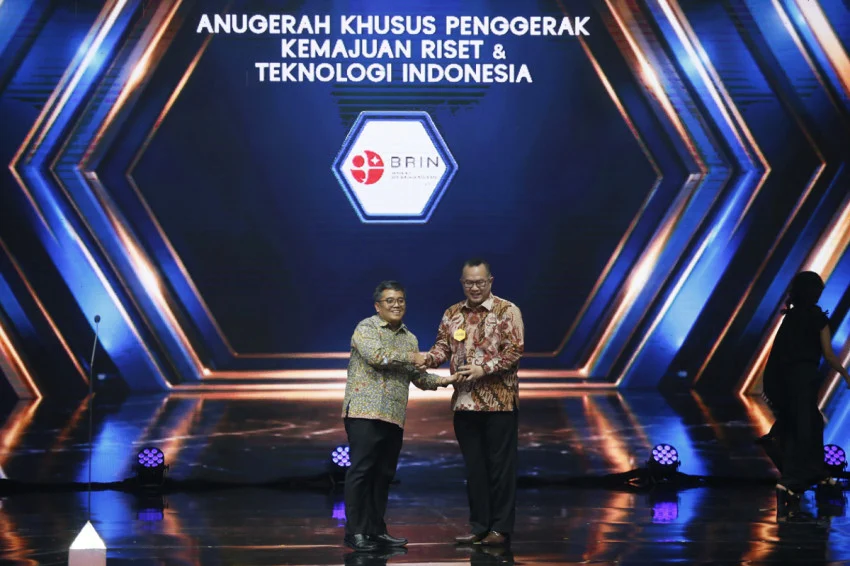
The National Research and Innovation Agency of Indonesia, widely known as Badan Riset dan Inovasi Nasional (BRIN), has been honored with the prestigious Special Award for Driving Indonesian Research and Technology Advancement at the Anugerah Penggerak Nusantara 2026. The high-profile event, hosted by the prominent iNews Media Group, took place at the prestigious Jakarta Concert Hall on Thursday, November 12, 2026. This national accolade serves as a testament to BRIN’s relentless pursuit of scientific excellence, technological innovation, and its foundational role in shaping Indonesia’s future as a competitive global knowledge-based economy.
The ceremony brought together top-tier government officials, academic leaders, industry pioneers, and visionaries from across the archipelago to celebrate individuals and institutions that have demonstrated extraordinary leadership and contribution toward national development. BRIN’s recognition in this specific category underscores the agency’s overarching mandate to consolidate national research efforts, streamline scientific output, and foster an ecosystem where homegrown technology can thrive and directly address socio-economic challenges.
Dedication to the Unsung Heroes of Indonesian Science
Following the formal presentation of the award, the Head of BRIN, Arif Satria, addressed the audience and media representatives. In his official remarks, he emphasized that the accolade belongs not to the administrative leadership alone, but to the entire community of researchers, scientists, academics, and administrative personnel operating under the BRIN umbrella. He specifically acknowledged the quiet, often invisible perseverance of researchers who dedicate countless hours in laboratories, field stations, and data centers across the country.
"Certainly, we dedicate this award to all researchers and the academic community of BRIN who have worked hard, remained diligent, and worked quietly—efforts that have ultimately yielded tangible impacts on progress and positive change," Arif stated during his acceptance speech.
His acknowledgment highlights a crucial aspect of the scientific community: much of the foundational research that drives modern civilization occurs far away from the public eye. By highlighting those who "work in silence," the BRIN leadership underscored the often-uncelebrated daily grind of empirical research, data collection, peer review, and technological prototyping that precedes every major public innovation.
The Dual Pillars of National Advancement: Human Capital and Innovation
Expanding on his vision for the nation, Arif elaborated on the core philosophy guiding contemporary development policy. According to the BRIN leadership, the trajectory of any sovereign nation relies fundamentally upon two interconnected pillars. The first is the strengthening of human capital—ensuring that the populace is well-educated, analytically equipped, and capable of critical thinking. The second is the mastery and generation of innovation and technology.
In a globalized economy characterized by rapid technological disruption—ranging from artificial intelligence and biotechnology to renewable energy transitions—nations that fail to innovate risk falling into the middle-income trap or remaining perpetual consumers rather than creators of technology. BRIN’s strategic mission focuses heavily on bridging the gap between theoretical research and commercialized, practical applications that can elevate Indonesia’s industrial standing.
Arif also extended his sincere gratitude to iNews Media Group for initiating the Anugerah Penggerak Nusantara 2026 and for recognizing the critical value of research and technology in the nation-building process. "May this serve as an enduring encouragement for BRIN to continuously provide solutions and generate a lasting impact for the advancement of the nation," he added.
Background and Context of Anugerah Penggerak Nusantara 2026
The Anugerah Penggerak Nusantara 2026 has quickly established itself as one of Indonesia’s premier institutional awards programs. Designed to honor entities, corporations, government agencies, and civic leaders that embody the spirit of national progress, the event aligns closely with the broader developmental vision of a progressive, self-reliant Indonesia.
As the country continues its journey toward long-term strategic milestones, such as Golden Indonesia 2045 (Indonesia Emas 2045), the role of media organizations in spotlighting developmental achievements has become increasingly vital. By establishing platforms like the Anugerah Penggerak Nusantara, media groups such as iNews help foster a healthy ecosystem of accountability, public recognition, and cross-sector collaboration. The selection process for the 2026 awards involved rigorous evaluations by panels of independent experts, journalists, and policy analysts who assessed nominees based on their measurable contributions to societal welfare, economic resilience, and institutional innovation.
The Evolution and Mandate of BRIN
To fully contextualize BRIN’s recent recognition, it is essential to examine the institutional journey of the agency. Established to unify Indonesia’s fragmented research landscape, BRIN integrated multiple legacy institutions—including the Indonesian Institute of Sciences (LIPI), the Agency for the Assessment and Application of Technology (BPPT), the National Nuclear Energy Agency (BATAN), and the National Institute of Aeronautics and Space (LAPAN)—under a single administrative roof.
The consolidation was designed to eliminate bureaucratic redundancies, pool national funding, optimize research infrastructure, and create a critical mass of scientific talent. Over the years, BRIN has faced the complex challenge of harmonizing diverse organizational cultures while scaling up its operational output. Receiving a high-profile national award in 2026 signals a maturing institution that is successfully delivering on its promise to streamline research and produce high-impact results for the public good.
Recent Technological Milestones and Research Focus Areas
In recent years, BRIN has accelerated its focus on several strategic domains critical to Indonesia’s national sovereignty and sustainable development. These include food security, health independence, green energy transitions, disaster mitigation, and digital transformation.
-
Food Security and Agricultural Biotechnology: With climate change posing severe threats to traditional agricultural cycles, BRIN researchers have been at the forefront of developing high-yielding, climate-resilient crop varieties. Furthermore, genomic research on indigenous Indonesian plants has opened new avenues for alternative nutrition and localized farming solutions.
-
Health and Pharmaceutical Independence: Historically, Indonesia has imported the vast majority of its active pharmaceutical ingredients (APIs). BRIN has actively partnered with state-owned enterprises and private pharmaceutical companies to advance domestic research into herbal medicine standardization, vaccine development, and biomedical equipment manufacturing, thereby reducing reliance on global supply chains during health crises.
-
Renewable Energy and Green Technology: As an archipelago rich in geothermal, solar, biomass, and hydro-potential, Indonesia is uniquely positioned to lead the Southeast Asian green transition. BRIN’s laboratories have continuously tested advanced battery technologies, biofuel formulations, and efficient conversion systems to support the government’s net-zero emission targets.
-
Disaster Mitigation and Aerospace Technology: Building upon the heritage of LAPAN and geological research centers, BRIN continues to monitor seismic activity, atmospheric conditions, and maritime security using indigenous satellite technology and advanced sensor networks. These systems provide critical early-warning data that save thousands of lives annually.
Implications of the Award for National Policy and Public Trust
The conferment of the Special Award for Driving Indonesian Research and Technology Advancement carries significant implications for both public policy and societal perception. For one, it reinforces the narrative that state-led scientific endeavors are gaining traction and yielding visible returns on investment. Public funding for research has historically faced scrutiny regarding its immediate utility; however, recognitions of this caliber help bridge the communication gap between the scientific community and the general public.
Moreover, the accolade strengthens BRIN’s institutional leverage when advocating for sustained or expanded research budgets within the national fiscal framework. Policymakers are more inclined to support robust science and technology allocations when independent media and civil society institutions validate the efficacy and societal impact of those investments.
Furthermore, this recognition acts as a morale booster for the younger generation of Indonesian scientists, engineers, and technologists. In a global job market where intellectual capital frequently migrates abroad in search of better facilities and remuneration (the brain drain phenomenon), cultivating a prestigious domestic research environment is paramount. Awards that celebrate national scientific achievement help foster a sense of pride and professional purpose among emerging STEM graduates who aspire to contribute directly to Indonesia’s development.
Looking Ahead: Challenges and Future Outlook
Despite the celebratory atmosphere at the Jakarta Concert Hall, the leadership at BRIN remains acutely aware of the structural challenges that lie ahead. Translating laboratory discoveries into commercialized industrial products—often referred to in innovation economics as crossing the "valley of death"—requires seamless collaboration between academic researchers, venture capitalists, manufacturing industries, and regulatory bodies.
Moving forward, BRIN faces the ongoing task of deepening its synergy with the private sector. While foundational and exploratory research remains the core duty of a national research agency, applied technological innovations must find a clear pathway to the market to genuinely transform the national economy. Strengthening intellectual property frameworks, streamlining bureaucratic procedures for tech transfer, and incentivizing private sector investment in domestic R&D will be critical components of BRIN’s strategic roadmap in the years following the 2026 awards.
Conclusion
The recognition of the National Research and Innovation Agency at the Anugerah Penggerak Nusantara 2026 marks a defining moment for Indonesia’s scientific community. By honoring the dedication of thousands of researchers who labor both visibly and quietly behind the scenes, the event underscored the fundamental truth that a nation’s future prosperity is inextricably linked to its capabilities in human capital and technological innovation. As BRIN continues to navigate its comprehensive mandate, this special award serves not only as a celebration of past achievements but as a powerful catalyst for future discovery, national resilience, and sustainable progress.
