
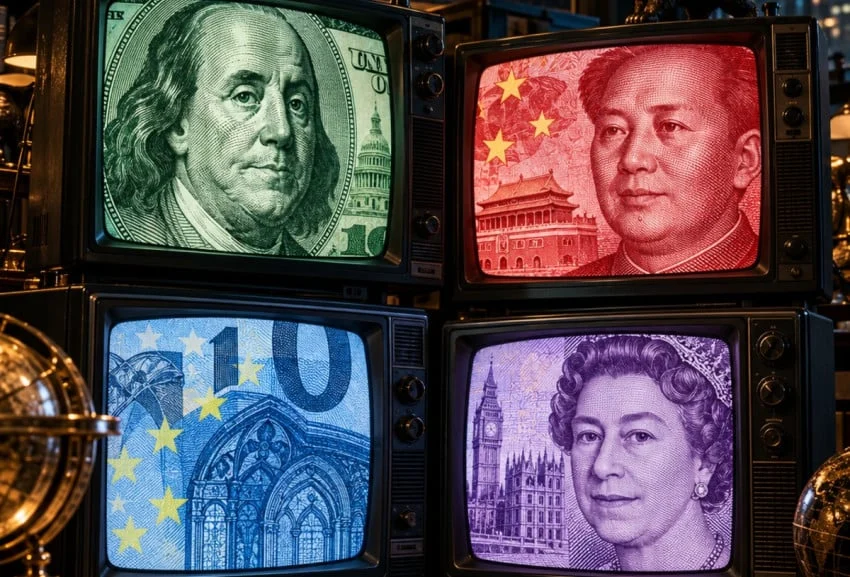
The ongoing discourse surrounding the global financial architecture has experienced a significant recalibration after senior diplomatic officials clarified the strategic objectives of the BRICS economic bloc. The much-discussed agenda aimed at complete de-dollarization—defined as the wholesale eradication of the United States dollar from cross-border trade settlements—has encountered practical stagnation. This friction arises primarily because influential member states, most notably India, have categorically declined to support the full substitution of the greenback. Instead of orchestrating a coordinated campaign to phase out the dominant global reserve currency, the coalition has pivoted toward a more pragmatic framework: strengthening the utilization of respective national currencies for bilateral trade while explicitly preserving space for the continued deployment of the United States dollar.
This strategic clarification was underscored by the Ambassador of the Russian Federation to India, Denis Alipov, during his address at the NDTV Defense Summit. Citing reports from the Russian state-owned news agency TASS and international financial observers, Alipov articulated that the BRICS alliance—comprising Brazil, Russia, India, China, South Africa, and its newly inducted members—operates without an anti-Western mandate. He emphasized that the collective does not position itself in direct opposition to the United States dollar, nor does it seek to dismantle Western-led financial institutions through antagonistic maneuvers. Rather, the bloc envisions its monetary initiatives as a complementary diversification of global payment channels, offering sovereign states viable alternatives centered on local currency settlements.
Background and Context of the BRICS Economic Evolution
The concept of de-dollarization within the BRICS framework has long captured the attention of macroeconomic analysts, policymakers, and international trade organizations. Historically, the global financial system has relied overwhelmingly on the United States dollar as the primary medium for international exchange, commodity pricing, and central bank reserve accumulation. This hegemony grants the United States significant geopolitical leverage, often referred to by economists as an exorbitant privilege, while exposing emerging economies to external vulnerabilities such as fluctuations in United States monetary policy, inflationary spillovers, and stringent sanctions regimes.
In response to these systemic vulnerabilities, discussions regarding alternative financial architectures gained substantial momentum following the escalation of geopolitical tensions and economic sanctions in the early 2020s. Member states began exploring mechanisms to insulate their domestic economies from external shocks. Proposals ranged from the creation of an independent BRICS reserve currency to the expansion of bilateral swap lines that allow nations to trade directly in rupees, rubles, yuan, reals, and rands.
However, the path toward a unified monetary policy or a standardized alternative currency has been fraught with structural divergence among member economies. While nations facing heavy Western sanctions, such as Russia, possess an urgent incentive to minimize their exposure to the dollar-dominated Swift financial messaging network, other members maintain deep, intricate economic ties with Western markets. India, in particular, has maintained a fiercely independent foreign policy doctrine, balancing strategic partnerships with Western democracies alongside long-standing cooperative frameworks with Moscow and Beijing. New Delhi’s reluctance to back the complete elimination of the dollar reflects its pragmatic economic interests, as the greenback remains the most liquid, stable, and widely accepted instrument for managing global supply chains and stabilizing its domestic foreign exchange reserves.
The Evolving Stance on Global Governance and Multilateralism
Beyond the technicalities of currency exchange, Ambassador Alipov’s recent commentary sheds light on the broader institutional identity of BRICS. For years, Western financial and political commentators have debated whether BRICS functions as a geopolitical counterweight designed to uproot existing post-World War II global governance structures, such as the International Monetary Fund, the World Bank, and the Group of Twenty (G20).
Alipov’s formal clarification directly addresses these anxieties. By positioning BRICS as an alternative platform rather than an adversarial bloc, the Russian envoy sought to reassure international markets that the coalition’s expansion and policy formulations are inclusive rather than exclusionary. According to diplomatic representations within the forum, no member state has formally tabled an anti-Western agenda or advocated for policies explicitly calculated to harm Western economic stability. Instead, the narrative promoted by key stakeholders frames BRICS as a representative voice for the Global South, aiming to secure greater representation and voting power within existing multilateral institutions rather than engineering a disruptive fracture in the global economy.
This nuance is critical for understanding the mechanics of international trade diplomacy. The pivot toward local currency settlements is not intended to trigger the collapse of the dollar, but rather to mitigate transaction costs, reduce exchange rate risks associated with intermediary currencies, and enhance the macroeconomic sovereignty of developing nations. By settling trade deficits and surpluses in national monies, emerging markets can conserve their hard currency reserves—predominantly dollars—for critical macroeconomic stabilization and external debt servicing.
Economic Implications and Regional Trajectories
The deceleration of the radical de-dollarization agenda carries profound implications for global trade flows, foreign exchange markets, and international monetary policy. By abandoning the pursuit of a singular, disruptive alternative currency, the BRICS alliance has effectively chosen a path of gradual, pragmatic financial integration. This approach minimizes the risk of sudden liquidity crunches and currency volatility that could otherwise destabilize fragile emerging markets.
For nations like Indonesia—which, while not a founding BRICS member, actively pursues robust local currency transaction (LCT) frameworks to insulate its economy—the validation of local currency usage reinforces national strategies. As Southeast Asia’s largest economy continues to expand its bilateral trade agreements utilizing direct exchange mechanisms (such as rupiah-rupee, rupiah-yuan, and rupiah-ringgit arrangements), the global trend moves away from total replacement and toward a multi-currency ecosystem. Indonesia’s ambitious targets for local currency transaction volumes highlight a regional commitment to reducing transaction friction without severing ties with global benchmark currencies.
The implications for the United States dollar are similarly nuanced. While the dollar will undoubtedly retain its preeminent status as the world’s leading reserve and transaction currency for the foreseeable future, its absolute monopoly on cross-border trade is steadily yielding ground to a more fragmented, diversified financial landscape. The proliferation of bilateral swap agreements and digital payment infrastructures developed by emerging economies means that the marginal demand for the dollar in regional trade will experience a controlled, secular decline.
Expert Analysis and Future Outlook
Financial analysts and macroeconomic researchers generally view the current stagnation of radical de-dollarization as a victory for economic realism over political rhetoric. Building a viable global reserve currency requires deep, liquid capital markets, fully convertible capital accounts, strong institutional rule of law, and widespread international trust—attributes that take decades to cultivate and which current emerging economies are still in the process of developing.
The divergence of views within BRICS—exemplified by India’s cautious stance and China’s aggressive push for renminbi internationalization—demonstrates that the bloc is heterogeneous, driven by distinct national interests rather than monolithic obedience. This internal diversity acts as a natural brake on radical initiatives, ensuring that policies adopted by the coalition remain anchored in economic viability rather than ideological posturing.
Looking forward, the trajectory of BRICS financial cooperation will likely center on technical harmonization rather than grand geopolitical declarations. Priorities will include the enhancement of cross-border payment linkages, the development of alternative messaging platforms to facilitate bilateral trade in local currencies, and the ongoing dialogue regarding macroeconomic policy coordination among central banks. As these initiatives mature, the global financial system will continue its evolution toward a multipolar framework, wherein the United States dollar shares space with a robust network of regional currencies, ensuring greater financial resilience and flexibility for emerging and developed economies alike.
