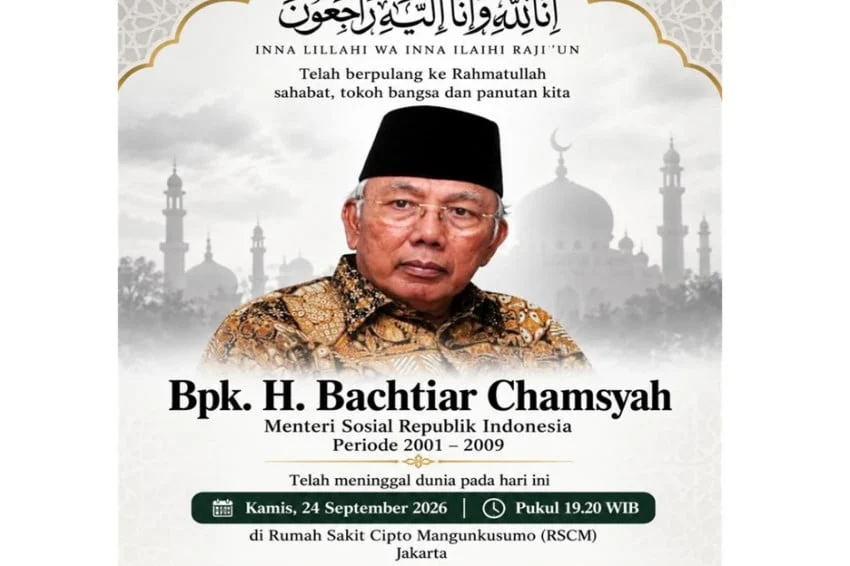
The Indonesian political landscape is mourning the loss of a prominent figure as H. Bachtiar Chamsyah, a seasoned politician and former Minister of Social Affairs, passed away on Thursday, September 24, 2026. The 80-year-old statesman breathed his last at 19:20 WIB at the Cipto Mangunkusumo Hospital (RSCM) in Jakarta, leaving behind a legacy that spanned several decades of service in both the legislative and executive branches of the Indonesian government.
His passing marks the end of an era for the United Development Party (PPP), where he served as a senior figure and mentor. As news of his departure circulated, tributes began pouring in from political allies, former colleagues, and government officials who recognized his significant contributions to the nation’s social welfare policies during his tenure as a cabinet minister.
A Life of Public Service and Political Dedication
Born on December 31, 1945, in Tiji, Sigli, Aceh, Bachtiar Chamsyah’s formative years were defined by the post-independence struggle and the necessity of nation-building. His educational journey began in his homeland of Aceh and later transitioned to North Sumatra, where he eventually earned a degree in Economics from the Universitas Medan Area. This academic foundation served as a springboard for his future roles in shaping the fiscal and social policies of the Indonesian state.
Before his rise to national prominence, Chamsyah was deeply embedded in the student activist movement of the 1960s. He was an active member of the Indonesian Student Action Union (KAMI) and the Islamic Students Association (HMI), organizations that were instrumental in shaping the political consciousness of the youth during the transition of the New Order era. These early experiences in organizational leadership provided him with the necessary skills to navigate the complex dynamics of Indonesian party politics, leading him to join the United Development Party (PPP).
Parliamentary Stature and Executive Leadership
Chamsyah’s transition from an activist to a career politician was characterized by steady advancement within the PPP. He served multiple terms as a member of the People’s Representative Council (DPR RI), where he earned a reputation as a shrewd negotiator and a disciplined legislator. During his time at the Senayan complex, he chaired Commission V—which oversees infrastructure and transportation—and gained national attention as the Chairman of the Special Committee (Pansus) for the "Bulog Gate" scandal, an investigation that solidified his image as a politician unafraid to tackle high-stakes issues.
His executive career reached its zenith when he was appointed as the Minister of Social Affairs. Serving during a pivotal period of Indonesia’s democratic transition, Chamsyah was tasked with restructuring the ministry’s approach to poverty alleviation and disaster response. His tenure was marked by efforts to professionalize the distribution of social assistance and to institutionalize the role of the ministry in responding to the frequent natural disasters that affect the Indonesian archipelago.
Chronology of the Final Moments and Funeral Arrangements
According to information released by the iNews Media Group, the late H. Bachtiar Chamsyah passed away following a period of declining health. His family has confirmed that his body will be laid in state at his residence located at Jl. Puspitek Raya, Gang Samping Kelurahan Setu, RT 014/RW 04, No. 26 A, Tangerang Selatan.
As of late Thursday evening, the family had not yet issued a formal statement regarding the specific timing of the funeral service or the burial site. However, it is expected that the funeral will be conducted with official honors, given his status as a former high-ranking cabinet member. Political observers anticipate that senior members of the PPP, along with current and former government officials, will attend the funeral to pay their final respects.
Fact-Based Analysis of His Political Impact
The influence of Bachtiar Chamsyah on the Indonesian political stage cannot be overstated, particularly concerning the internal dynamics of the PPP. As a senior cadre, he acted as a stabilizing force during periods of party fragmentation. His approach to politics was grounded in the principles of moderate Islamic governance, aligning with the PPP’s ideological roots while maintaining a pragmatic stance on economic policy.
His tenure as Minister of Social Affairs also provided a template for how the ministry manages its budget under the decentralization framework. By strengthening the relationship between the central government and local social agencies, Chamsyah helped formalize the mechanism for social safety nets, which became a critical infrastructure for subsequent administrations to build upon.
However, his career was not without challenges. Like many senior politicians who navigated the transition from the New Order to the Reformasi era, Chamsyah faced scrutiny regarding the institutional challenges of his time. His legacy, therefore, is viewed through the lens of a career that spanned the evolution of Indonesian democracy—from the centralized governance of the past to the more pluralistic and competitive political environment of the present.
Reflections from the Political Community
Though formal statements from the current government are still forthcoming, early reactions from political circles indicate a sense of profound loss. Analysts note that with the passing of figures like Chamsyah, the younger generation of politicians is losing a direct link to the political culture of the late 20th century.
"Bachtiar Chamsyah was a man who understood the intricacies of the parliament as well as he understood the needs of the grassroots," said a former legislative colleague who requested anonymity. "He was a bridge-builder, someone who could maintain party discipline while ensuring that the legislative agenda remained focused on the broader public interest."
His colleagues often recall his sharp wit in debates and his ability to maintain decorum even during the most heated political sessions. His commitment to the PPP remained steadfast, even as he transitioned into an elder statesman role within the party’s advisory council.
Broader Implications and Legacy
The death of H. Bachtiar Chamsyah occurs at a time when the Indonesian political landscape is undergoing its own transition. As the country prepares for future election cycles, the departure of senior figures prompts a reflection on the institutional memory they carry. Chamsyah’s life represents the archetype of the Indonesian politician who emerged from the student movement, survived the rigors of partisan politics, and reached the highest echelons of executive power.
His contributions to the Ministry of Social Affairs paved the way for more modern, digital-based social assistance programs. Although the systems have evolved, the administrative foundations he helped set during his years as Minister remain central to the way the Indonesian state interacts with its most vulnerable citizens.
In the coming days, further details regarding the final memorial services will be disseminated by the family and party representatives. The public is expected to offer an outpouring of condolences, acknowledging his decades of service to the Republic of Indonesia. For the PPP, his passing represents a significant void in its leadership, necessitating a period of mourning and, eventually, a reflection on how his followers will carry on the work he began.
As the nation reflects on his life, it is clear that H. Bachtiar Chamsyah will be remembered not only as a minister or a parliamentarian but as a dedicated public servant who navigated the complexities of Indonesian history with unwavering focus and an enduring commitment to the values he championed throughout his long and distinguished career. The formal announcement of his passing serves as a somber reminder of the transient nature of political power, yet the legacy of his service continues to resonate within the halls of the government he once served.