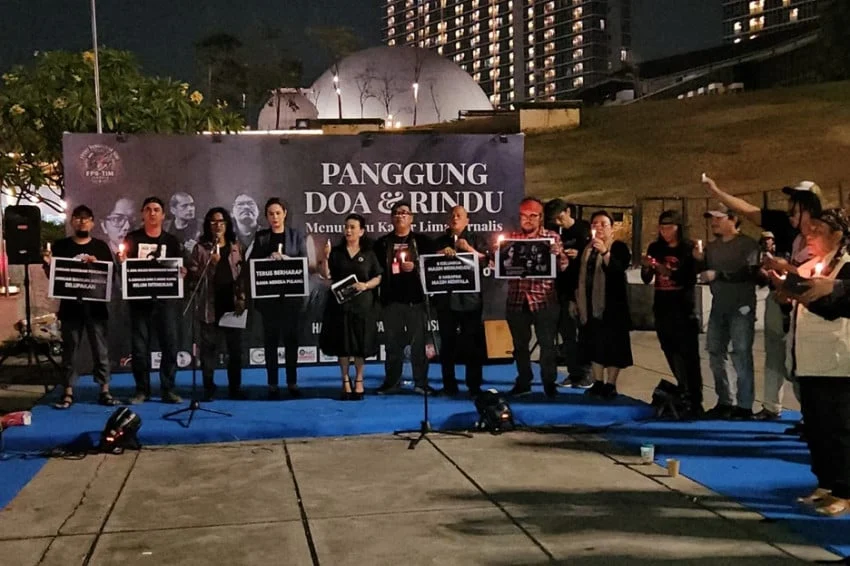
A collective of artists, activists, and media colleagues gathered at the iconic front courtyard of Taman Ismail Marzuki (TIM) in Central Jakarta on Monday evening, September 14, 2026, to host a poignant vigil titled "Panggung Doa dan Rindu" (Stage of Prayer and Longing). The event served as a solemn platform to express solidarity and hope for the safe recovery of five journalists and three boat crew members who have remained missing since losing contact in the waters of the Sunda Strait on September 7, 2026.
The atmosphere was heavy with anticipation and reflection as participants lit candles, recited poetry, and joined in a collective prayer for the missing individuals. The somber melody of "Tanah Airku," a patriotic anthem composed by Ibu Soed, underscored the emotional gravity of the gathering, reflecting the national concern surrounding the disappearance of members of the press corps. Among those currently the subject of an extensive search-and-rescue operation is Yudistiro Pranoto, a dedicated photojournalist representing iNews Media Group.
Chronology of the Disappearance
The incident, which has gripped the Indonesian media community, began on the morning of September 7, 2026. According to preliminary reports, the group of eight—comprised of five journalists and three crew members—departed for a maritime reporting assignment in the Sunda Strait. The region is known for its volatile weather patterns and complex currents, which frequently pose challenges to maritime navigation.
By the afternoon of September 7, communication with the vessel was severed. When the boat failed to arrive at its scheduled destination or check in with their respective newsrooms, emergency protocols were initiated. Local authorities, including the National Search and Rescue Agency (BASARNAS), were notified, and a massive multi-agency search operation was launched shortly thereafter.
As of September 14, the search has entered its eighth day. Despite the deployment of sonar technology, aerial surveillance, and naval patrols, the wreckage of the vessel has yet to be located. The search perimeter has been expanded significantly, covering a vast area stretching from the southern tip of Sumatra to the western coast of Banten, accounting for potential drift patterns caused by the strait’s powerful underwater currents.
The Humanitarian Response at TIM
The vigil at Taman Ismail Marzuki was not merely an emotional outlet but a testament to the tight-knit nature of Indonesia’s journalistic community. David Karo-karo, a representative of the Front Penggerak Seniman TIM and the primary initiator of the event, stated that the gathering was organized spontaneously. "This is an act of humanitarian solidarity," Karo-karo noted. "We are standing with our colleagues and their families, holding onto hope that our friends will be found safe. The arts community recognizes the vital role journalists play in our society, and we feel their absence deeply."
Throughout the evening, speakers highlighted the risks inherent in the journalistic profession, particularly when reporting from remote or hazardous environments. Participants held placards bearing messages of support, such as "Bring Our Colleagues Home" and "Solidarity for the Missing." The presence of both veteran journalists and younger members of the press highlighted a generational commitment to the safety and welfare of media practitioners.
Operational Challenges and Official Search Efforts
The search-and-rescue mission has faced significant environmental hurdles. The Sunda Strait, separating the islands of Java and Sumatra, is a critical maritime lane characterized by high traffic and unpredictable oceanic conditions. Meteorological reports from the week of the incident indicated moderate to rough seas, which may have compromised the integrity of smaller vessels.
In response to the gravity of the situation, the Indonesian government has officially extended the search period by an additional three days. This decision, announced earlier this week, acknowledges the persistence of the families and the media industry in demanding that every possible effort be made before transitioning the operation from a rescue mission to a recovery mission.
"The search is being conducted with the highest priority," said a spokesperson for the regional disaster management authority. "We are utilizing every available asset, including local fishing vessels that have been recruited to assist in the coastal search. However, the vastness of the search area and the depth of the waters in certain sections of the strait remain the primary obstacles."
The Impact on Media Safety Protocols
The disappearance of the five journalists has prompted a broader conversation regarding safety protocols for media personnel conducting field assignments. Many news organizations are now under pressure to re-evaluate their risk management strategies, particularly regarding maritime travel.
Industry experts suggest that this incident may catalyze a nationwide review of safety equipment requirements for journalists. "Journalists often find themselves in high-risk zones to bring the truth to the public," said an analyst from a Jakarta-based media watchdog group. "The tragedy in the Sunda Strait serves as a harsh reminder that the safety of the reporter must always be prioritized over the story. It is imperative that news organizations invest in advanced tracking technology and stringent weather-monitoring protocols for all field assignments."
The media industry is currently mourning the loss of potential stories these journalists were meant to cover, but the primary focus remains on the human element. The families of the missing journalists have been provided with counseling and support from their respective media houses, while the wider public continues to monitor the news for any sign of progress in the search efforts.
Broader Implications for Freedom of the Press
While the current situation is primarily a search-and-rescue crisis, it also underscores the fragility of the media landscape in Indonesia. The disappearance of five individuals from the field is a significant blow to the reporting capacity of the affected organizations. Furthermore, the event highlights the essential, often dangerous work that journalists undertake to provide transparency in democratic processes.
The solidarity shown by the artistic community at TIM signifies a growing recognition of the role of journalism in the public sphere. When journalists are endangered, the flow of information is disrupted, and the public’s right to know is curtailed. The vigil served to remind the public that journalists are not merely observers of history, but active participants who often face extreme vulnerabilities.
Looking Ahead: The Wait for News
As of Tuesday morning, the search continues unabated. The families of Yudistiro Pranoto and his colleagues remain in a state of suspended hope, waiting for updates from the joint command center. The extension of the search window offers a sliver of optimism, yet the harsh reality of the elapsed time weighs heavily on the rescuers.
The incident is expected to lead to a formal investigation by the National Transportation Safety Committee (KNKT) once the search phase concludes. This investigation will seek to determine the root cause of the disappearance, whether it was due to mechanical failure, sudden weather events, or human error. For now, however, the focus remains singular: the safe return of the five journalists and the three crew members.
The event at Taman Ismail Marzuki concluded with a final prayer, leaving the attendees with a sense of shared responsibility. The "Panggung Doa and Rindu" has become a symbol of the resilience of the press and the unity of the community. Regardless of the outcome of the search, the gathering has solidified a commitment to ensure that no journalist is ever left to face such a crisis in isolation.
As the nation watches the Sunda Strait, the hope remains that the waters will yield answers, and that the missing will be returned to their families. Until then, the vigil at TIM stands as a poignant reminder of the enduring bond between the people who tell the stories of the nation and the people who witness them. The search continues, and with it, the prayers of a nation.