
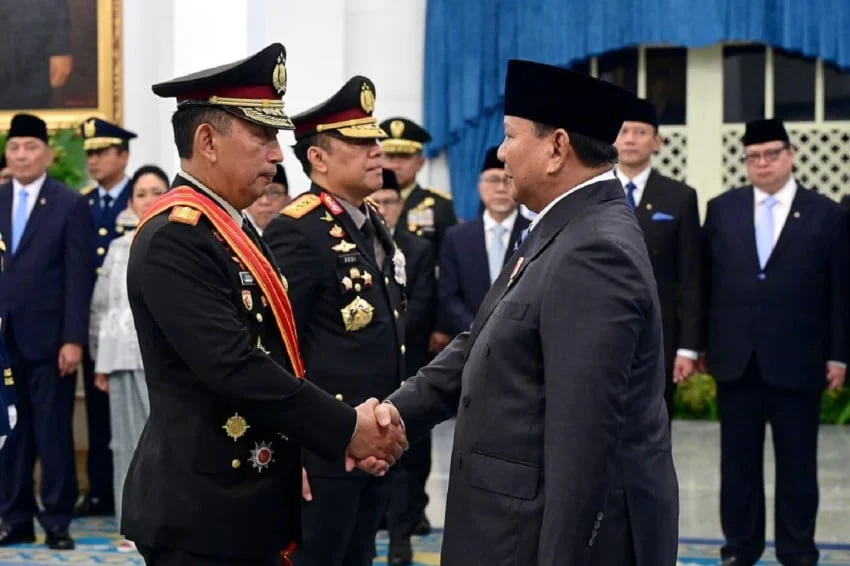
The political stability of Indonesia has been plunged into uncertainty following a dramatic announcement from the Criminal Investigation Agency (Bareskrim) of the Indonesian National Police. Authorities have formally named three high-ranking police generals as suspects in a sprawling investigation involving illegal electronic surveillance and the systematic destruction of digital evidence targeting President Prabowo Subianto. The gravity of these allegations, which Minister of State Secretary Prasetyo Hadi has characterized as potentially amounting to acts of treason, has triggered a massive security response across Jakarta, including the reported deployment of over 20,000 military personnel to secure critical government infrastructure.
The suspects, who have since been taken into custody, include Jenderal Polisi Listyo Sigit Prabowo, the former Chief of National Police who was serving as the Presidential Chief of Staff (KSP); Irjen Ahrie Sonta, the Head of the Legal Division of the National Police; and Irjen Eko Hadi Santoso, a senior official at the Sespim Lemdiklat Polri. These arrests represent an unprecedented breach of internal security at the highest echelons of the Indonesian state apparatus, raising urgent questions regarding the loyalty of law enforcement leadership and the integrity of the nation’s intelligence frameworks.
Chronology of the Surveillance Operation
According to preliminary findings released by Bareskrim investigators, the illicit surveillance activities were conducted over a sustained period, spanning from 2025 to 2026. The scope of the operation involved sophisticated electronic interception techniques designed to monitor private communications within the presidential complex. Investigators allege that the suspects utilized their official positions to bypass standard security protocols, effectively creating a "shadow" monitoring network.
The discovery of the plot reportedly surfaced during a routine security audit of the presidential digital communications infrastructure. The audit revealed unauthorized access points and evidence that encrypted data streams had been diverted to external servers. Furthermore, forensic cyber analysts identified a deliberate effort to purge digital logs and erase audit trails, suggesting that the operation was not merely for data collection but was part of a broader, coordinated strategy to undermine the executive branch.
While the specific motive behind this operation remains the subject of ongoing judicial inquiry, security analysts suggest that the involvement of senior officials—particularly those holding dual roles in law enforcement and presidential administration—indicates a calculated attempt to leverage institutional power against the head of state. The transition from illegal surveillance to the destruction of state evidence is considered by legal experts as a critical threshold that elevates the charges from professional misconduct to national security crimes.
Institutional Response and National Security Measures
The administration’s response was swift and uncompromising. Following the initial briefings by Bareskrim, Minister of State Secretary Prasetyo Hadi addressed the public, emphasizing that the government views the breach as a direct threat to the democratic order. "This is not merely a matter of internal police discipline," Hadi stated. "When the instruments of the state are turned against the President, we are looking at potential acts of treason. We will ensure that the rule of law is upheld without exception."
In response to the perceived threat, the Indonesian military (TNI) has moved to increase its presence in the capital. The deployment of over 20,000 troops serves as a precautionary measure intended to maintain public order and ensure the continuity of government functions. This mobilization of forces underscores the severity of the crisis, as the government seeks to prevent any potential civil unrest or attempts to exploit the current political vacuum.
The National Police, currently grappling with the reputational fallout of having its former chief named as a key suspect, has initiated a sweeping internal reform process. The current leadership has pledged full cooperation with the Bareskrim investigators, promising a transparent and thorough inquiry that will purge elements involved in the conspiracy. However, the arrest of Listyo Sigit Prabowo, a figure who only months prior was decorated with the Bintang Mahaputera Adipurna for his service, has sent shockwaves through the political establishment, casting doubt on the vetting processes for top-tier security appointments.
Global Context: Historical Precedents of Internal Coups
The Indonesian situation, while unique in its specific operational details, finds resonance in historical events where the internal security apparatus turned against the executive. The danger of a "state within a state" is a recurring theme in modern political history, where trusted officials leverage their proximity to power to destabilize the government from within.
The most prominent example of this dynamic occurred on August 19, 1991, during the collapse of the Soviet Union. A group of hardline officials, known as the State Committee on the State of Emergency (GKChP), attempted to seize power by placing President Mikhail Gorbachev under house arrest at his dacha in Foros, Crimea. The plotters, including Vice President Gennady Yanayev, KGB Chairman Vladimir Kryuchkov, and Defense Minister Dmitry Yazov, claimed that Gorbachev was physically incapacitated and unable to lead.
The Soviet coup attempt serves as a stark historical parallel to the Indonesian case. In both instances, the conspirators held high-ranking positions that granted them access to the highest levels of state secrets and physical security. The CIA, in intelligence assessments drafted months before the 1991 collapse, had warned of the specific individuals involved in the coup, noting their growing dissatisfaction with Gorbachev’s reformist policies. Similarly, the current investigation in Indonesia will likely examine whether there were early warning signs of the suspects’ ideological or political departure from the administration’s agenda.
Legal Implications and Political Impact
The legal ramifications for the three generals are severe. Under Indonesian law, acts of treason or conspiracy to undermine the sovereignty of the state carry heavy penalties, including life imprisonment. The inclusion of the "destruction of electronic evidence" charge adds a layer of cyber-criminality that complicates the prosecution, as it involves the handling of highly classified state information.
From a political standpoint, the crisis has forced a realignment of support for President Prabowo. While the opposition has called for a transparent, independent investigation, there is a broad consensus across the political spectrum that the stability of the state must remain the primary concern. The event has also sparked a debate regarding the centralization of power. Critics argue that the current structure of the Indonesian intelligence and law enforcement agencies allows for too much unchecked authority, while proponents of the administration argue that the problem lies in the vetting of personnel rather than the institutional design itself.
As the case moves toward trial, the following factors will be critical in shaping the nation’s future trajectory:
- Evidence Integrity: The prosecution must prove that the digital logs recovered are admissible and demonstrate a clear intent to facilitate an overthrow of the government.
- Public Confidence: The ability of the judiciary to conduct a fair and public trial will be essential to restoring trust in the National Police.
- Regional Stability: Indonesia’s role as a regional leader in Southeast Asia necessitates that this crisis does not translate into international instability. External observers, including neighboring ASEAN nations, are closely monitoring the security situation in Jakarta to ensure that trade and diplomatic ties remain unaffected.
Conclusion: A Test of Democratic Resilience
The investigation into the alleged surveillance of President Prabowo Subianto is far from concluded. As more details emerge from the Bareskrim’s interrogation of the suspects, the full extent of the conspiracy—and whether it involved external actors or further collaborators within the police and military—will become clearer.
This episode serves as a sobering reminder of the fragility of modern democratic governance. Even in established states, the trust placed in senior security officials is a vulnerability that, if exploited, can threaten the very foundation of the executive branch. The Indonesian government’s response to this crisis will be a definitive test of its institutional resilience, the independence of its judiciary, and its ability to maintain order in the face of internal betrayal. For now, the nation remains on high alert, waiting for the legal process to dismantle the remnants of what many are calling the most significant security breach in the country’s modern history.
