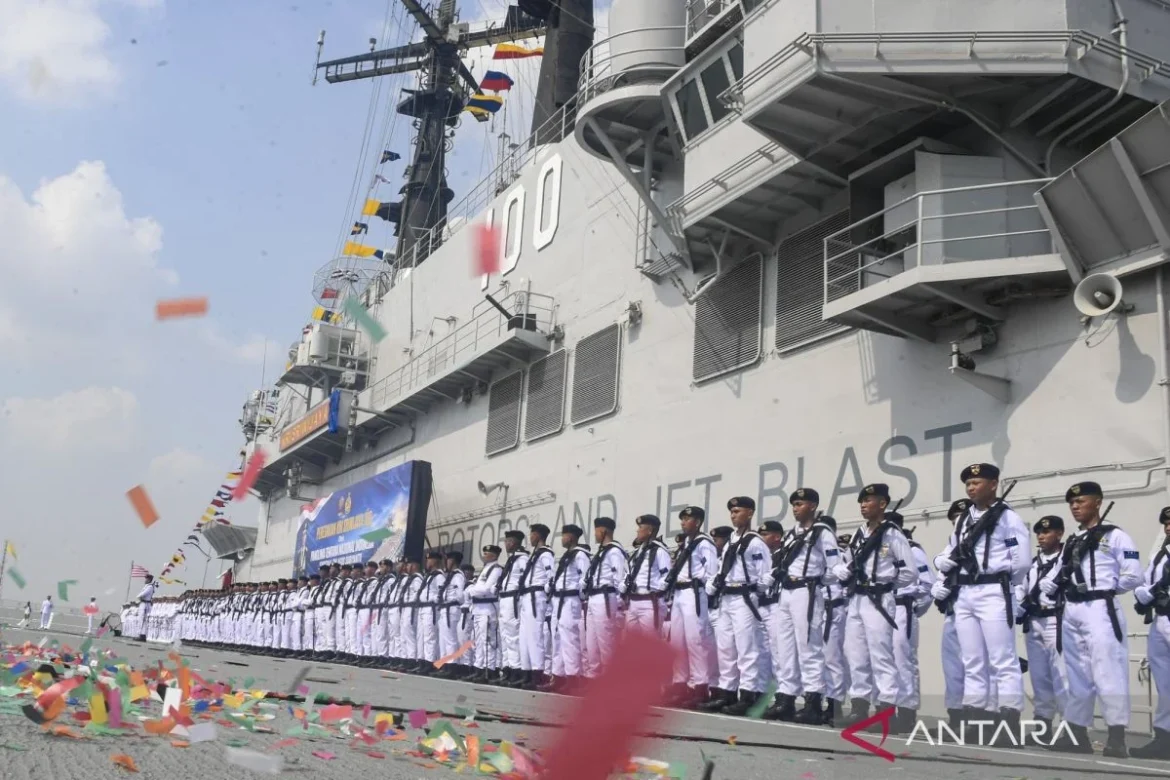
The arrival of the former Italian Navy aircraft carrier ITS Giuseppe Garibaldi at Pier 107 of Tanjung Priok Port in North Jakarta marks a monumental milestone for the Indonesian Navy (Tentara Nasional Indonesia Angkatan Laut, or TNI AL). Bertthing in Jakarta following its long maritime transit, this decommissioned flagship represents more than just a surface combatant acquisition; it signifies the introduction of fixed-wing and rotary aviation capabilities to the archipelagic nation’s naval fleet for the very first time. Originally commissioned under the Italian flag with hull number C551, the vessel is slated to undergo an official handover and flag-changing ceremony on September 24, 2026, officially rechristening it as KRI Sriwijaya.
This historic transfer has reignited national and international discourse regarding the strategic utility, operational definitions, and broader geopolitical implications of operating a sovereign floating air base. As the Indonesian archipelago—spanning over 17,000 islands—prepares to integrate this massive platform into its defense architecture, military analysts, government officials, and naval strategists are closely scrutinizing how the newly minted KRI Sriwijaya will reshape Southeast Asia’s naval balance and redefine the operational doctrines of the TNI AL.
Chronology and Transition Phase: From Italian Flag to Red and White
The journey of the vessel from the Mediterranean to Southeast Asia is the culmination of extensive bilateral defense diplomacy between Jakarta and Rome. Preliminary discussions regarding the acquisition of the Italian carrier began years prior, driven by TNI AL’s strategic blueprint to expand its blue-water projection and enhance its disaster response capabilities across the vast maritime zones of the Indonesian maritime domain.
Upon its arrival on Friday, September 18, the vessel immediately entered a designated preparation phase at Tanjung Priok. While the physical arrival has captivated public and media attention, the formalization of ownership remains a scheduled event. On September 24, 2026, the Italian naval ensign will be lowered, and the Indonesian Red and White flag will be hoisted, officially bringing KRI Sriwijaya into active service under the Indonesian command structure.
Government officials have confirmed high-level diplomatic and executive participation in the transition process. Reports indicate that state secretariats and defense ministries have coordinated visits, including a planned audience between the President of the Republic of Indonesia and official representatives of the Italian Navy, underscoring the deep strategic partnership underpinning the transfer. Furthermore, Chief of Staff of the Navy (KSAL) Admiral Muhammad Ali has offered extensive briefings to the public and the legislature, detailing the rationale behind selecting the Italian carrier and outlining the phased integration roadmap.
Unpacking the Platform: What Constitutes an Aircraft Carrier?
The introduction of KRI Sriwijaya has prompted widespread public curiosity regarding the precise definition and military utility of an aircraft carrier. In naval architecture and tactical doctrine, an aircraft carrier is fundamentally defined as a large warship engineered primarily as a mobile, sea-going air base. Unlike conventional surface combatants—such as frigates, corvettes, and destroyers—whose primary offensive and defensive capabilities rely on surface-to-surface missiles, naval artillery, torpedoes, and localized anti-aircraft systems, an aircraft carrier’s primary weapon system is its air wing.
An authentic aircraft carrier is distinguished not merely by its tonnage, but by its core design features. These include an expansive flight deck, a below-deck hangar bay configured for aircraft maintenance and storage, specialized aviation fuel storage and distribution systems, and sophisticated air traffic control architecture. These integrated systems allow the vessel to launch, recover, service, and coordinate dozens of fixed-wing aircraft and rotary assets simultaneously, projecting military power far beyond the immediate horizon of the ship itself.
Global naval forces, including the United States Navy, classify aircraft carriers as critical instruments of multi-mission power projection. Beyond high-intensity combat operations, these platforms serve as nodes for maritime security patrols, power projection deterrence, freedom of navigation enforcement, and large-scale humanitarian assistance and disaster relief (HADR) operations.
Strategic Redirection: Focusing on Military Operations Other Than War (OMSO)
Despite its heritage as a capable light fleet carrier that historically operated vertical/short take-off and landing (V/STOL) aircraft such as the AV-8B Harrier II, the operational profile of KRI Sriwijaya within the TNI AL will be tailored closely to Indonesia’s specific national security framework. Rather than transforming the vessel into an aggressive power-projection platform akin to those operated by superpowers, the Indonesian defense establishment has emphasized a more pragmatic, multi-functional doctrine centered heavily on Military Operations Other Than War (OMSP – Operasi Militer Selain Perang).
Admiral Muhammad Ali has explicitly detailed that the carrier will undergo significant structural refits, propulsion overhauls, and internal layout reconfigurations to match Indonesia’s domestic operational realities. The primary focus of KRI Sriwijaya will leverage its expansive deck space and internal volume to support rotary-wing aviation (helicopters), uncrewed aerial vehicles (drones), logistical transport, and rapid medical deployment.
This strategic pivot directly addresses the geographical realities of Indonesia. As a sprawling archipelagic state prone to natural disasters—including earthquakes, volcanic eruptions, tsunamis, and extreme weather events—logistical bottlenecks frequently paralyze traditional relief efforts. When ground transport routes and regional airports are severely damaged or entirely isolated, maritime-based air support becomes the single most viable mechanism for delivering aid.
HADR and Maritime Security Implications
The utility of KRI Sriwijaya as a floating command, control, and logistics hub in times of crisis cannot be overstated. By operating as a mobile airfield, the vessel can station multiple heavy-lift and utility helicopters directly off the coast of a disaster-stricken region, bypassing compromised infrastructure.
Defense analysts note that the integration of the carrier will supercharge Indonesia’s disaster response playbook. Helicopters operating from the flight deck can rapidly airlift tons of medical supplies, clean water, and food rations, while simultaneously executing medical evacuations (MEDEVAC) of injured civilians back to the ship’s onboard medical facilities or mainland hospitals. Furthermore, the incorporation of unmanned aerial systems (drones) from the vessel will dramatically enhance search and rescue (SAR) coordination and wide-area damage assessment capabilities over isolated islands.
In addition to humanitarian missions, the presence of a dedicated aviation platform fundamentally alters the tactical dynamics of maritime surveillance across Indonesia’s three Exclusive Economic Zones (EEZ) and vital sea lanes of communication (ALKI – Alur Laut Kepulauan Indonesia). Operating air patrols from a mobile platform increases response times against illegal fishing, transnational smuggling, and unauthorized foreign incursions, bridging vast maritime gaps that land-based aviation assets struggle to cover continuously.
Technical Adaptation and Future Aviation Roadmap
Integrating a vessel of this scale presents unique engineering and logistical challenges for the TNI AL. The Giuseppe Garibaldi has a rich operational history, and adapting its systems to modern Indonesian naval standards requires meticulous engineering work. Current refit plans focus heavily on engine rehabilitation, combat system compatibility upgrades, and aviation support infrastructure optimization.
A critical area of discussion among naval planners is the future composition of the ship’s embarked air wing. While the TNI AL has expressed a strong desire to eventually equip the carrier with advanced aviation assets capable of vertical or short take-off operations, the immediate operational focus remains centered on multi-role helicopters and tactical drones. These platforms offer immediate utility for anti-submarine warfare (ASW), surface surveillance, transport, and HADR missions without demanding the complex, high-cost maintenance ecosystem required for high-performance fixed-wing strike fighters.
Naval architects and defense economists point out that maintaining an aircraft carrier requires a sustained budgetary commitment, specialized training regimens for flight deck crews, and robust supply chains. The successful commissioning of KRI Sriwijaya will therefore serve as a rigorous testing ground for Indonesia’s defense industrial base and naval logistics networks over the coming decades.
Broader Geopolitical and Regional Impact
The commissioning of KRI Sriwijaya as Southeast Asia’s first modern aircraft carrier platform introduces a notable shift into the regional security landscape. While Indonesia maintains a strictly defensive foreign policy rooted in its "free and active" (bebas aktif) doctrine, the acquisition signals a clear intent by Jakarta to bolster its comprehensive maritime defense posture amid rising geopolitical friction in the Indo-Pacific.
Regional observers have monitored the acquisition closely, noting that while the ship is currently configured primarily for transport, rotary operations, and humanitarian duties, the underlying hull possesses inherent latent power-projection capabilities. This dual-use flexibility enhances Indonesia’s diplomatic leverage and signals to regional and global powers that Jakarta is serious about enforcing sovereignty across its maritime frontiers.
As the countdown to the September 24, 2026, commissioning ceremony continues at Tanjung Priok, the eyes of the global defense community remain fixed on Jakarta. The transformation of the former ITS Giuseppe Garibaldi into KRI Sriwijaya stands as a defining chapter in modern Indonesian naval history—a bold step that bridges historical maritime ambitions with the complex security demands of the 21st century.