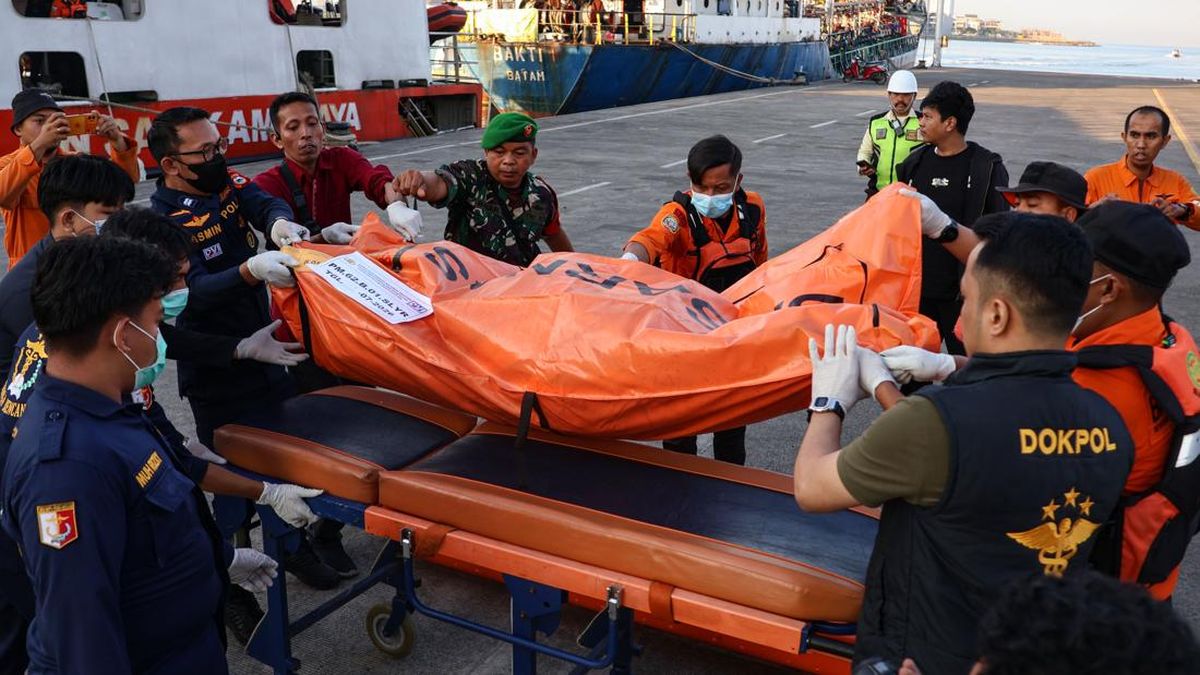
The joint Search and Rescue (SAR) team operating in the Sunda Strait region has confirmed that recent reports regarding individuals washed ashore—initially believed to be connected to the ongoing search for five journalists and three vessel crew members who lost contact during a reporting assignment—have yielded no tangible results. Despite extensive ground and maritime verification efforts conducted around the Bakauheni Port area in Lampung and surrounding waters, authorities have found no evidence to substantiate the claims.
The disappearance of the eight individuals, comprising media professionals and maritime crew members tracking activity near the Anak Krakatau volcano, has triggered a massive, multi-agency response. As the operation enters its critical phases, coordination between the National Search and Rescue Agency (Basarnas), the Indonesian Navy (TNI AL), and the Water Police (Polairud) remains absolute, even as rescue teams combat challenging oceanic and weather conditions characteristic of the volatile Sunda Strait corridor.
Unverified Reports of Stranded Survivors Prove Unfounded
Rumors regarding stranded survivors began circulating, prompting immediate mobilization by regional emergency response units. However, subsequent investigations by joint tactical units proved the reports to be unreliable.
Danlanal Banten, Lieutenant Colonel (P) Wawan Subagyo Mardani, addressed the validity of the rumors during a press briefing, noting that while every piece of incoming information is treated with the utmost seriousness, the recent tip-off regarding stranded individuals lacked credibility.
"For the information regarding stranded persons, after it was followed up by a joint team from Basarnas, the Indonesian Navy, and Polairud, the reliability and validity of the information were found to be low. Nevertheless, the personnel continued the search, and up until late afternoon, approximately at 2:30 PM, it was reported that the targeted location yielded entirely negative results," stated Lieutenant Colonel Wawan.
Echoing these remarks, the Head of the Banten SAR Office, Al Amrad, confirmed that field teams deployed directly to the reported coordinates found no trace of the missing group.
"We dug up information regarding the reported stranded individuals and proceeded directly to the location. We coordinated with the Lampung SAR Office, our counterparts in the TNI within Lampung, the Navy, and Polairud. They searched the reported area, but to date, there has been no breakthrough," Amrad explained.
Escalation of Maritime and Terrestrial Search Sectors
With the unverified reports dismissed, the joint SAR operation redirected its full operational capacity toward high-probability zones surrounding the geographic epicenter of the disappearance. On the fourth day of the relentless search operation, the tactical framework was partitioned into four primary maritime sectors, alongside a specialized fifth sector focusing on island landmasses situated approximately three kilometers from the Anak Krakatau volcanic complex.
To maximize coverage, authorities deployed heavy-duty search assets, including the rescue vessel KN SAR Tetuka and the Rigid Inflatable Boat (RIB) 02 Banten. Unlike previous days where operations remained strictly coastal or pelagic, the latest strategy incorporated rigorous terrestrial sweeps. Specialized teams landed directly on the shores of remote islands to comb through dense vegetation and rugged terrain.
"For the special sector outside the previous four zones, we deployed KN SAR Tetuka and RIB 02 Banten. RIB 02 returned to the Marina Pier at 3:31 PM after conducting a sweep around Anak Krakatau and searching three specific island points—Rakata Island, Sertung Island, and Panjang Island—where personnel performed thorough ground searches," Amrad elaborated.
Despite the deployment of advanced surface craft and specialized landing parties across Rakata, Sertung, and Panjang islands, the comprehensive sweeps have yet to uncover definitive clues pointing to the whereabouts of the missing journalists and vessel crew.
Context and Chronology of the Sunda Strait Incident
The unfolding emergency began when a vessel carrying a media crew undertaking journalistic coverage of the Anak Krakatau volcano lost all communication channels. The Sunda Strait, situated between the islands of Java and Sumatra, is a heavily trafficked maritime artery known for unpredictable weather patterns, strong tidal currents, and seismic activity associated with the Krakatau geological complex.
Journalistic missions covering maritime and volcanic activity in this region face inherent logistical and environmental hazards. Anak Krakatau, an active volcanic island that emerged from the caldera formed by the cataclysmic 1883 eruption of Krakatoa, remains a focal point for both scientific monitoring and news reporting due to its frequent eruptive phases and potential to trigger localized tsunamis.
When communication with the vessel abruptly ceased, emergency protocols were immediately triggered. Basarnas Banten, in close cooperation with regional naval commands and maritime police divisions, established a centralized crisis command post to coordinate tracking, drift-vector calculations, and asset deployment. The operation has since involved daily deployments of personnel, high-speed patrol vessels, and specialized reconnaissance units navigating the treacherous waters between the Banten coastline in West Java and the southern tip of Sumatra.
Inter-Agency Coordination and Strategic Challenges
The search operation highlights the complexities inherent in multi-agency disaster response and maritime rescue missions in Indonesia. The coordination framework relies on seamless communication between Basarnas as the leading operational authority, the Indonesian Navy providing tactical maritime support and surveillance assets, and the National Police providing regional security and coastal patrols.
Search planners utilize meteorological and oceanographic data, including wind direction, wave heights, and surface current models, to project drift trajectories for missing vessels or persons. However, the unique topography of the Sunda Strait—marked by deep underwater trenches, volcanic remnants, and rapid shifts in wind velocity—presents extraordinary obstacles for rescue planners.
Furthermore, the proliferation of unverified information and rumors across digital platforms and local communication channels has added friction to the operational tempo. Emergency officials have repeatedly urged the public and media outlets to rely solely on official updates released by authorized agencies to prevent operational distraction and alleviate unnecessary anxiety among the families of the missing individuals.
Implications for Maritime Safety and Journalistic Operations
The ongoing incident has brought renewed attention to the protocols governing media expeditions and professional voyages into high-risk natural zones. While journalists frequently deploy to remote or hazardous environments to document geological phenomena, environmental crises, and maritime events, the inherent dangers underscore the critical importance of rigorous safety preparations.
Industry stakeholders, press associations, and maritime authorities are expected to re-evaluate safety compliance measures for media crews operating in marine environments. Key considerations moving forward include mandatory real-time satellite tracking devices for all vessels entering volcanic hazard zones, mandatory pre-departure briefings with local maritime authorities, and strict adherence to marine weather advisories issued by the Indonesian Agency for Meteorology, Climatology, and Geophysics (BMKG).
As the search operation extends beyond its initial critical window, the psychological and operational toll on the joint rescue teams continues to mount. Family members of the missing journalists and crew remain gathered at coordination hubs, awaiting news as search perimeters are systematically expanded.
Outlook of the Ongoing SAR Mission
Authorities have emphasized that search and rescue operations will continue unabated, driven by protocols that mandate comprehensive efforts as long as viable survival windows and investigative leads exist. The joint SAR command center is scheduled to adjust its tactical deployment map based on daily operational evaluations, prevailing current trends, and any credible intelligence that may emerge from commercial vessels transiting the Sunda Strait.
While the false alarm regarding stranded individuals tested the patience and resources of the rescue teams, the incident has reinforced the resolve of the joint forces. As KN SAR Tetuka and auxiliary craft prepare for subsequent sweeps, the primary objective remains unchanged: locating the missing journalists and crew members, and bringing clarity to one of the most tense maritime emergencies in recent regional history.