
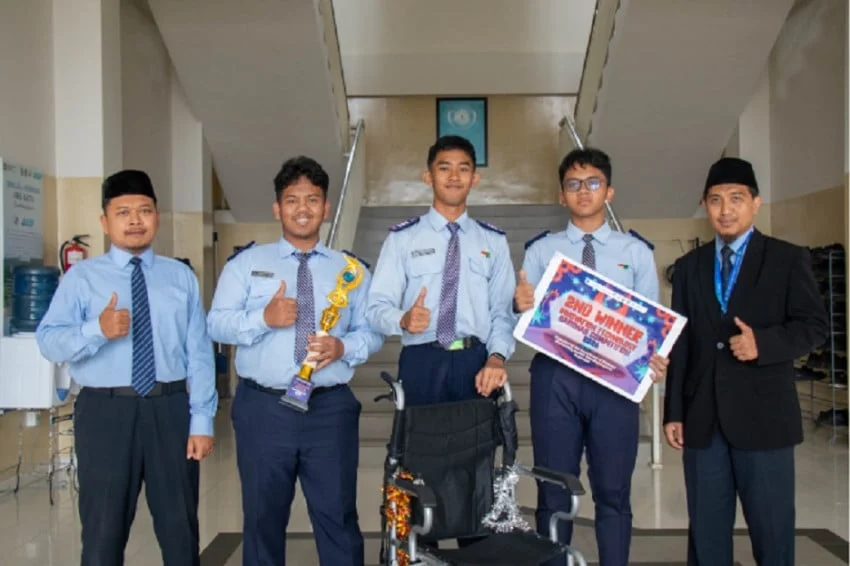
In an inspiring display of youthful innovation and humanitarian engineering, three high school students from East Java have captured national attention by securing second place at one of Indonesia’s most prestigious robotics and technology competitions. Muhammad Nero Alfath, Muhammad Zakwan Abqory, and Naufal Rafi Hermawan, all students at SMA Al Hikmah IIBS in Batu City, triumphed in the Innovation Technology category at the Baronas Competition 2026. The high-profile event was organized and hosted by the Department of Electrical Engineering at the Institut Teknologi Sepuluh Nopember (ITS) in Surabaya, drawing brilliant young minds from across the archipelago to showcase their technological prowess.
The winning project developed by the brilliant trio centers around an advanced wheelchair automation system designed to significantly enhance mobility and independence for individuals with physical disabilities. By leveraging modern automation technology, the students sought to address real-world accessibility challenges, merging technical complexity with a deep sense of social responsibility. Their achievement not only highlights the rapidly growing capabilities of Indonesian youth in STEM (Science, Technology, Engineering, and Mathematics) fields but also underscores the pivotal role that forward-thinking educational institutions play in nurturing practical, problem-solving skills outside the traditional classroom environment.
The Journey to Baronas Competition 2026
The path to the podium at ITS Surabaya was neither short nor simple. The Baronas Competition is widely recognized as one of the most rigorous academic and technical arenas for Indonesian students, known for setting exceptionally high standards in engineering, robotics, and applied technology. Months prior to the final judging, the trio from SMA Al Hikmah IIBS conceptualized their wheelchair automation project, driven by the observation that traditional manual wheelchairs often pose significant physical barriers for users with severe upper-body mobility limitations.
Preliminary phases of the competition required the students to submit comprehensive technical proposals, design schematics, and proof-of-concept demonstrations. Competing against dozens of other talented teams representing elite senior high schools from various provinces, the Al Hikmah IIBS team successfully navigated the rigorous selection rounds. Their ability to translate complex electrical engineering concepts into a tangible, user-friendly humanitarian application ultimately convinced the expert panel of judges—comprising ITS faculty members and industry professionals—to award them the second-place trophy in the fiercely contested Innovation Technology division.
Engineering Humanitarian Technology: The Automated Wheelchair Project
At the core of the students’ success is an automated wheelchair system engineered to prioritize user autonomy, safety, and comfort. While commercial motorized wheelchairs exist in the global market, many remain prohibitively expensive or fail to incorporate adaptive automation features tailored to specific user needs. Addressing these gaps, Alfath, Abqory, and Hermawan designed a system focused on seamless integration, responsive controls, and reliable automation mechanics.
The development process demanded extensive collaboration, testing, and troubleshooting. The students utilized microcontroller units, sensor arrays, and custom-programmed control interfaces to enable smoother navigation and obstacle detection. By automating critical aspects of mobility, the device aims to reduce user fatigue and minimize the risk of navigation accidents in indoor and outdoor environments. Faculty advisors and mentors at SMA Al Hikmah IIBS provided guidance throughout the hardware assembly and software calibration phases, ensuring that the final prototype met high standards of engineering safety and operational reliability.
The Significance of ITS Baronas Competition in Indonesian Education
The Baronas Competition, hosted annually by the Department of Electrical Engineering at ITS Surabaya, has established itself as a premier benchmark for technological innovation among Indonesian youth. Over the years, the event has served as a launchpad for future engineers, researchers, and tech entrepreneurs. By challenging high school students to tackle complex technological hurdles, ITS aims to foster a culture of research and development from an early age.
The success of students from institutions outside major metropolitan centers—such as Batu City in East Java—demonstrates a decentralized spread of technical literacy and educational excellence across Indonesia. Competitions like Baronas bridge the gap between theoretical classroom knowledge and practical industry application, equipping the younger generation with the critical thinking and collaborative skills necessary to navigate an increasingly technology-driven global economy.
Broader Implications and Future Prospects for Assistive Technology
The triumph of these three high school innovators highlights a broader trend: the rising demand for accessible, locally developed assistive technologies. In many developing nations, specialized medical and mobility equipment can be scarce or overly expensive, placing a heavy burden on individuals with disabilities and their families. When young minds turn their focus toward humanitarian engineering, it opens up the possibility of scalable, cost-effective solutions tailored to local socioeconomic conditions.
Experts in the field of biomedical and electrical engineering note that early exposure to assistive technology design fosters empathy alongside technical mastery. By identifying real-world struggles and applying engineering principles to solve them, students like Alfath, Abqory, and Hermawan cultivate a mindset geared toward sustainable social impact. As they look toward the future, the young inventors plan to refine their prototype further, exploring potential partnerships with medical device manufacturers or disability advocacy groups to bring their automated wheelchair concept closer to mass production and practical deployment.
Conclusion and Recognition
The outstanding achievement of Muhammad Nero Alfath, Muhammad Zakwan Abqory, and Naufal Rafi Hermawan serves as a powerful testament to the potential harbored within Indonesia’s secondary education system. Winning second place in the Innovation Technology category at the Baronas Competition 2026 is not merely a personal milestone for the three teenagers; it is a proud moment for SMA Al Hikmah IIBS, the educational community of Batu City, and the wider landscape of youth-led innovation in Indonesia. As these young engineers continue their academic and developmental journeys, their success stands as an enduring reminder that technology, when guided by compassion, possesses the profound ability to transform lives and reshape communities for the better.
