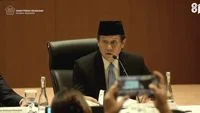
President Prabowo Subianto held a high-stakes meeting with ten former Chiefs of the Indonesian National Police (Kapolri) at his private residence in Hambalang, Bogor, West Java, this past Sunday. The gathering, which also saw the presence of the incumbent Kapolri, General Suyudi Ario Seto, comes at a critical juncture for the Indonesian state apparatus as it grapples with a systemic crisis involving allegations of illicit wiretapping and unauthorized access to electronic transactions—crimes that have reportedly reached the highest echelons of the government, including the President himself.
The meeting served as both a consultative session on national security and a symbolic gathering of institutional memory. According to an official statement released by the Presidential Secretariat’s Bureau for Press, Media, and Information, the discussion centered on navigating the current political climate and addressing pressing national security issues. The event acted as a bridge between generations, allowing current leadership to draw from the institutional experiences of those who previously helmed the police force.
The Participants and Institutional Gravity
The list of attendees represented a significant portion of the police force’s modern history. Among those present were Roesmanhadi, Roesdihardjo, Surojo Bimantoro, Da’i Bachtiar, Sutanto, Bambang Hendarso Danuri, Timur Pradopo, Sutarman, Badrodin Haiti, and Tito Karnavian, the latter currently serving as the Minister of Home Affairs.
The presence of such a high-profile delegation, supported by Minister of Defense Sjafrie Sjamsoeddin, Minister of State Secretary Prasetyo Hadi, Cabinet Secretary Teddy Indra Wijaya, and TNI Commander General Agus Subiyanto, underscores the gravity of the situation. The convergence of military and police leadership in Hambalang suggests that the administration is seeking to solidify a unified front against internal threats that have compromised the integrity of the state’s digital and communications infrastructure.
The Wiretapping Scandal: A Chronology of Crisis
The meeting occurred against the backdrop of a widening investigation conducted by the Criminal Investigation Agency (Bareskrim) of the National Police. The probe concerns a sophisticated web of illegal surveillance and unauthorized electronic data access. Central to the investigation is the implication of former Kapolri Listyo Sigit Prabowo, who has been formally named a suspect alongside several high-ranking police officials.
The chronology of the scandal began to unfold as cybersecurity experts and investigators identified patterns of illicit monitoring targeting not only the President but a vast array of high-value individuals. This list of victims is extensive, spanning government ministers, prominent political figures, influential business magnates, media personalities, and key figures within civil society.
As the Bareskrim investigation intensified, the following key individuals were named as suspects:
- Listyo Sigit Prabowo: Former Chief of the National Police.
- Irjen Pol Ahrie Sonta Nasution: Former Head of the Legal Division (Kadivkum) of the National Police.
- Irjen Eko Hadi Santoso: Widyaiswara Kepolisian Utama TK1 Sespim Lemdiklat Polri.
- Irjen Slamet Uliandi: Former Head of the Information and Communication Technology Division (Kadiv TIK).
In a swift move to maintain the rule of law, Bareskrim has detained Listyo Sigit, Ahrie Sonta, and Eko Hadi at the Mako Brimob detention center in Kelapa Dua, Depok. Irjen Slamet Uliandi has been exempted from immediate detention due to health complications, though he remains under strict monitoring by authorities.
Legal Implications and Statutory Framework
The charges brought against these officials are severe, reflecting the potential damage to national security. The Bareskrim investigation is building a case based on three primary pillars of Indonesian law:
- Article 258 of Law No. 1 of 2023 (New KUHP): Addressing criminal acts that undermine the security and integrity of information systems, carrying a potential sentence of up to 10 years in prison.
- Article 332 (1) and/or (2) of the KUHP: Pertaining to the misuse of electronic communications and unauthorized access, with a maximum penalty of 6 years.
- Article 31 (1) of the ITE Law (Information and Electronic Transactions): Specifically addressing the interception of electronic information, which carries a maximum penalty of 8 years.
The legal strategy employed by the state aims to demonstrate that no individual, regardless of their past status as a top-ranking official, is above the law. Legal observers note that the invocation of the new KUHP alongside the ITE Law signals a robust effort by the administration to modernize its response to cyber-based threats.
Analysis: Implications for Institutional Trust
The involvement of a former Kapolri in an illicit surveillance scheme is unprecedented in the post-reform era. The implications of this crisis are manifold:
1. Erosion of Institutional Integrity
The National Police have long fought to regain public trust following various scandals. The revelation that the institution’s top leadership may have been involved in a domestic espionage operation targeting the President and other state officials creates a profound trust deficit. The current leadership under General Suyudi Ario Seto faces the daunting task of purging the ranks while ensuring that the institution remains functional and focused on its core mandate.
2. Cybersecurity and National Sovereignty
The scale of the surveillance, which targeted private citizens and business leaders, indicates a collapse of internal data security protocols. This event will likely trigger a comprehensive audit of the National Police’s technological infrastructure. Future policies may include stricter oversight of the TIK (Information and Communication Technology) division and the implementation of decentralized, redundant security protocols to prevent a single point of failure or corruption.
3. The "Hambalang Consultations" as a Stabilizing Force
By inviting the retired Chiefs to his home, President Prabowo is utilizing a "wise elder" strategy. These former leaders represent decades of experience in crisis management. By involving them in the narrative, the President is signaling that the current investigation is not a political purge but a necessary surgical operation to restore the health of the state. It provides the administration with a buffer, showing that the institutional history of the police supports the current crackdown.
Future Outlook and Administrative Reform
As the investigation progresses, the government is expected to announce a series of structural reforms within the National Police. Observers anticipate a tightening of the vetting processes for those appointed to the TIK division and a greater role for the National Cyber and Crypto Agency (BSSN) in auditing the police’s digital capabilities.
Furthermore, the public expects transparency regarding the motive behind the surveillance. Was this a move for political leverage, commercial intelligence, or a rogue effort to consolidate power? The answers to these questions will be critical in determining whether the government can successfully move past this crisis.
For President Prabowo, the ability to manage this situation while maintaining the stability of the security forces will be a defining test of his early presidency. The meeting in Hambalang serves as a message to both the internal ranks of the police and the broader public: the government is fully aware of the breach, the culprits are being held accountable, and the structural integrity of the nation’s security architecture remains the primary objective.
The coming weeks will likely see further disclosures as the detainees undergo questioning. The legal proceedings will be scrutinized by the international community and domestic stakeholders alike, as the outcome will set a precedent for how Indonesia handles high-level corruption and the weaponization of surveillance technology in the digital age. The meeting between the President and the former police chiefs is, therefore, not just a historical snapshot, but a strategic maneuver to ensure that the rule of law prevails in a period of significant institutional turbulence.