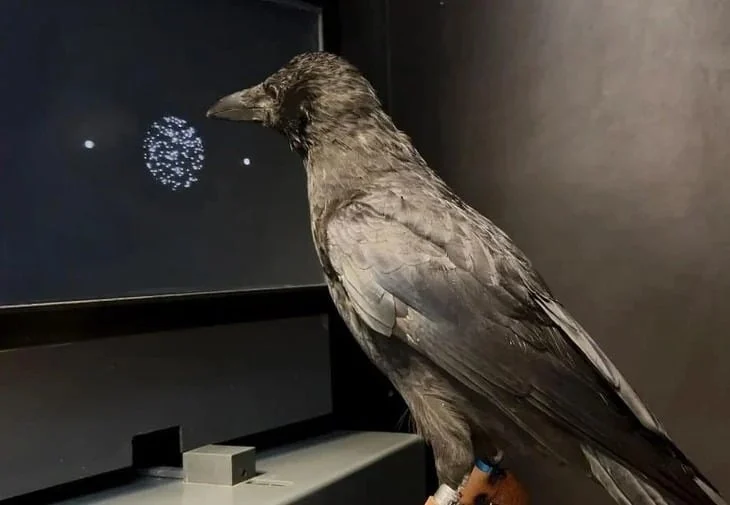
Neuroscience has long sought to understand the neural architectures that govern rapid decision-making across different species. Recent findings from a comprehensive cognitive study conducted by researchers at the University of Tübingen in Germany have added a remarkable new chapter to this scientific inquiry. According to groundbreaking research published in the prestigious scientific journal Science, the avian brain—specifically that of the carrion crow—possesses the extraordinary capacity to detect motion directions within a staggering 70 milliseconds, enabling these birds to execute perceptual decisions roughly twice as fast as adult humans performing comparable tasks.
This revelation challenges long-held anthropocentric assumptions regarding cognitive processing speeds and neurological efficiency. While traditional scientific paradigms often equate larger mammalian brains, particularly those of primates and humans, with superior computational speed, the humble corvid brain continues to dismantle these hierarchies. The study not only highlights the evolutionary marvel of avian neurobiology but also opens new avenues for research into artificial intelligence, neural latency, and the fundamental mechanics of cognitive choice.
Methodological Framework and Experimental Design
To investigate the inner workings of avian cognitive processing and perceptual decision-making, neurobiologist Philipp Schmidbauer and Professor Andreas Nieder from the Institute of Neurobiology at the University of Tübingen devised a rigorous visual-motor experiment. The primary objective was to measure how efficiently crow brains could recognize, interpret, and react to directional motion presented through digital stimuli.
The experiment enlisted two healthy carrion crows (Corvus corone), a species already renowned within the scientific community for its high levels of problem-solving intelligence, tool use, and social complexity. The subjects were trained to sit before a specialized touch-sensitive screen displaying dynamic visual fields consisting of moving white dots against a high-contrast black background.
The core task assigned to the birds was deceptively simple in concept yet complex in execution: observe the field of dots, determine the net direction of their collective movement—either predominantly to the left or to the right—and communicate that decision by physically pecking the corresponding target area on the touch screen. Correct responses were immediately reinforced with food rewards, conditioning the subjects to optimize their focus and accuracy.
To rigorously test the limits of their perceptual processing, the researchers manipulated the difficulty of the task across multiple trials. This was achieved by systematically varying the coherence of the motion. In some trials, the vast majority of the dots moved uniformly in a single direction, creating a clear and unambiguous visual signal. In other trials, the proportion of coherently moving dots was drastically reduced, introducing random noise into the visual field and forcing the crows to parse subtle, ambiguous signals under intense cognitive pressure.
Chronology and Execution of the Study
The research project unfolded over an extended period of behavioral training, neurological monitoring, and data synthesis at the University of Tübingen’s neurobiology laboratories.
Initial phases of the project, beginning several months prior to data collection, were dedicated to habituating the crows to the experimental apparatus. Ensuring the birds were comfortable interacting with the touch screens and understood the correlation between accurate pecks and dietary rewards was foundational to the integrity of the data. Once the behavioral baseline was established, automated testing protocols were introduced to record thousands of individual trials without human interference, eliminating potential observer bias.
During the active testing phase, high-speed optical tracking systems recorded the exact latency between the presentation of the visual stimulus and the physical motor response of the subjects. The temporal resolution of these recordings allowed the research team to dissect the decision-making process into micro-intervals.
As the trials progressed, the researchers began recording neural activity directly from targeted regions of the avian brain. Specifically, electrodes were implanted to monitor neuronal firing patterns within the nidopallium caudolaterale (NCL), an anatomical structure widely recognized as the avian functional equivalent of the mammalian prefrontal cortex. This region is critically involved in executive functions, working memory, abstract reasoning, and decision-making.
By synchronizing the precise millisecond of stimulus onset with the electrical spikes recorded in the NCL, the team mapped the exact timeline of information flow from visual reception to motor execution. The final phase of the project involved cross-analyzing these neural signatures against human and primate benchmark data gathered from historical cognitive studies utilizing similar moving-dot paradigms.
Empirical Findings and Performance Metrics
The quantitative results of the Tübingen experiment surpassed initial hypotheses regarding avian reaction times. When analyzing the aggregate data, researchers discovered that the two carrion crows were capable of determining the direction of moving dots and executing a definitive choice in an average of just 235 milliseconds—translating to a mere 0.235 seconds from the moment the stimulus appeared on screen.
Comparative analysis revealed that this processing and reaction speed is approximately twice as fast as the cognitive-motor performance typically recorded in humans and macaque monkeys when subjected to identical visual discrimination challenges. While human subjects generally require between 400 and 500 milliseconds to process, deliberate, and execute a motor response in similar motion-detection tasks, the crows consistently halved that duration.
Furthermore, the study illuminated the astounding physiological baseline of individual neural components within the crow brain. Detailed electrophysiological recordings demonstrated that individual neurons within the nidopallium caudolaterale are capable of detecting and signaling the direction of visual motion within an astonishing 70 milliseconds of stimulus exposure. This rapid signal detection forms the foundation of their lightning-fast behavioral output.
Accuracy remained remarkably high despite the compressed timeline. Even under high-difficulty conditions where dot coherence was low and the visual signal was obscured by erratic motion noise, the crows did not resort to random guessing. Instead, their choices remained statistically significantly more accurate than chance. When presented with unambiguous, high-coherence directional signals, their rate of correct responses approached a near-perfect 100 percent.
Official Insights and Expert Analysis
Detailing the significance of these findings, lead researcher Philipp Schmidbauer emphasized that the data paints a complex picture of avian cognitive architecture.
"These results demonstrate unequivocally that crows are not merely capable of rapid, reflexive reactions to environmental stimuli," Schmidbauer explained during an institutional review of the findings. "Rather, they possess a sophisticated mechanism for the rapid analysis of complex visual information, combining high-speed neural processing with exceptional perceptual accuracy."
Co-author Professor Andreas Nieder underscored the evolutionary implications of the discovery, noting that intelligence and processing speed are not exclusive domains of mammalian lineages.
"For decades, neuroscience has focused heavily on mammalian models, assuming that complex executive control requires a layered mammalian neocortex," Nieder stated. "Our work with corvids shows that entirely different brain architectures—such as the avian pallium—can achieve equal or even superior computational performance in specific sensory-motor domains. Evolution has engineered multiple pathways to high-level cognition."
Independent neuroscientists not directly affiliated with the Tübingen study have praised the methodological rigor of the research. Many have pointed out that the findings challenge prevailing neuroscientific theories concerning brain size and axonal conduction delays. Traditional neurological models suggest that larger brains with longer neural pathways inherently suffer from increased transmission latencies, whereas smaller brains with compact neural distances can transmit signals more rapidly. However, the sheer density and interconnectivity of the avian forebrain appear to play a more decisive role in minimizing latency than simple volumetric metrics.
Broader Implications and Future Horizons
The revelation that crow brains can process motion and make decisions in under a quarter of a second carries profound implications across multiple scientific disciplines, extending far beyond behavioral ornithology.
In the field of neurobiology, the mapping of the nidopallium caudolaterale provides a fresh comparative model for studying executive control. By understanding how the avian brain achieves high-speed data integration without a traditional six-layered neocortex, researchers gain a unique perspective on the fundamental design principles required for conscious perception and decision-making. This comparative approach helps isolate which neural configurations are universal requirements for intelligence and which are mere evolutionary artifacts of specific lineages.
In computer science and artificial intelligence, these biological insights offer valuable blueprints for neuromorphic engineering. Current autonomous systems, such as self-driving vehicles and robotic navigation drones, often struggle with the trade-off between processing speed and decision accuracy when interpreting dynamic visual environments. By emulating the neural efficiency observed in corvid brains—where rapid sensory processing is paired with robust error mitigation—engineers may be able to develop artificial neural networks capable of ultra-low latency navigation and threat detection.
Moreover, the study reinforces the growing scientific consensus regarding the cognitive sophistication of corvids. Popularly termed "feathered apes," crows and ravens continue to exhibit cognitive proficiencies that rival or exceed those of many mammals, including primates. As ongoing research continues to unveil the hidden depths of avian neurology, humanity is forced to continually revise its understanding of intelligence in the natural world.
Future research initiatives at the University of Tübingen and partner institutions are expected to explore whether this rapid processing speed extends to other sensory modalities, such as auditory and tactile discrimination, or if it is a specialized adaptation tuned primarily for visual tracking during flight and foraging. As these studies progress, the humble crow remains firmly established at the forefront of cognitive science.