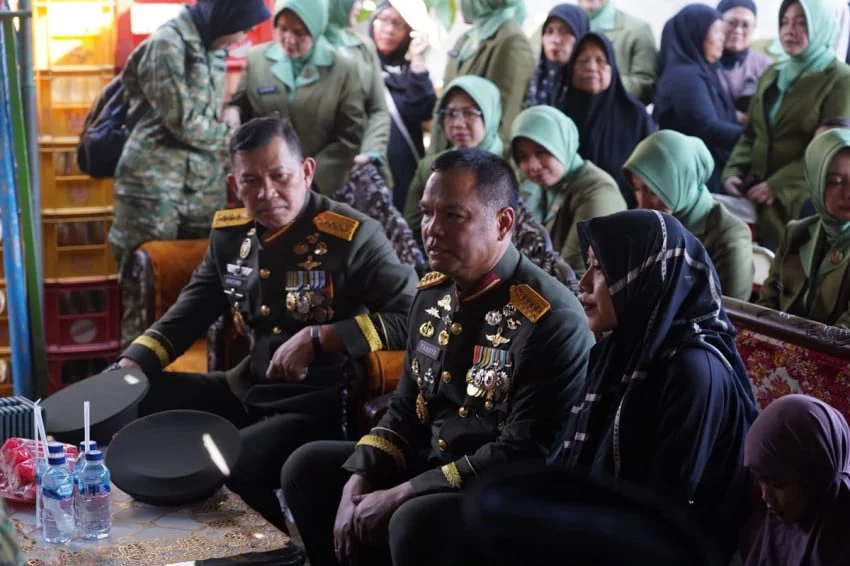
The quiet town of Trenggalek in East Java was enveloped in profound solemnity and national grief on Saturday, November 7, 2026. At the Karangsoko Heroes Cemetery (Taman Makam Pahlawan), military honors and tearful farewells marked the final resting place of Sergeant (Posthumous) Heri Prasetyo, a dedicated soldier who made the ultimate sacrifice while executing a critical humanitarian and environmental mission.
The military funeral was presided over by the Chief of Staff of the Indonesian Army (KSAD), General TNI Tandyo Budi Revita. Also in attendance was the Head of the National Disaster Management Agency (BNPB), Lieutenant General TNI Kristomei Sianturi. The presence of these high-ranking officials underscored the immense gravity of the loss and served as a testament to the nation’s profound gratitude for Sergeant Heri’s unwavering dedication to public safety, environmental protection, and national service.
A Fallen Hero of the Skies
Sergeant (Posthumous) Heri Prasetyo served as a dedicated flight crew member, holding the position of Ba Fourier Siud Heli Serbu 1 Flite Heli B Dron 31/Amur Yudha Cakti within the Indonesian Army Aviation Center (Puspenerbad). His life was cut short following a tragic helicopter accident while on active duty.
Almarhum (the deceased) perished alongside members of his dedicated flight crew while operating a Mil Mi-17V5A helicopter, bearing the registration number HA-5235. The fatal incident occurred on Wednesday, November 4, 2026, in Kuala Pembuang, a district within Central Kalimantan. At the time of the catastrophe, the aircraft was deployed on the front lines of Indonesia’s relentless battle against severe environmental threats, specifically operating as part of the aerial firefighting task force addressing forest and land fires (Kebakaran Hutan dan Lahan, commonly known as Karhutla).
Chronology of the Tragedy in Central Kalimantan
The sequence of events leading to the tragic loss of Sergeant Heri Prasetyo unfolded during a period of heightened operational tempo for Indonesia’s disaster mitigation and military aviation units. Central Kalimantan, like several other forested regions across the archipelago, frequently experiences severe dry spells that spark widespread peatland and forest fires. These fires release toxic smog, threaten local biodiversity, and endanger civilian settlements.
To combat these fires effectively, authorities rely heavily on aerial suppression tactics, most notably water bombing. On Wednesday, November 4, 2026, the crew of the Mil Mi-17V5A helicopter (registration HA-5235) was tasked with executing precision water-bombing sorties over remote and volatile hotspots in the Kuala Pembuang region.
Operating heavily modified transport helicopters in dense smoke, low visibility, and turbulent thermal updrafts demands exceptional piloting skills and immense courage. During one of these demanding operational flights, the aircraft encountered catastrophic difficulties leading to the fatal crash. Emergency response teams and search-and-rescue units were immediately mobilized to the crash site in the remote swaths of Central Kalimantan. Despite swift efforts to secure the area and recover the personnel, the severity of the accident left no survivors among the on-board crew members. The tragedy plunged the Indonesian Army Aviation community and the broader national disaster response apparatus into deep mourning.

High-Level Tributes and National Condolences
The solemn ceremony at Karangsoko Heroes Cemetery in Trenggalek reflected the profound respect held for Sergeant Heri within both military and civilian leadership circles. General TNI Tandyo Budi Revita personally laid a wreath and offered condolences to the grieving family of the fallen soldier. Speaking briefly after the ceremony, the Army Chief of Staff emphasized that Sergeant Heri’s death in the line of duty exemplifies the highest values of military service—loyalty, bravery, and selflessness for the greater good of the nation.
Similarly, BNPB Head Lieutenant General TNI Kristomei Sianturi highlighted the critical role played by aviation personnel in national disaster management. He noted that agencies like BNPB could not effectively execute large-scale emergency responses—such as mitigating the catastrophic risks of Karhutla—without the fearless cooperation and technical expertise of the Indonesian National Armed Forces (TNI).
"Sergeant Heri Prasetyo was not merely a soldier carrying out a tactical order; he was a humanitarian defender of our ecosystem, protecting countless civilian lives from the invisible threat of toxic smoke and raging wildfires," stated officials close to the memorial proceedings. "His sacrifice reminds us of the perilous conditions our service members routinely navigate on behalf of the Indonesian people."
The Broader Impact and Implications for Aerial Firefighting
The loss of the Mi-17V5A helicopter and its crew highlights the immense risks associated with aerial firefighting and disaster mitigation in Indonesia’s challenging tropical terrain. Forest and land fires remain a perennial challenge for the country, threatening Indonesia’s ecological stability, international climate commitments, and public health.
In recent years, the Indonesian government has scaled up preventative measures and integrated rapid-response task forces comprising military, police, environmental agencies, and local volunteers. Aerial assets, including medium and heavy-lift helicopters like the Mi-17 series, form the backbone of these rapid response efforts, allowing operators to dump thousands of liters of water directly onto inaccessible hotspots before fires can expand into uncontrollable conflagrations.
However, operating these complex rotorcraft in hazardous meteorological conditions—often characterized by zero-visibility smoke, unpredictable wind shifts, and remote wilderness areas lacking proper emergency infrastructure—places an extraordinary burden on flight crews. The accident in Kuala Pembuang serves as a sobering reminder of the human cost borne by military personnel assigned to non-combat military operations (Operasi Militer Selain Perang – OMSP), which include disaster relief, search and rescue, and environmental protection.
Following the incident, aviation safety experts and military analysts have reiterated the necessity of continuous maintenance protocols, stringent safety audits, and advanced training simulations for flight personnel operating in high-stress environments. Moreover, calls have grown louder to ensure that families of fallen personnel engaged in high-risk environmental operations receive comprehensive state support, recognition, and long-term care.
A Legacy of Courage
As the final volleys of the military rifle salute echoed across the hills of Trenggalek and the Indonesian flag was folded and presented to the grieving relatives, the nation paused to honor a quiet hero. Sergeant (Posthumous) Heri Prasetyo’s name will be etched into the collective memory of the nation—not only as a disciplined soldier of the Indonesian Army Aviation Center, but as a steadfast guardian of the earth who gave his last full measure of devotion in the skies above Kalimantan.