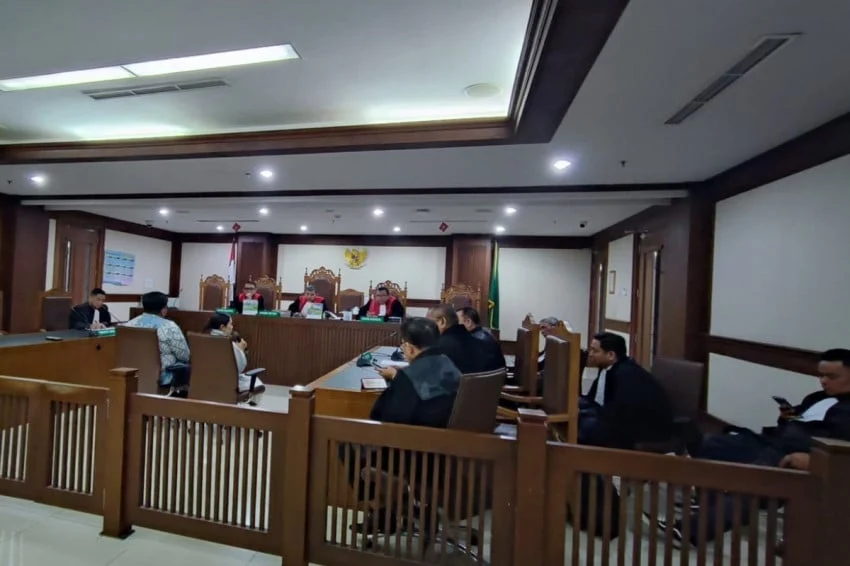
The ongoing legal proceedings at the Central Jakarta District Court regarding the high-profile extortion case involving defendant Bangun Paulus Tudungta (BPT) reached a critical juncture on Monday, October 26, 2026. During the latest session, the Public Prosecutor (JPU) formally challenged the admissibility and relevance of testimony provided by two defense witnesses, Inje Zahwa Aulia and Ricky Haposan. Prosecutor Andri Saputra contended that the testimonies offered by the two individuals—who identified themselves as close friends of the defendant—failed to address the substantive elements of the criminal charges, thereby lacking legal weight in the court’s determination of guilt or innocence.
The Dynamics of the Hearing
The courtroom atmosphere remained tense as the defense team attempted to leverage character witnesses to bolster the defendant’s position. Inje Zahwa Aulia and Ricky Haposan were presented as "a de charge" witnesses, a legal designation intended to provide evidence favorable to the accused. However, under cross-examination by the prosecution, it became evident that neither witness possessed direct knowledge of the specific events forming the basis of the extortion allegations against BPT.
Prosecutor Andri Saputra emphasized that the court’s mandate is to adjudicate the specific facts surrounding the alleged crime. According to the prosecution, the testimony provided by Aulia and Haposan was limited to subjective impressions of the defendant’s character and personal history. "If we correlate their statements to the legal process or the indictment, there is clearly no connection," Saputra stated during a press briefing following the adjournment. "When questioned on the stand, it was confirmed that neither witness had any factual awareness of the circumstances surrounding the alleged extortion."
The prosecution argued that in a criminal trial, the burden of proof relies on establishing the actus reus (the guilty act) and mens rea (the guilty mind) relative to the specific charges. By failing to provide testimony related to the actual incident, the witnesses were unable to refute or clarify the prosecution’s evidence, rendering their appearance essentially moot in the eyes of the state.
Chronology of the Case
The case against Bangun Paulus Tudungta has been under intense public scrutiny since the initial investigation was launched. The timeline of the legal proceedings reflects a series of procedural challenges and evidentiary debates that have drawn out the trial:
- Initial Filing and Investigation: The investigation into the alleged extortion began following a series of complaints filed by the victim, which led to the arrest of BPT. The police gathered digital evidence, financial statements, and witness reports that eventually resulted in the formal indictment.
- First Hearing (Pre-Trial Phase): The case officially moved to the Central Jakarta District Court, where the defense attempted to challenge the validity of the prosecution’s indictment through an eksepsi (demurrer).
- Rejection of the Demurrer: Following extensive deliberations, the panel of judges ruled that the prosecution’s case met the formal requirements for a full trial, allowing the proceedings to move to the substantive stage—the examination of witnesses and evidence.
- Mid-Trial Proceedings (October 2026): The court entered the phase of hearing witnesses. The defense’s decision to call character witnesses rather than factual witnesses marked a strategic pivot that was ultimately met with significant resistance from the JPU.
The Role of ‘A De Charge’ Witnesses in Indonesian Law
Under the Indonesian Criminal Procedure Code (KUHAP), a defendant has the right to present witnesses who can provide evidence in their favor. However, the efficacy of such testimony is subject to the judge’s assessment of relevance and credibility. Legal analysts note that while character testimony can influence sentencing—should the defendant be found guilty—it rarely impacts the determination of the actual commission of a crime.
In this instance, the prosecution’s move to label the testimony as "irrelevant" is a standard procedural tactic to prevent the court record from being cluttered with non-probative information. By clarifying that the witnesses had no knowledge of the specific incident, the prosecution is attempting to ensure that the panel of judges remains focused on the primary evidence, such as financial transaction logs, communication logs, and the victim’s testimony, which are central to the extortion charge.

Broader Implications for the Trial
The rejection of the defense’s witness testimony underscores a significant challenge for the legal team of Bangun Paulus Tudungta. With the prosecution maintaining a confident stance, the defense is now faced with the necessity of presenting evidence that can directly refute the allegations of extortion.
Legal observers following the case suggest that if the defense fails to bring forward witnesses with direct knowledge of the facts, the court will rely heavily on the prosecution’s evidence. The extortion charge is a serious criminal offense under the Indonesian Criminal Code, and convictions often carry significant custodial sentences. Consequently, the legal strategy employed by the defense in the coming weeks will be critical to the defendant’s future.
Public Interest and Judicial Integrity
The Central Jakarta District Court has become a focal point for the public, as the case involves allegations of power dynamics and coercive practices. The transparency of the proceedings is being monitored by legal watchdogs, who emphasize the importance of keeping the trial focused on the rule of law rather than emotional or subjective narratives.
Prosecutor Andri Saputra’s focus on "pokok perkara" (the essence of the case) aligns with the judicial principle of judicial economy—ensuring that trials are conducted efficiently by focusing only on evidence that can prove or disprove the elements of the crime. The court is expected to continue with additional evidentiary hearings in the following weeks, where the focus will likely return to physical evidence and expert testimonies that delve into the specific details of the alleged extortion.
Conclusion and Future Outlook
As the trial progresses toward its closing arguments, the defense will need to navigate the court’s strict requirements for relevance. The incident involving the two witnesses serves as a reminder of the rigorous standards of evidence required in Indonesian criminal law.
While the defense may feel that their witnesses provided a necessary perspective on the character of the accused, the legal reality remains that objective facts hold the most weight. For now, the trial continues, with the prosecution showing no signs of backing down from its position that the case against BPT is grounded in solid, verifiable evidence. The next hearing, expected to take place in early November, will likely see the court address further procedural matters before potentially moving toward the deliberation phase.
The public is encouraged to continue monitoring the proceedings, as the final verdict will likely serve as a benchmark for how extortion cases are handled within the jurisdiction of the Central Jakarta District Court. The legal team for the defendant has yet to issue a formal statement regarding the prosecution’s challenge to their witnesses, but their next steps will be scrutinized by the legal community to see if they can pivot toward more substantive evidentiary support.