The ongoing enforcement of vehicle registration regulations in Indonesia’s West Java region yielded a notable infraction when local traffic authorities intercepted a black Toyota Kijang Innova traveling along the bustling Puncak resort corridor. The vehicle, bearing the registration plate B 1153 EQN, immediately drew the attention of law enforcement officers due to a glaring discrepancy: while officially registered as a government-owned asset requiring red-and-white institutional plates, the automobile was brazenly outfitted with private white-background plates.
The incident, which quickly circulated across digital media platforms after being captured and published by an observant Instagram user under the handle @dulyanidul, underscores a persistent issue regarding the unauthorized alteration and personal misuse of state-owned operational vehicles. As administrative oversight tightens across various governmental departments and educational institutions, this roadside interception provides a clear window into the enforcement mechanisms utilized by the Indonesian National Police to curb administrative fraud and the misappropriation of public facilities.
Chronology of the Interception Along the Puncak Corridor
The sequence of events unfolded on a busy afternoon along the winding and heavily monitored Puncak route in Bogor regency, a popular weekend destination for travelers originating from the greater Jakarta metropolitan area. Members of the Bogor Regency Police Traffic Unit (Satlantas Polres Bogor) were conducting routine motor vehicle surveillance and document inspections when they flagged the black Toyota Kijang Innova.
Recognizing the potential for a traffic violation, an officer stationed on a police motorcycle gestured for the driver to pull over to the side of the road. Dashcam and bystander footage documenting the encounter shows the traffic officer instructing the motorist to move his vehicle clear of the active traffic lane to facilitate a proper inspection of the driver’s license and the vehicle’s registration documents.
Upon request, the driver produced the Vehicle Registration Number Proof, commonly known in Indonesia as the STNK. When questioned regarding the legal ownership of the automobile and the origin of the registration papers, the driver offered a candid yet legally problematic explanation. He stated that the vehicle belonged to his sibling, who had allegedly borrowed or checked it out from a state polytechnic institution.
The conducting officer swiftly pointed out the fundamental contradiction between the vehicle’s official documentation and its physical appearance, noting that the vehicle was legally mandated to display red administrative plates designated for government property. Cornered by the observation, the driver admitted that the vehicle was indeed an official state asset. However, he attempted to justify the clandestine replacement of the plates by citing unverified advice he claimed to have received. According to the motorist, he was told that government-owned vehicles were prohibited from displaying red plates when traveling outside the territorial boundaries of Jakarta.
Recognizing that the justification held no validity under Indonesian traffic law, the traffic personnel informed the driver that he would be issued a formal citation for operating a motor vehicle with a registration plate that did not conform to the official specifications recorded in the state database. The vehicle was subsequently processed in accordance with standard traffic violation procedures.
Regulatory Framework Governing Vehicle Registration Plates
The enforcement action taken by the Bogor Traffic Police is firmly rooted in national regulatory frameworks designed to maintain transparency and order within the national transportation network. Specifically, the regulation governing vehicle registration markers is outlined in Indonesian National Police Regulation Number 7 of 2021, which entered into force on May 5, 2021.
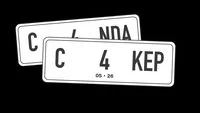
Under this regulation, the color coding of vehicle registration plates—formally known as Tanda Nomor Kendaraan Bermotor (TNKB)—serves a vital function in identifying the legal status and ownership category of every motor vehicle operating on public thoroughfares. The regulation establishes distinct visual categories:
- White background with black text for privately owned motor vehicles, legal entities, foreign representatives, and international organizations.
- Yellow background with black text for public transport vehicles.
- Green background with black text for vehicles operating within free trade zones possessing special customs privileges.
- Red background with white text, which is strictly designated for vehicles belonging to government agencies, state institutions, regional authorities, and state-owned enterprises utilized by Civil Servants or State Apparatus personnel.
The deliberate substitution of a red government plate with a private white plate constitutes a violation of national traffic laws, as it obfuscates the true ownership of the vehicle and hampers public accountability and state asset tracking.
Strict Limitations on the Use of State Operational Vehicles
Beyond the immediate traffic violation concerning mismatched registration plates, the incident highlights broader systemic issues regarding the misuse of public property for personal convenience. Government-owned operational vehicles are procured using state budgets derived from public taxation and are intended exclusively to support the official duties and administrative functions of government bodies.
The operational boundaries for these vehicles are explicitly detailed in the Regulation of the State Minister for Administrative Reform and Bureaucratic Reform Number 87 of 2005 concerning Guidelines for Efficiency and Discipline of Civil Servants. This regulatory instrument outlines strict parameters to prevent the personal enrichment or unauthorized leisure use of state facilities by government employees.
According to the appendix of the 2005 ministerial regulation, the utilization of official operational vehicles is strictly governed by three primary principles:
- Official Purpose Only: Operational vehicles may only be utilized for official duties that directly support the core tasks, functions, and institutional responsibilities of the respective government agency.
- Weekday Limitation: The operation of official vehicles is restricted to official working days as established by prevailing government calendars.
- Geographical Restrictions: Operational vehicles are strictly limited to use within the municipal or regional boundaries of the city where the office is located. Any operation outside the designated city requires explicit written permission from the leadership of the government agency or a designated authorized official possessing the appropriate administrative competence.
These provisions align with the standard government working hours defined under Presidential Decree Number 68 of 1995, which designates Monday through Thursday from 07:30 to 16:00 as standard operational hours, during which civil servants are required to wear prescribed institutional uniforms, though minor institutional variations are permitted based on internal agency policies.
Disciplinary Implications and Sanctions for Violations
The unauthorized removal of red government plates and the subsequent deployment of state assets for leisure travel—such as a trip along the Puncak tourism route—constitutes a serious breach of administrative discipline. Civil Servants or individuals entrusted with the custody of state property who engage in such practices expose themselves to severe disciplinary measures.
Under Government Regulation Number 94 of 2021 concerning the Discipline of Civil Servants, any abuse of authority, misuse of state property, or violation of established operational guidelines is subject to progressive disciplinary actions. Depending on the severity of the infraction and the degree of administrative loss or reputational damage inflicted upon the institution, penalties can range from written reprimands and temporary suspensions to demotion in rank or dishonorable discharge from the civil service.
Furthermore, if investigations reveal that state vehicles were acquired or utilized through illicit loan arrangements involving educational or administrative institutions—as hinted by the driver’s statement regarding a polytechnic—internal audits may be expanded to investigate the accountability of the accountable asset manager within the originating institution.
Broader Societal and Governance Implications
Incidents of this nature frequently trigger public discourse regarding integrity, accountability, and the social contract between government apparatuses and the citizenry. In an era defined by high levels of digital connectivity, civil servants and citizens alike are subject to intense public scrutiny. The widespread dissemination of the Puncak interception via social media platforms demonstrates the growing role of citizen journalism in monitoring governance and enforcing informal public accountability.
Transportation analysts and governance watchdogs frequently point out that the practice of disguising government vehicles—often referred to colloquially as "plating switching"—is typically motivated by a desire to evade suspicion during private travel, bypass local traffic restriction schemes such as odd-even license plate rules, or avoid tolls and parking fees associated with commercial zones. However, such practices undermine the integrity of public administration and erode public trust in state institutions.
The decisive action executed by the Bogor Traffic Police serves as a stark reminder that traffic enforcement agencies do not grant blanket immunity to individuals operating state-registered machinery. As regulatory bodies continue to harmonize digital surveillance, automated license plate recognition systems, and roadside manual inspections, the margin for exploiting state-owned assets for private convenience continues to narrow significantly. The legal fallout from the Puncak incident is expected to serve as a cautionary precedent for other institutional asset holders across the archipelago.