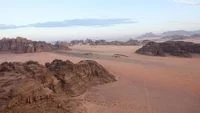
Wadi Rum in Jordan has officially claimed the top global ranking as the premier destination for witnessing breathtaking sunsets and experiencing the ethereal beauty of the golden hour. Often celebrated as the Valley of the Moon, this majestic expanse of red desert sand and dramatic sandstone rock formations undergoes a mesmerizing visual transformation as daylight fades, casting a rich, cinematic glow across the landscape.
The prestigious designation stems from a comprehensive global analysis conducted by travel firm Kuoni in collaboration with Jim Dale, founder and senior meteorologist at British Weather Services. Released in September 2026, the study evaluated 165 destinations worldwide to identify the absolute best locations for capturing twilight and sunset vistas. Scoring an impressive 95.92 out of 100, Wadi Rum outperformed all other contenders, solidifying its reputation as a crown jewel of global desert landscapes and an essential pilgrimage site for photography enthusiasts, nature lovers, and travelers seeking moments of profound tranquility.
Methodological Framework and Evaluation Criteria
The rigorous methodology behind the Kuoni and British Weather Services analysis established a multi-variable framework designed to determine the optimal conditions for viewing sunsets and the golden hour. Researchers evaluated 165 renowned global destinations based on six distinct environmental and meteorological indicators.
Cloud cover was assigned the highest weighting at 35 percent, as minimal atmospheric obstruction is crucial for uninterrupted sunset viewing. Light pollution accounted for 20 percent of the total score, ensuring that locations offering pristine night skies after dusk were duly recognized. Brightness resulting from artificial light sources held a 15 percent weight, while historical rainfall data accounted for another 15 percent, minimizing the likelihood of sudden weather disruptions. Wind speed contributed 8 percent to the metric, as calmer conditions enhance the overall twilight experience, and the average duration of the sunset made up the final 7 percent of the evaluation.
Through this meticulous scoring system, Wadi Rum emerged victorious. As a designated UNESCO World Heritage site, the Jordanian desert benefits from exceptionally favorable meteorological conditions, boasting an average cloud cover of a mere 15.3 percent and negligible annual precipitation averaging just 0.1 millimeters.
Meteorological Science Behind the Golden Hour
Explaining the scientific phenomena that elevate these specific destinations, meteorologist Jim Dale noted that the most visually striking color spectrums during dusk occur during a very specific temporal window. The richest, most saturated hues emerge between the physical sunset and civil twilight—a period when the sun sits precisely six degrees or less below the horizon.
During this precise alignment, sunlight must travel through a significantly thicker layer of the Earth’s atmosphere. This atmospheric filtration scatters shorter wavelengths of light, such as blue and violet, while allowing longer wavelengths—reds, oranges, and deep ambers—to dominate the visual field. In expansive, unobstructed environments like Wadi Rum, this scientific process creates a panoramic canvas of shifting chromatic intensity that lasts far longer and appears vastly more dramatic than in urban or topographically confined settings.
Cinematic Appeal and Pop Culture Significance
Beyond its meteorological superiority, Wadi Rum has long captivated the international creative community. The landscape’s otherworldly topography has frequently served as a cinematic double for extraterrestrial worlds. Most notably, Wadi Rum gained widespread global recognition as a primary filming location for Denis Villeneuve’s epic science fiction adaptations of Frank Herbert’s Dune.
The sweeping dunes and jagged, weathered monoliths of the Jordanian desert were utilized to depict Planet Arrakis, the harsh, sun-baked desert world central to the narrative. This exposure has driven a significant surge in eco-tourism and cinematic tourism, drawing travelers eager to witness the exact vistas immortalized on the silver screen. Furthermore, the complete absence of significant light pollution in the region allows visitors to seamlessly transition from marveling at the vibrant sunset to engaging in world-class stargazing as the nocturnal desert sky reveals its constellations.
Global Rankings: The Top Five Destinations Revealed
While Wadi Rum secured the undisputed first-place position, the Kuoni analysis highlighted several other extraordinary locations across the globe that excel in providing unmatched twilight experiences.
Securing the second-place position with a score of 94.93 is Sossusvlei in Namibia. Located within the vast Namib-Naukluft National Park, Sossusvlei is characterized by striking white clay pans surrounded by towering, rust-colored sand dunes. According to the study, Sossusvlei boasts an average cloud cover of just 14.8 percent, representing the lowest cloud obstruction among all top-tier global contenders. The golden hour here typically lasts just over 27 minutes, during which the iron oxide within the sand causes the towering dunes to flare in brilliant shades of burnt orange and crimson as the sun dips below the horizon.
Claiming the third spot is another Namibian marvel, Damaraland, which achieved a score of 91.83. This rugged, semi-desert region is defined by ancient mountain ranges and serves as a vital sanctuary for desert-adapted wildlife, including free-roaming elephants, black rhinos, and zebras. Damaraland is also home to Twyfelfontein, a UNESCO World Heritage site renowned for its concentration of ancient rock engravings. Interestingly, despite having a slightly higher average cloud cover of 20.6 percent, the presence of sparse clouds at the horizon often enhances the visual complexity of the sunset, creating dynamic structural patterns against the fading light.
The Atacama Desert in Chile secured the fourth position with a score of 91.23. Famed for being one of the driest non-polar deserts on Earth, the Atacama offers exceptionally stable atmospheric conditions and remarkably clear skies. The region’s vast salt flats and volcanic horizons provide a stark, minimalist backdrop that allows the dramatic gradient of evening colors to take center stage without visual distraction.
Rounding out the top five is Wahiba Sands in Oman, which attained a score of 89.89. This sprawling sea of sand dunes presents a quintessential Middle Eastern desert landscape. As daylight wanes, the undulating ridges of golden-brown sand cast long, dramatic shadows, offering observers an immersive cultural and visual experience framed by the serene vastness of the Arabian desert.
Broader Implications for the Global Travel Industry
The release of this comprehensive meteorological and geographical analysis arrives at a pivotal time for the global tourism sector. As travelers increasingly seek purposeful, experiential journeys centered around nature, wellness, and photography, destinations that prioritize the preservation of their natural assets—such as dark-sky conservation and landscape protection—are experiencing a surge in demand.
Tourism boards in Jordan, Namibia, Chile, and Oman are expected to leverage these findings to promote sustainable tourism initiatives. By highlighting the scientific and aesthetic value of their natural environments, these nations can attract conscious travelers who appreciate the delicate balance of preserving pristine wilderness areas while engaging in low-impact tourism. Ultimately, the recognition of Wadi Rum and its runner-ups underscores the timeless human fascination with the transition from day to night, reminding global audiences of the raw, unaltered beauty found in the world’s most remote and majestic natural sanctuaries.