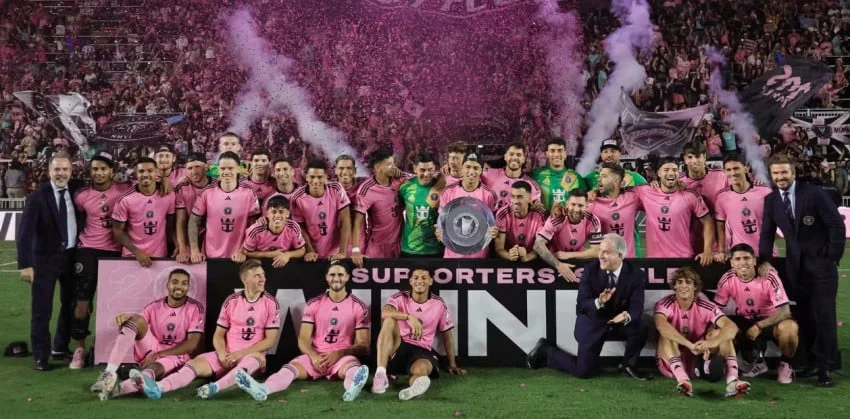
The landscape of professional soccer in North America is undergoing a seismic shift as Major League Soccer (MLS) continues to cement its status as a premier global sporting entity. According to the latest financial assessments from the Forbes 2026 valuation report, the league has reached a historic milestone, with five individual franchises now boasting valuations exceeding USD 1 billion. This rapid appreciation of assets reflects not only the successful expansion strategy employed by the league over the past decade but also a fundamental change in the commercial appeal of soccer within the United States market. Leading the charge is Inter Miami CF, a franchise that has redefined the economic possibilities of the league through strategic investments, global marketing, and the acquisition of high-profile talent.
The Rise of Inter Miami: A Commercial Phenomenon
Inter Miami CF currently holds the top position in the MLS valuation rankings with a staggering valuation of USD 1.35 billion. This figure represents a dramatic acceleration in the club’s financial trajectory, fueled largely by the arrival of Lionel Messi. The impact of the Argentine superstar on the club’s balance sheet has been transformative; revenue surged from a modest USD 56 million in 2022 to an impressive USD 200 million by the close of 2025.
Beyond the immediate ticket sales and sponsorship interest generated by Messi, the club’s success on the pitch has played a critical role in its financial valuation. Securing the inaugural MLS Cup title in the club’s history served as a pivotal turning point, validating the ownership group’s heavy investment in the roster. The ownership, led by Jorge and Jose Mas alongside David Beckham, has strategically positioned the club to capitalize on this momentum. Looking toward the future, the development of the Nu Stadium at Miami Freedom Park is widely projected to provide an additional layer of revenue stability. By controlling their own stadium assets, Inter Miami is moving away from the revenue-sharing constraints of leased facilities, a move that analysts expect will further bolster their valuation in the coming years.
The Competitive Landscape: LAFC and LA Galaxy
While Inter Miami currently captures the spotlight, the battle for commercial dominance remains intense. Los Angeles Football Club (LAFC), which held the title of the league’s most valuable club for three consecutive years prior to the 2026 report, currently sits in second place with a valuation of USD 1.32 billion. Despite losing the top spot, LAFC’s financial health remains robust, underpinned by an annual revenue of USD 167 million in 2025.
LAFC’s strategy has centered on international brand expansion and high-impact roster management. A prime example of this is the club’s record-breaking acquisition of Son Heung-min from Tottenham Hotspur. The transfer, valued at approximately USD 26.5 million, stands as the most expensive in MLS history. This move signifies a shift in league policy and club ambition, demonstrating that MLS teams are now capable of competing with European giants for elite talent in their prime, rather than exclusively serving as a destination for veteran players nearing retirement.
Completing the top three is the historic LA Galaxy, with a valuation of USD 1.08 billion and a 2025 revenue of USD 106 million. As the most decorated club in league history, holding six MLS Cup titles, the Galaxy continues to maintain a strong brand presence. Their consistent performance and established fanbase serve as a cornerstone for the league’s overall market stability, proving that long-term tenure in the MLS ecosystem remains a viable path to sustained billion-dollar valuations.
Historical Context and Growth Chronology
The current financial standing of the MLS is a far cry from its humble origins. Founded in 1996 with just ten teams, the league struggled for relevance in a market dominated by the NFL, NBA, and MLB. The turning point for the league’s economic expansion can be traced back to the early 2000s, specifically following the 2002 FIFA World Cup, which sparked a renewed interest in soccer across the United States.
Key milestones in the league’s chronology include:
- 2007: The Designated Player Rule: The introduction of the "Beckham Rule" allowed teams to sign players outside of the salary cap, effectively opening the door for global icons to join the league.
- 2015-2020: The Expansion Era: The league aggressively pursued new markets, including Atlanta, Seattle, and Los Angeles, significantly increasing the geographic footprint and television audience.
- 2023: The Apple TV Partnership: The landmark 10-year global broadcast deal with Apple revolutionized how fans consume the sport, providing a centralized platform that has contributed significantly to the surge in franchise valuations.
- 2026: The Billion-Dollar Benchmark: The current year marks the first time multiple franchises have crossed the ten-figure valuation mark, signaling a maturation of the league’s business model.
Analytical Perspectives on Market Implication
The rise in valuations is not merely a product of individual club success but reflects a broader trend of institutional investment in North American soccer. Private equity firms and major media conglomerates have increasingly sought stakes in MLS clubs, viewing them as undervalued assets compared to European soccer clubs or other major American sports franchises.
"The financial trajectory we are seeing is a reflection of the systemic maturation of the league," says one industry analyst. "When you combine a centralized media distribution model with the growing popularity of soccer among the younger demographic in the U.S., you create a high-growth environment. The billion-dollar valuation is no longer a ceiling; it is becoming the standard for top-tier MLS organizations."
The implications of these valuations are significant for the league’s governance. As clubs become more valuable, the pressure on ownership to deliver modern, soccer-specific stadiums increases. This leads to better infrastructure, which in turn improves the match-day experience and creates further revenue streams through premium seating and non-soccer event hosting. Furthermore, the ability to attract global stars like Messi and Son indicates that the "retirement league" stigma has effectively been dismantled, replaced by a competitive environment that offers both high financial rewards and high-level sporting challenges.
Official Responses and Future Outlook
While club owners and league officials have remained largely guarded regarding specific financial metrics, the consensus from the front offices of the top-valued clubs suggests a focus on sustainable long-term growth. Representatives from Inter Miami have emphasized that their valuation is a result of a multi-year plan that prioritizes the "integration of sports, entertainment, and infrastructure."
Conversely, the league leadership has pointed to the upcoming 2026 FIFA World Cup, which will be co-hosted by the United States, as the ultimate catalyst for the next phase of growth. The influx of international attention and the modernization of infrastructure required for the tournament are expected to have a "halo effect" on MLS clubs, potentially pushing the valuations of mid-tier franchises toward the billion-dollar mark by 2030.
However, challenges remain. The league must continue to balance its salary cap regulations with the desire to attract elite talent. Critics argue that while the top five clubs are thriving, the gap between the wealthiest franchises and those in smaller markets could lead to competitive imbalances. Maintaining parity, which has long been a hallmark of American sports, will be essential to ensuring that the league remains attractive to its diverse, national fanbase.
Conclusion: A New Era for American Soccer
The ascent of MLS to a multi-billion dollar commercial enterprise represents one of the most successful sports business stories of the 21st century. By leveraging global partnerships, embracing technological innovation, and strategically investing in high-profile talent, the league has transformed itself from a peripheral interest into a central pillar of the North American sports entertainment industry.
As Inter Miami, LAFC, and the LA Galaxy continue to push the boundaries of what is possible in the MLS market, they provide a roadmap for other franchises to follow. The transition from regional soccer clubs to global brands is well underway. With the momentum of the 2026 World Cup on the horizon and the continuous evolution of media and commercial rights, the next decade promises to be even more transformative for the league. The threshold of USD 1 billion is no longer just a milestone; it is the new starting line for a league that is rapidly closing the gap with the most prestigious sports organizations in the world. As the business of soccer in the United States continues to evolve, the focus will undoubtedly shift from simply proving the league’s viability to establishing its dominance on the international stage. Whether through further stadium expansions, innovative digital broadcasting, or the continued recruitment of world-class talent, Major League Soccer has firmly secured its position as a major player in the global sporting economy.