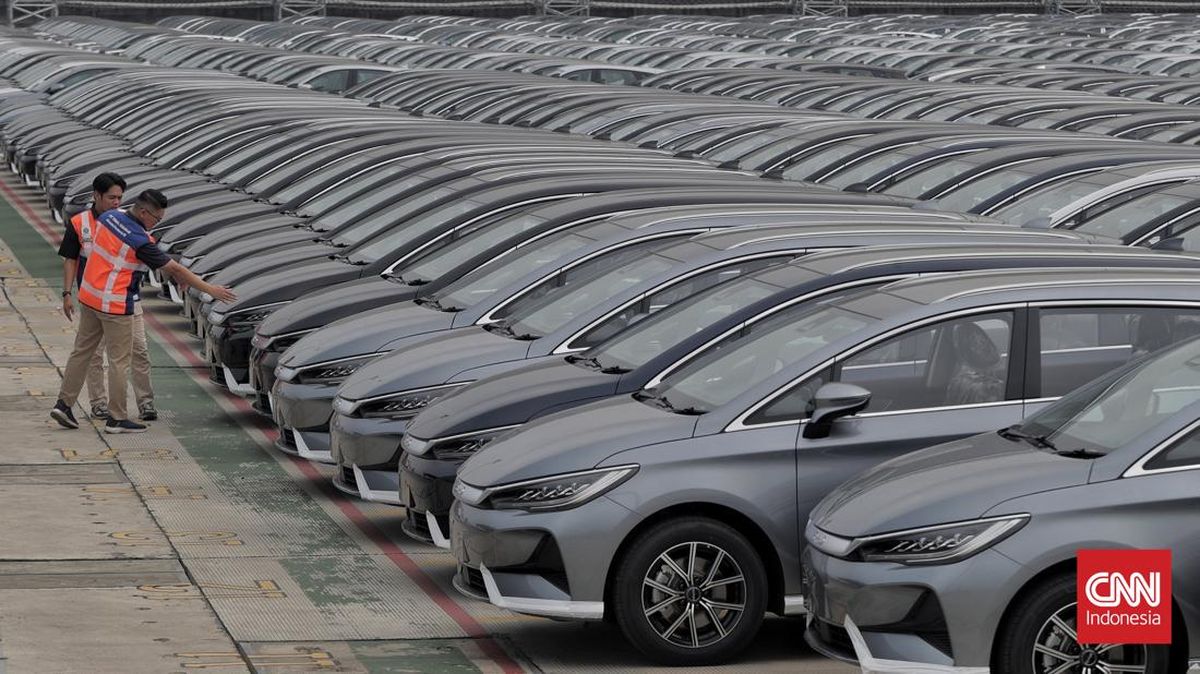
The Indonesian electric vehicle (EV) landscape is overwhelmingly dominated by China, with the nation’s products playing the role of the primary driver in the burgeoning market. This stark reality was highlighted by Agus Purwadi, a senior researcher at the Center for Sustainable Transportation Systems at the Bandung Institute of Technology (ITB), during a presentation in Jakarta on Tuesday, April 14. Purwadi’s analysis of the national electrification development trajectory painted a clear picture: a sea of "red," signifying Chinese origin, engulfing the majority of electrified vehicles.
"When it comes to electrification in Indonesia, the position is dominated by products colored reddish," Purwadi stated, gesturing towards a diagram that used red as an indicator for Chinese products. His explanation underscored the significant influence of China in the nation’s burgeoning EV industry, asserting that over 60% of the electrified products available in Indonesia hail from the East Asian powerhouse. This observation aligns with the recent surge of Chinese automotive brands entering the Indonesian market, with their numbers now reaching sixteen. The vast majority of these brands are focusing their sales efforts on electrified vehicles, particularly Battery Electric Vehicles (BEVs).
The Shadow of "Cannibalization" in Southeast Asia
The phenomenon of Chinese dominance in the EV sector is not an isolated incident confined to Indonesia. Neighboring countries like Thailand are experiencing a similar trend, with some analysts suggesting that the influx of Chinese EVs has already led to significant "cannibalization" within their domestic automotive industries. In Thailand, approximately 80% of electric cars are reportedly of Chinese origin. Data from 2024 indicates a concerning trend: the closure of several Japanese automotive plants in Thailand, including those of Subaru, Honda, and most recently, Suzuki.
"Thailand is already facing challenges in its automotive industry. Many factories are beginning to close, leading to a decay in Thailand’s growth," Purwadi explained. "Why? Because it is being cannibalized, even though it’s supposed to be a new product category. They are adding (brands), but this is cannibalizing or reducing." This suggests a scenario where the rapid expansion of Chinese EV brands, often offering competitive pricing and advanced features, is outcompeting and displacing established automotive players, particularly those with a historical presence in the market.
Pockets of Success: India and Vietnam Forge Their Own Paths
In contrast to the challenges faced by some Southeast Asian nations, India and Vietnam are being lauded for their successful navigation of the electrification wave. These two countries are recognized for their ability to cultivate robust domestic industrial bases. Purwadi pointed to their "big green" indicators on his presentation, associating this color with "local production." This encompasses domestic brands, Chinese vehicles produced locally, or other forms of local manufacturing.
The presence of a local production base is identified as the key differentiator, setting these nations apart from those that primarily serve as mere consumer markets. "So, there is at least a local base. For others, it’s practically just a market base. For these, there is a local industrial base beginning to emerge. Whether it’s a domestic brand, a Chinese brand produced locally, or other local production," he elaborated.
Purwadi attributes the success of India and Vietnam to their well-measured and consistent government policies aimed at fostering domestic industries. "This serves as a lesson for us. Why are India and Vietnam’s electrification efforts beginning to succeed in building internally? Because they have measured policies and implementation. And indeed, even with these efforts, they can promote their products," he remarked. He cited India’s achievements as particularly noteworthy, given its relatively lower Gross Domestic Product (GDP) compared to Indonesia. Vietnam, too, has demonstrated significant progress through the development of local brands supported by global collaborations.
Malaysia’s Middle Ground and Long-Term Projections
Within the Southeast Asian region, Malaysia appears to hold a slightly more favorable position than Indonesia, though it too remains heavily influenced by Chinese products. "Malaysia is also slightly better than Indonesia in terms of its share. However, it is still dominated by China," Purwadi observed. This suggests that while other nations are making strides, the gravitational pull of China’s manufacturing prowess and market presence remains a significant factor across the region.
Looking ahead, recent global projections indicate that China’s dominance in the electrification industry is poised to persist in the long term. These forecasts position China as the primary player, followed by developed nations such as those in Europe and the United States. Developing countries, including Indonesia, are expected to continue their growth trajectories but are unlikely to rival China’s established leadership in the foreseeable future. "It is predicted that China will continue to dominate until 2035," Agus Purwadi concluded.
The Indonesian Context: A Nascent Industry Facing Global Realities
Indonesia’s automotive sector has historically been reliant on established global manufacturers, with a strong presence of Japanese brands. However, the global shift towards electrification has presented both opportunities and challenges. The government has been actively promoting EV adoption through various incentives and policy frameworks, aiming to reduce reliance on fossil fuels and position Indonesia as a key player in the EV supply chain, particularly in battery production, given its rich nickel reserves.
The ITB researcher’s assessment underscores the immediate reality: the Indonesian EV market is largely being shaped by imported Chinese vehicles. While this provides consumers with more affordable and accessible EV options, it raises questions about the long-term development of a self-sufficient domestic automotive industry. The concern of "cannibalization," as observed in Thailand, could manifest in Indonesia if local manufacturing capabilities and domestic brands struggle to compete with the sheer volume and aggressive pricing strategies of Chinese manufacturers.
Potential Implications for Indonesia’s Automotive Future
The strong Chinese influence in Indonesia’s EV market has several potential implications:
- Economic Dependence: A heavy reliance on imported EVs could lead to a significant outflow of capital and limit the growth of local job creation in manufacturing and research and development.
- Technological Transfer: While increased EV availability is positive, the extent of genuine technological transfer and local capacity building remains a critical factor for long-term industrial development.
- Competitive Landscape: Established automotive players in Indonesia, often with Japanese origins, may face increased pressure to adapt their strategies, potentially leading to consolidation or a shift in focus.
- Consumer Benefits: For consumers, the influx of Chinese EVs generally translates to more competitive pricing and a wider range of choices, accelerating EV adoption.
- Government Policy Effectiveness: The Indonesian government’s policies aimed at fostering local EV production and battery manufacturing will be crucial in shaping the future balance of power in the market. The success of initiatives like the development of the EV battery ecosystem, heavily reliant on domestic nickel resources, will be a key determinant.
A Call for Strategic Development
The findings presented by Agus Purwadi serve as a critical juncture for Indonesia’s automotive electrification strategy. While embracing the opportunities presented by the global EV transition, the nation must carefully consider how to foster a sustainable and domestically integrated industry. Learning from the experiences of countries like India and Vietnam, which have prioritized local production and strategic industrial policies, could provide a roadmap for Indonesia.
The Indonesian government’s commitment to developing a comprehensive EV ecosystem, from raw material processing to final vehicle assembly and battery production, is paramount. This requires not only attracting foreign investment but also nurturing local talent, fostering innovation, and creating an environment where domestic automotive players can thrive alongside international competitors. The long-term vision should be to move beyond being merely a market for electrified vehicles and to establish Indonesia as a significant producer and innovator in its own right. The coming years will be crucial in determining whether Indonesia can effectively navigate this complex global landscape and carve out a strong, independent future for its automotive sector in the age of electrification.